

By MefLyN AnwanA, April 14, 2026
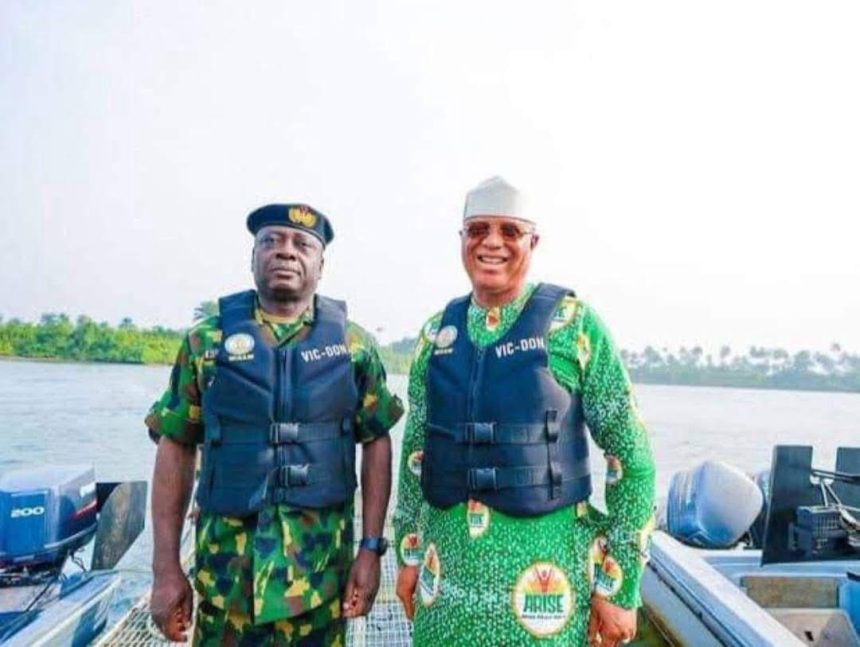
The development of waterways and the full embrace of the blue economy represent one of the most consequential economic transitions in the history of Akwa Ibom State. Under the leadership of Governor Umo Eno, this initiative goes beyond infrastructure; it is a deliberate and structured strategy to reposition the state as a globally competitive economic hub.
This is not incremental development but systemic transformation, aligned with global competitiveness frameworks as seen in World Economic Forum and development pathways validated by the Organisation for Economic Co-operation and Development.
At its core, this vision signals a transition into a production-oriented, export-enabled system, where every policy, investment, and institution is calibrated toward wealth creation at scale. What this means in practical terms is that Akwa Ibom is positioning itself for structure, scale, and global relevance.
Across the world, the nations that dominate maritime and blue economy ecosystems are among the most advanced economies. Countries such as the United States, China, Japan, Germany, United Kingdom, Netherlands, Norway, South Korea, Singapore, and the United Arab Emirates have built resilient, high-income economies on the backbone of maritime trade, port infrastructure, offshore energy, and ocean-based industries. Their dominance is not incidental but the outcome of deliberate investments in logistics efficiency, industrial clustering, and sustainable ocean governance.
According to the OECD, ocean-based industries are projected to exceed $3 trillion annually by 2030, reinforcing a simple but powerful principle: prosperity follows structure. When the right systems ports, logistics, and integrated industrial ecosystems are built, wealth creation scales, shifting the mindset from local competition to global benchmarking.
This vision is further strengthened by the administration’s track record across key sectors. Across the MSME landscape, targeted support initiatives have enabled businesses to formalize, scale operations, and access finance through structured interventions such as the ₦4 billion AKSG/BOI revolving fund, generating multiplier effects that include job creation, enterprise expansion, and increased internally generated revenue.
In agriculture, strategic investments such as the tree crop revolution and Ibom Model Farm initiatives will expand production capacity and strengthen value chains in cassava and oil palm, while cooperative systems and trader grants are improving access to finance and deepening rural participation in economic activity. Complementary investments in education, road infrastructure, aviation, healthcare, real estate, tourism, rural development, and security have created a stable and enabling environment for sustained growth, while humanitarian and social development programs ensure that economic expansion translates into improved livelihoods across communities. Together, these efforts form a strong and integrated foundation upon which the blue economy can scale efficiently and sustainably.
At the center of this transformation is the Oron Marine Terminal, integrating shore protection, jetty systems, warehousing, and recreational infrastructure into a single coordinated platform. This is not a standalone project but a phased modular maritime architecture designed to evolve into a multi-terminal maritime logistics hub comparable to global systems such as the Port of Rotterdam, the Port of Singapore, and Dubai’s Jebel Ali Port ecosystem.
This project presents a modular maritime gateway engineered to evolve into a multi-terminal port system and integrated blue economy ecosystem, designed to turn global trade flows into a trillion-dollar economic engine.
Positioned within the Gulf of Guinea, this initiative is strategically aligned to function as a regional trade node, facilitating cargo movement, cross-border exchange, and distributed supply chains across West and Central Africa. What emerges is a clear structural shift from isolated infrastructure to an integrated economic ecosystem where ports, logistics, industry, and commerce converge into a single coordinated system converting coastal geography into structured economic output, trade connectivity, and scalable enterprise growth.
Currently, the Oron shoreline supports moderate capacity marine activity and is now undergoing development to scale into a full commercial maritime hub. The execution pathway of this transformation is both deliberate and scalable, beginning with foundational infrastructure through the development of the Oron Marine Terminal and its supporting systems, followed by the activation of trade and logistics through cargo handling, shipping services, and inland distribution networks. This naturally leads to industrial clustering, where agro-processors, manufacturers, exporters, logistics firms, and SMEs co-locate and scale, ultimately culminating in export expansion and full integration into regional and global value chains. This progression ensures that value is not only moved but created, retained, and multiplied within the state’s economy.
What defines today’s leading modular systems is not just their phased design but their ability to scale into high-value economic assets. Early-stage innovations such as the Sea Technology Floating Terminal in Sweden and modular terminal systems developed by Delft University of Technology demonstrate that even initial deployments can unlock between $5 billion and $20 billion in long-term asset value, with a single 1 million TEU module capable of generating $100 million to $300 million annually once integrated into active trade routes.
At full scale, the pattern becomes even more compelling. The Tuas Mega Port at the Port of Singapore represents over $20 billion in investment and is projected to handle up to 65 million TEUs annually, while Jebel Ali supports a trade ecosystem exceeding $100 billion. In Asia, the Port of Busan handles over 20 million TEUs annually, and the Port of Shanghai exceeds 50 million TEUs, anchoring global trade flows worth hundreds of billions of dollars.
Across these systems, the pattern is consistent: phased investments ranging from $5 billion to over $20 billion, annual trade values extending into tens or hundreds of billions of dollars, and GDP contributions reaching up to 5–10% in port-driven economies, clearly demonstrating that modular ports are not incremental infrastructure but scalable economic engines that transform geography into sustained, compounding wealth.
Beyond logistics, the blue economy unlocks a wide spectrum of high-impact industries that collectively redefine the state’s economic structure. Maritime transport and port operations create opportunities across cargo handling, shipping services, and vessel management, while entire ecosystems emerge in warehousing, freight forwarding, customs brokerage, and inland distribution. Industrial and manufacturing clusters develop in proximity to port infrastructure, particularly in agro-processing, petrochemicals, light manufacturing, and assembly industries, supported by export processing zones that catalyze value-added production for regional and international markets.
Fisheries and aquaculture scale significantly through improved access to cold-chain logistics and export channels, while tourism and hospitality leverage coastal assets to attract both domestic and international visitors. Marine services, including ship maintenance, offshore support services, and marine engineering, evolve into specialized high-value sectors. The result is an interconnected economic ecosystem where multiple industries grow simultaneously, reinforcing one another and expanding opportunities for businesses, entrepreneurs, and investors.
For Akwa Ibom, this transformation delivers a structural advantage that goes beyond growth into economic independence. The expansion of waterways will fundamentally improve the movement of goods, people, and services, reducing logistics costs, decongesting road infrastructure, and integrating rural and riverine communities into formal economic systems. More importantly, it provides direct access to international trade routes and regional markets, reducing structural dependence on neighboring hubs and positioning the state as a destination for trade and investment.
In global positioning terms, Akwa Ibom is emerging at the intersection of becoming Nigeria’s maritime and export hub, a leading blue economy center in West Africa, and a competitive destination for investment, innovation, and trade. This positioning mirrors the structural outcomes seen in the world’s most advanced port economies. The Port of Shanghai facilitates cargo flows valued at over $700 billion annually, while the Port of Singapore processes goods exceeding $1 trillion yearly, contributing approximately 7–8% of national GDP.
In Europe, the Port of Rotterdam handles between €400–€500 billion in trade annually, contributing about 6% of the Netherlands’ GDP, while Jebel Ali underpins a trade ecosystem exceeding $350 billion annually, contributing an estimated 20–25% of Dubai’s GDP. In Asia, the Port of Busan supports a national trade volume of over $1.3 trillion, serving as a critical gateway for high-value exports.
What these figures demonstrate is a consistent global pattern: ports are not merely transit points but orchestrators of national productivity, trade dominance, and wealth creation at scale.
The transition into a blue economy also aligns with global sustainability frameworks, ensuring that development is both economically productive and environmentally responsible. It supports the sustainable use of marine resources, strengthens coastal protection, and introduces pathways for energy diversification—expanding from traditional oil and gas into offshore energy services and marine-based renewable solutions.
Under the Governor Umo Eno-led administration, this elevates Akwa Ibom into a driver of regional and global value chains while anchoring a pathway that moves decisively from potential to performance, from dependence to diversification, and from aspiration to prosperity. What is unfolding is not merely a policy direction in line with the ARISE Agenda, but a structural reorientation of economic thought and execution.

Akwa Ibom is not just building infrastructure; it is building a trillion-dollar economic future anchored on waterways, trade, and global relevance.
From the positioning of the Oron Marine Terminal integrating shore protection, jetty systems, warehousing, and recreational infrastructure.
Akwa Ibom State’s 129-kilometer coastline along the Gulf of Guinea is strategically positioned to evolve into a high-performance maritime economic corridor.
This project and supporting infrastructures including shore protection, jetties, and integrated logistics assets shows the coastline is being structured for scale, efficiency, and global competitiveness.
Leveraging its greenfield advantage, the state can develop a next-generation port ecosystem free from legacy constraints, enabling faster vessel turnaround, optimized cargo handling, and seamless trade connectivity comparable to leading global hubs such as the Port of Rotterdam and the Port of Singapore.
Through a modular development model, each unit functions as a scalable economic asset, with cumulative deployment across the coastline forming a multi-node maritime network capable of generating significant long-term value. Positioned along active shipping routes, this system enables Akwa Ibom to transition into a trade capture hub converting passing cargo flows into structured economic output.
This transformation will drive industrial clustering across agro-processing, manufacturing, and marine services, creating an integrated ecosystem where logistics, industry, and trade reinforce one another.Ultimately , Akwa Ibom will transform geography into value, leveraging optimally the 129 km coastline to become a trillion-dollar economic engine, capturing global trade flows and converting them into sustained, compounding prosperity.
Akwa Ibom is transforming its coastline into a globally competitive maritime and industrial ecosystem designed to capture international trade and generate trillion-dollar economic value.