RismadarVoice Reporters
September 16, 2026
European Commission President Ursula von der Leyen has proposed opening the way for Canada to become the European Union’s first “associate member,” potentially creating an unprecedented form of partnership between the North American country and the 27-member bloc.
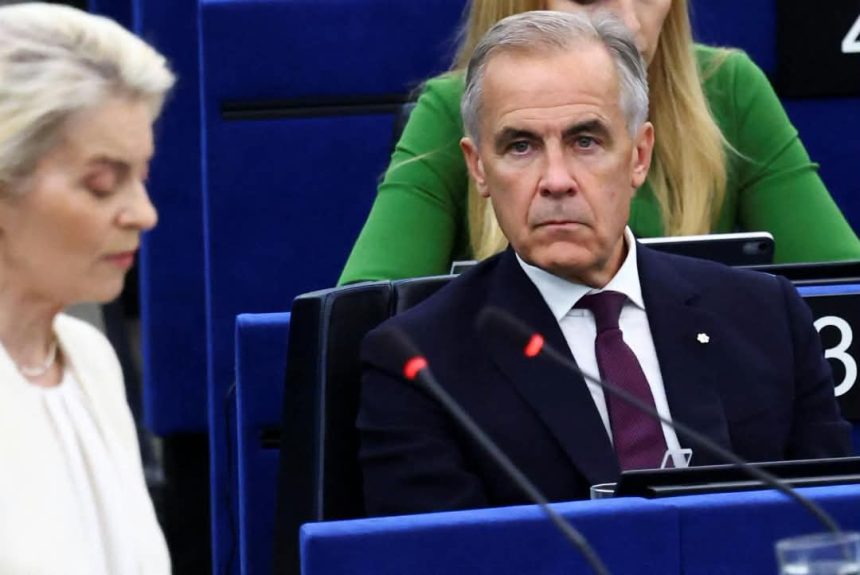
Von der Leyen presented the proposal during her annual State of the Union address to the European Parliament in Strasbourg on Wednesday, as Canada seeks closer economic and strategic cooperation with European partners.
Canadian Prime Minister Mark Carney, who attended the address, has expressed interest in developing what he described as a unique alliance between Canada and the European Union.
The proposed arrangement would stop short of full EU membership and could instead establish a new framework allowing Canada to cooperate more closely with the bloc in selected economic and strategic areas.
WHAT WOULD ASSOCIATE MEMBERSHIP MEAN?
There is currently no established category of “associate membership” under European Union treaties, meaning the precise rights and responsibilities attached to such an arrangement would have to be negotiated.

Potential areas for deeper cooperation include trade, manufacturing, technology, defence, energy and critical minerals.
Canada could also gain greater participation in selected European programmes and strategic initiatives without becoming a full EU member.
However, any arrangement involving closer integration with the EU could require Canada to align with certain European regulations and standards.
One of the central questions would be how much access Canada receives to European institutions and markets in exchange for accepting EU rules.
Existing arrangements involving countries such as Norway and Iceland demonstrate how non-EU countries can participate closely in parts of the European economic system while remaining outside the bloc’s formal decision-making structures.
Any Canadian model, however, would have to be separately negotiated because no existing EU framework provides exactly the status proposed by von der Leyen.
APPROVAL FROM EU MEMBERS WOULD BE REQUIRED
The European Commission cannot create the proposed arrangement independently.
Establishing such a status would require extensive negotiations and agreement among the European Union’s 27 member states.
Governments would have to determine what associate membership means legally, how much access Canada would receive and what obligations Ottawa would accept.
The negotiations could therefore become complicated, particularly over questions involving sovereignty, regulatory alignment and Canada’s ability to influence European rules affecting it.
CANADA, EU ALREADY EXPANDING COOPERATION
Canada and the European Union already maintain extensive economic and security relations.
Their Comprehensive Economic and Trade Agreement provides the foundation for significant bilateral trade, while cooperation has expanded into security and defence.
Canada has also secured participation in the EU’s Security Action for Europe initiative, which supports joint defence procurement.
The two sides have additionally identified areas including cyber security, military mobility, emerging technologies, artificial intelligence, energy security and space security for closer cooperation.
The proposed associate membership could bring some of these existing arrangements together under a broader political and economic framework.

PROPOSAL COMES AMID CHANGING GLOBAL ALLIANCES
The initiative comes as Canada seeks to diversify its international economic and strategic relationships amid tensions in its traditionally dominant trading relationship with the United States.
Carney’s government has set a goal of substantially increasing Canada’s trade outside the United States over the coming decade.
Von der Leyen has meanwhile argued that changing geopolitical conditions require Europe to strengthen cooperation with countries sharing common economic and security interests.
Canada and the EU are expected to continue discussions on the proposed relationship, although the eventual structure, legal status and timetable remain subject to negotiations among Canada, European institutions and the EU’s 27 member governments.