RismadarVoice Reporters
September 14, 2026
Churches in Minnesota have become the centre of two separate legal battles linked to the Trump administration’s immigration enforcement drive, with cases raising questions about religious freedom, government surveillance and the right to protest.
The disputes involve churches in Minneapolis and St. Paul and reflect the growing tension between faith communities, federal immigration authorities and activists opposed to the crackdown.
In one case, a Minneapolis Baptist church and several religious organisations are challenging alleged government surveillance carried out on church property. In another, more than 30 protesters are seeking to have federal charges dismissed after disrupting a worship service at a St. Paul church whose pastor also held a leadership role with U.S. Immigration and Customs Enforcement.

The cases come months after a major federal immigration enforcement operation in Minnesota triggered widespread protests and turned the state into a focal point of opposition to the Trump administration’s immigration policies.
Although immigration agents are no longer visibly operating around some churches, the effects of the enforcement campaign remain.
At Holy Trinity Lutheran Church in Minneapolis, signs declaring that everyone is welcome except ICE remain outside the building. The church had previously supported protesters by providing whistles used to alert residents when federal immigration officers were nearby.
The Rev. Ingrid Rasmussen, the church’s pastor, said the signs would remain because the congregation wanted the church to continue serving as a sanctuary for vulnerable people.
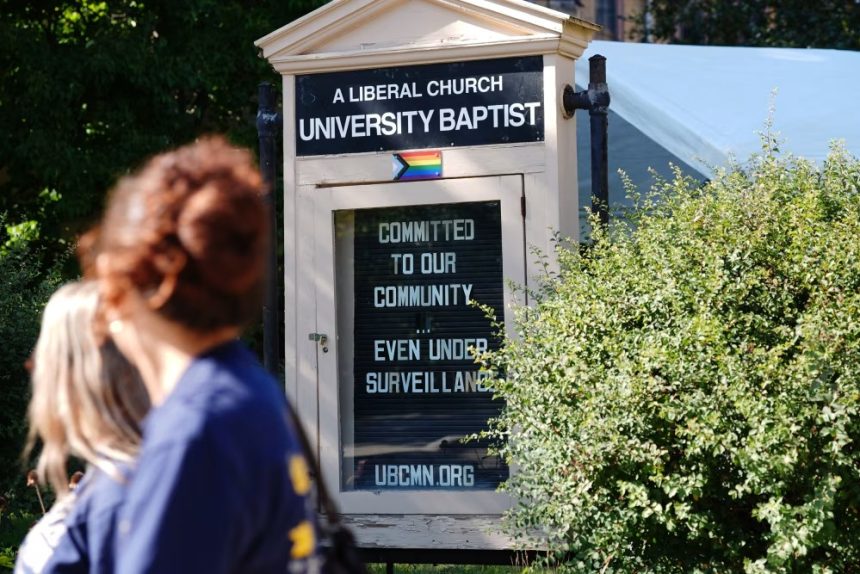
The legal dispute involving University Baptist Church emerged after court documents revealed that federal agents had conducted surveillance targeting groups involved in protests against immigration enforcement.
According to the documents, Homeland Security agents carried out surveillance operations at the church’s gym on four occasions. One operation allegedly involved an undercover agent entering the premises.

The surveillance was linked to a federal case involving 15 people accused of obstructing immigration enforcement in Minneapolis. Prosecutors allege that one of the defendants was involved in training protesters to physically interfere with federal officers.
University Baptist Church is affiliated with American Baptist Churches USA and the Alliance of Baptists. The two organisations were among religious groups that previously obtained a federal court order restricting immigration enforcement activities at their member congregations.
The groups have now asked the court to determine whether the surveillance breached that order. They are also seeking information on whether other places of worship were subjected to similar operations.
Federal authorities have rejected the allegation, arguing that the surveillance was part of an investigation into suspected efforts to train people to commit violence against federal officers rather than an immigration enforcement operation.
A federal judge heard arguments in the case on September 4, with a ruling still pending.
The church’s interim pastor, the Rev. Cody J. Sanders, said members were deeply disturbed by the surveillance but remained committed to supporting vulnerable communities.
A separate case involves more than three dozen people accused of disrupting a worship service at Cities Church in St. Paul during a January protest against immigration enforcement.
Among those facing charges is former CNN journalist Don Lemon and several activists.
The protesters entered the Southern Baptist church during a Sunday service. Some reportedly approached the pulpit while others chanted slogans calling for an end to ICE operations and remembered Renee Good, a woman fatally shot by an ICE officer in Minneapolis in January.
Defence lawyers filed several motions in August seeking dismissal of the charges. They argue, among other things, that the prosecution was selective or retaliatory and point to the alleged surveillance of University Baptist Church.

The defence maintains that the government’s treatment of churches in the surveillance case conflicts with its claim that the prosecution of protesters is intended to protect religious worship.
However, an attorney representing Cities Church said the protesters had violated the sanctity of worship by entering the church and disrupting services.
The lawyer argued that nobody had the right to enter a church and interrupt a religious service, adding that the incident had caused significant distress within the congregation.
The motions are expected to be heard in federal court later in October.
Beyond the court cases, religious leaders across the Twin Cities say the immigration enforcement campaign has continued to affect their congregations.
Some churches report lingering anxiety among immigrant members, concerns about possible government surveillance and increased demands for financial assistance.

Several Protestant congregations that openly opposed the enforcement campaign have also strengthened their security arrangements.
The Rev. Mariah Furness Tollgaard, senior pastor of Hamline Church in St. Paul, said some religious leaders remain concerned about whether federal authorities monitored other congregations.
Nicholas Tangen of the Evangelical Lutheran Church in America’s Minneapolis Area Synod said many church leaders were experiencing fatigue after months of tension.
He described the mood among congregations as one of growing weariness, even as many continue their advocacy work.