RismadarVoice Reporters
September 3, 2026
Chinese President Xi Jinping has arrived in Egypt as Beijing seeks to strengthen its economic and diplomatic influence across the Middle East and present itself as an alternative stabilising force to the United States.
Xi’s visit to Cairo, his first trip to Egypt in a decade, comes as China continues to expand its strategic relationship with one of Washington’s longstanding allies in the region.
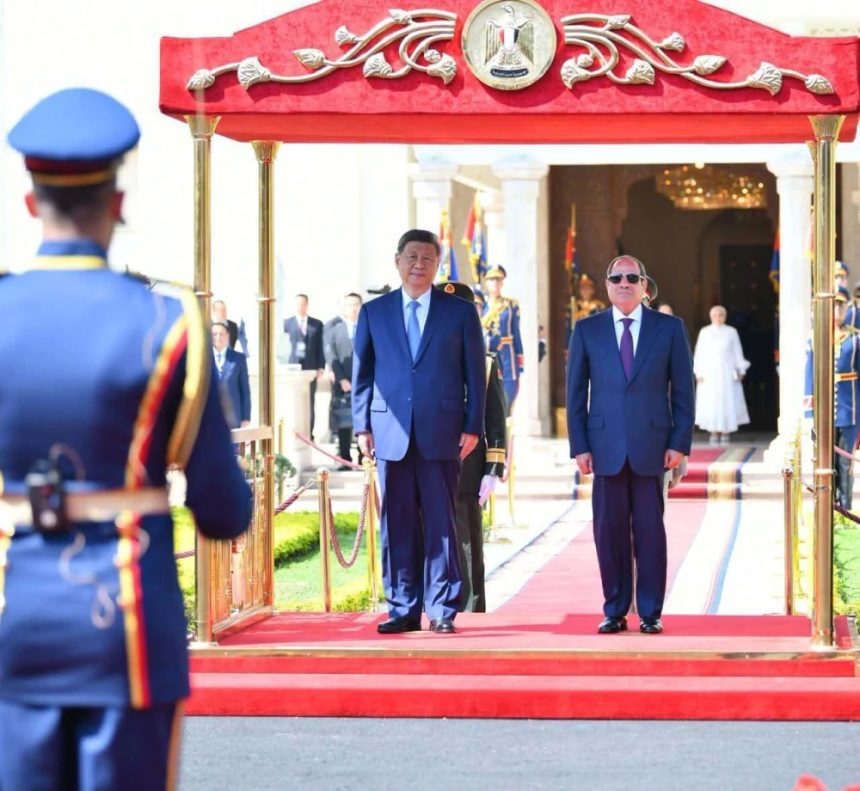
The Chinese leader arrived at Cairo airport on Tuesday, where he was welcomed by Egyptian President Abdel Fattah el-Sissi and military guards during a red-carpet ceremony.

During talks with el-Sissi on Wednesday, Xi called for closer cooperation between the two countries and urged them to oppose what China described as unilateralism and bullying. He also advocated joint efforts toward what he described as a fairer and more balanced system of global governance.
The visit comes against the backdrop of heightened tensions in the Middle East, particularly the ongoing war involving Iran and the disruption of oil shipments through the Strait of Hormuz.
China has increasingly sought to portray itself as a mediator and stabilising power in the region, while contrasting its approach with the United States’ longstanding military involvement in the Middle East.
Xi also visited the Grand Egyptian Museum near the Giza pyramids during his trip. His last visit to the wider region was to Saudi Arabia in 2022.
The visit coincides with the 70th anniversary of diplomatic relations between China and Egypt. Both countries marked the occasion with opinion articles published in Egyptian state-run newspapers.
Xi said China and Egypt should broaden practical cooperation through development, while el-Sissi praised Chinese investment in Egypt and reiterated Cairo’s support for Beijing’s position that Taiwan is part of China.
Egypt, meanwhile, has increasingly viewed its partnership with China as a means of diversifying its international strategic relationships.

Cairo joined the BRICS grouping in 2023, alongside major emerging economies including Brazil, Russia, India, China and South Africa. The bloc is widely regarded as an alternative to Western-led institutions such as the G7.
In 2024, Egypt also signed agreements with China to deepen cooperation under Beijing’s Belt and Road Initiative, which focuses on infrastructure and connectivity projects around the world.
China has invested more than $10 billion in Egypt, including the development of a business district east of Cairo and an electric railway serving industrial areas in the Nile Delta.
Government figures put annual trade between China and Egypt at about $20 billion, compared with $15.7 billion in trade between the United States and Egypt in 2025.
Egypt remains an important U.S. partner on regional security issues, while Washington and Cairo have maintained close relations.
China’s broader regional ambitions were highlighted in 2023 when Beijing brokered an agreement that restored diplomatic relations between Iran and Saudi Arabia. The deal was viewed as a demonstration of China’s growing ability to compete with the United States for influence in the Middle East.
Although relations between Riyadh and Tehran have since deteriorated amid the wider regional conflict, China has continued positioning itself as a diplomatic player.
Beijing has also consistently supported a two-state solution to the Israeli-Palestinian conflict. Shortly before the Hamas attack on Israel in 2023 and the subsequent Gaza war, Xi hosted Palestinian President Mahmoud Abbas and announced a strategic partnership with the Palestinian Authority.

Egypt’s strategic importance has also increased because of the disruption of shipping through the Strait of Hormuz. With oil shipments affected by the Iran war, the Suez Canal, which is controlled by Egypt, has become a key alternative route for energy transportation.
Middle East expert Muhammad Zulfikar Rakhmat said China had strong reasons to strengthen its relationship with Egypt because of the country’s control of the strategically important canal.
He described Egypt as a potential base from which China could expand its engagement with the wider Arab and African regions.
China and Egypt also expanded their military cooperation in August by conducting a multiday air exercise involving several Egyptian bases. The exercise marked the first time China’s J-16 fighter jets participated in combat exercises alongside Egypt’s French-made Rafale aircraft.


Xi travelled to Cairo after attending a two-day meeting of the Shanghai Cooperation Organisation in Bishkek, Kyrgyzstan.
The political and security grouping, which is often viewed as a counterweight to U.S. global influence, brought together leaders including those of Russia, India, Pakistan and Iran.