RismadarVoice Reporters, June 4, 2026
Despite mounting criticism at home and abroad, analysts say Israel’s National Security Minister, Itamar Ben-Gvir reflects not just the far-right fringe, but a significant and growing strand within Israeli politics and society.
In recent weeks, Ben-Gvir has drawn renewed international condemnation following a series of controversial statements and actions. He publicly rejected any U.S.-brokered ceasefire arrangement with Iran that he claimed would undermine Israel’s interests, and was also seen in footage confronting and taunting activists from the Global Sumud Flotilla who were in Israeli custody incidents that triggered diplomatic backlash from several Western governments.
The UK, France, Italy, Canada, and the United States all reportedly expressed concern over his conduct. Israeli Prime Minister, Benjamin Netanyahu later distanced the government from the minister’s actions, describing them as inconsistent with “Israel’s values and norms.” Foreign Minister Gideon Sa’ar went further, accusing Ben-Gvir of damaging Israel’s international standing and insisting he does not represent the country’s image.

However, while some Israeli officials and media outlets have attempted to frame Ben-Gvir as an outlier, other voices argue he is instead a product and reflection of Israel’s evolving political landscape.
Ben-Gvir, leader of the far-right Otzma Yehudit (Jewish Power) party, has held the position of National Security Minister since 2022, overseeing the police and prison services. Critics say his tenure has been marked by increasing politicisation of law enforcement and harsher treatment of Palestinian detainees, including those held without trial.
Opposition lawmaker Aida Touma-Sliman of the Hadash party argues that Ben-Gvir does not operate in isolation.
“He’s not acting alone,” she told Al Jazeera. “What he is doing reflects a network of political and institutional support. Without that, he could not function in the way he does.”
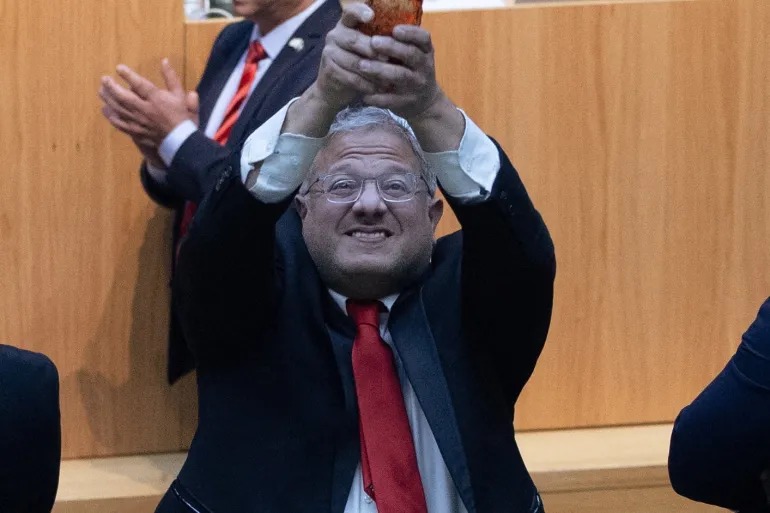
Ben-Gvir’s political profile predates his ministerial role by decades. He first gained public attention in 1995, during the turbulent period following the Oslo Accords, when he was filmed holding a Cadillac ornament taken from the vehicle of then-Prime Minister Yitzhak Rabin and making a threatening remark shortly before Rabin’s assassination by an extremist.
Born near Jerusalem in 1976, Ben-Gvir has said he was drawn to religious and nationalist politics as a teenager. He became associated with the ideology of the banned Kach movement, founded by Rabbi Meir Kahane, which was outlawed in Israel in the late 1980s and later designated a terrorist organisation.
In 1994, a Kach-linked extremist carried out the Hebron massacre, killing dozens of Palestinian worshippers. Ben-Gvir has since been criticised for past associations with figures connected to that movement, including publicly displayed admiration for Baruch Goldstein, the perpetrator of the attack.
Over the years, he has faced multiple legal proceedings and was convicted in 2007 of incitement to racism and support for a banned organisation. Despite earlier attempts by legal authorities to block his admission to the bar, he later qualified as a lawyer and became active in representing right-wing settlers and activists.
Ben-Gvir entered the Knesset as part of a broader alliance between far-right factions that strengthened under Prime Minister Netanyahu’s coalition arrangements in 2022. Together with Bezalel Smotrich of the Religious Zionist Party, he has helped anchor one of the most right-wing governments in Israel’s history.

Since taking office, he has expanded firearm licensing among Israeli settlers in the occupied West Bank and repeatedly visited the Al-Aqsa Mosque compound moves widely condemned internationally and viewed by Palestinians as provocative.
Human rights groups and critics accuse him of endorsing or normalising harsher treatment of Palestinians, particularly in detention facilities. Supporters, however, argue his policies are rooted in security concerns following repeated cycles of conflict and attacks.
The controversy surrounding Ben-Gvir has intensified questions over whether he represents an extremist deviation or a broader shift within Israeli society.
Former Israeli government adviser Daniel Levy argues that criticism often focuses on Ben-Gvir’s personal conduct rather than the policies implemented under his authority.
“The focus tends to be on the spectacle,” he said, “rather than on the underlying systems and policies that continue regardless of who is in front of the camera.”
Pollster Dahlia Scheindlin has similarly noted that Ben-Gvir’s appeal lies in a populist, confrontational style common among far-right movements globally, while his core ideology reflects positions already present within parts of Israel’s political mainstream.
“His supporters span secular and religious communities,” she said, “united by the belief that security challenges require forceful responses.”
Despite international criticism and diplomatic unease, Ben-Gvir maintains a solid domestic support base within Israel’s right-wing electorate. While some coalition partners have sought to limit his influence, his political presence continues to shape debates over security policy, civil rights, and Israel’s approach to the Palestinian territories.
Ben-Gvir was approached for comment on the issues raised but had not responded at the time of publication.