RismadarVoice Reporters
August 27, 2026
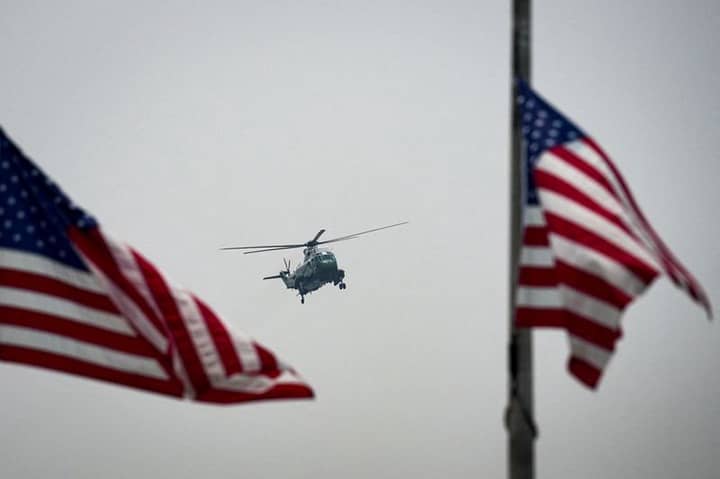
The National Transportation Safety Board (NTSB) has said communication problems prevented the crew of Marine One, the military helicopter carrying US President Donald Trump, from reaching air traffic controllers before taking off on August 4.
The helicopter later came dangerously close to a passenger jet departing Ronald Reagan Washington National Airport in Washington, DC.
According to the NTSB, the Marine One crew attempted at least twice to provide the required three-minute notice of departure to air traffic controllers but was unsuccessful because of communication difficulties.
The failure meant that commercial air traffic at the airport was not halted as required when Marine One was preparing to depart.
The incident involved Envoy Air Flight 3742, an Embraer E170 regional jet travelling to Pensacola, Florida. The two aircraft came within approximately 0.82 nautical miles horizontally and 700 feet vertically of each other, according to preliminary NTSB estimates.

The passenger aircraft’s collision-avoidance system issued a traffic warning shortly after takeoff, while the Marine One pilots saw the aircraft and briefly delayed their departure to allow it to pass safely. No collision occurred, and officials said the president was not in danger.
The NTSB also disclosed that Marine One pilots and air traffic controllers had met on July 30, less than a week before the incident, to discuss previous problems with the required three-minute departure notification.
The pilots had reportedly described communications as “spotty,” while an alternative arrangement to relay the warning through Joint Base Anacostia-Bolling also failed during the August 4 incident.
Investigators further found that the temporary relocation of Marine One’s landing zone from the White House South Lawn to the Ellipse, because of construction work at the White House, contributed to inadequate radio line-of-sight with air traffic controllers.

Following the incident, the Federal Aviation Administration relocated an antenna and changed communication procedures. Subsequent tests reportedly showed that the communication problem had been resolved.
The incident is being investigated by the NTSB. It has also renewed concerns about aviation safety around Reagan National Airport, particularly following the January 2025 mid-air collision between an Army helicopter and an American Airlines regional jet that killed 67 people.