RismadarVoice Reporters
November 4, 2026
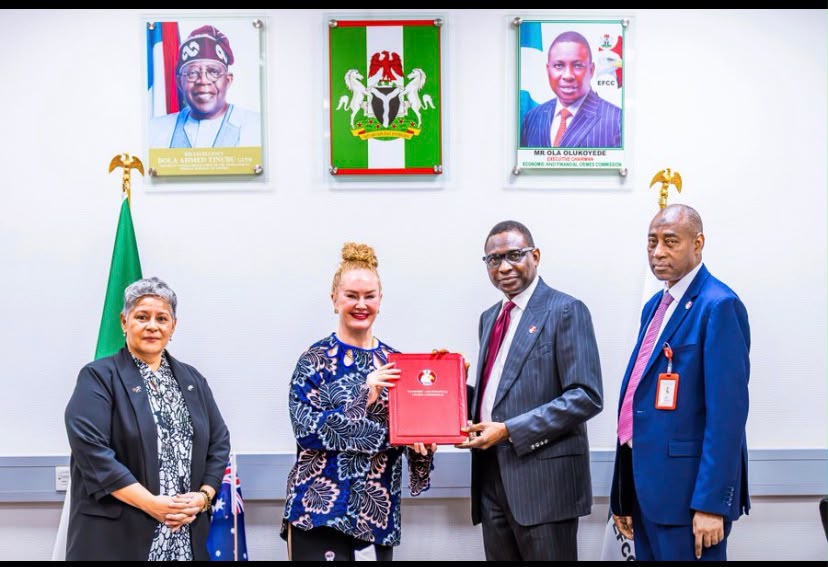
The Economic and Financial Crimes Commission (EFCC) and the Australian Federal Police (AFP) have signed a Memorandum of Understanding (MoU) to strengthen cooperation in combating cybercrime, financial fraud and other transnational offences.
The agreement was signed on Wednesday at the EFCC headquarters in Jabi, Abuja, as part of efforts to deepen collaboration between the two law enforcement agencies.
Speaking at the ceremony, Australian High Commissioner to Nigeria, Leilani Bin-Juda, commended EFCC Chairman Ola Olukoyede and the commission’s personnel for sustaining cooperation with Australian authorities.
She described cybercrime as a global challenge requiring coordinated responses, intelligence sharing and technological cooperation among countries.
Bin-Juda also acknowledged Nigeria’s role in regional efforts to address cyber-enabled financial crimes.
Assistant Commissioner of the Australian Federal Police, Sandra Booth, said the agreement represented another important step in a partnership dating back to 2004.
According to her, the relationship has supported investigations involving cyber-enabled fraud, business email compromise, financial crimes and other sophisticated criminal activities.

Booth explained that the new agreement would provide a clearer framework for continued cooperation, professional development and the exchange of investigative expertise.
She expressed optimism that the partnership would strengthen both agencies’ capacity to investigate offences involving criminal networks operating across national borders.
In his remarks, EFCC Chairman Ola Olukoyede welcomed the agreement and reaffirmed the commission’s commitment to international collaboration against financial crimes.
Olukoyede observed that financial offences increasingly involve individuals, organisations and financial systems operating across several jurisdictions.
He stressed that effective investigations require cooperation between law enforcement agencies, particularly where criminal proceeds and electronic evidence move between countries.
The EFCC chairman also noted that organised criminal networks frequently cooperate across borders, making international partnerships essential to disrupting their operations.
He explained that the MoU would formalise the existing relationship between the commission and the Australian Federal Police while providing a more structured approach to future collaboration.

The agreement comes amid growing international concern over online scams, cyber-enabled financial fraud and the movement of illicit funds through digital and conventional financial systems.
Both agencies are expected to use the partnership to strengthen institutional cooperation and support investigations involving financial crimes with international dimensions.
The development reflects continuing efforts by Nigerian and Australian law enforcement authorities to improve cross-border coordination in tackling organised crime.