

RismadarVoice Reporters
August 31, 2026
The Economic and Financial Crimes Commission, EFCC, says it recovered more than ₦1.233 trillion and secured 10,872 convictions in 34 months under the leadership of its Executive Chairman, Ola Olukoyede.
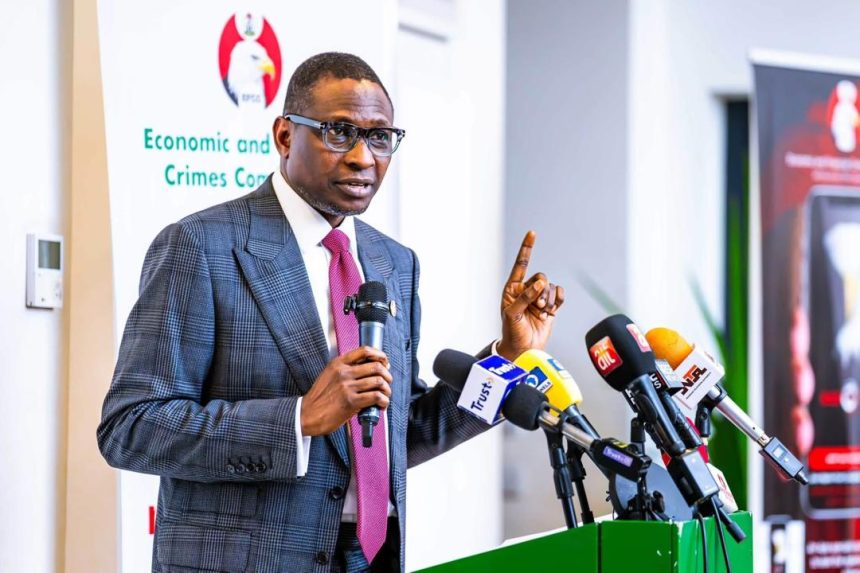
Olukoyede disclosed this on Monday, August 31, 2026, while presenting his stewardship before journalists.
According to the EFCC chairman, the Commission recorded its highest-ever monetary asset recovery during the period under review, with total recoveries of ₦1,233,612,040,411.11.
The Commission also recovered $684.48 million, £373,905.78 and €9.34 million.
Olukoyede said about ₦397.26 billion, representing 33 per cent of the naira recoveries, was recovered directly for the Federal Government, while ₦836.34 billion, representing 67 per cent, was recovered on behalf of ministries, departments and agencies, state revenue services, companies, individuals and foreign victims.
He said the figures showed that two out of every three naira recovered by the Commission were for beneficiaries other than the Federal Government.
On prosecution, Olukoyede said the EFCC received 49,673 petitions, investigated 39,615 cases and filed 14,476 cases in court between October 2023 and July 2026.

He said the Commission secured 10,872 convictions within the period, representing a conviction-to-filing ratio of 75.1 per cent.
In the first half of 2026 alone, the EFCC recorded 1,370 convictions from 1,889 cases filed in court.
The EFCC chairman said advance fee fraud and cybercrime accounted for nearly two-thirds of the 46,288 offences recorded across nine major crime categories between 2024 and 2026.
He added that total recorded offences rose by 24.1 per cent between 2024 and 2025, with increases in procurement fraud, bank fraud, cybercrime and economic governance offences.
Olukoyede said the Commission had also continued to pursue high-profile cases involving former governors, ministers, other public office holders, heads of agencies, financial sector operators and corporate officials.
He disclosed that ₦661.32 billion and $492.37 million recovered by the Commission had been released to beneficiaries during the period under review.
The EFCC also recovered about ₦288.1 billion in federal and state tax obligations, including ₦173.2 billion for the Federal Government and ₦114.9 billion for states’ Internal Revenue Services.
Olukoyede said proceeds of crime recovered by the Commission were increasingly being deployed for productive national purposes.
He recalled the Federal Government’s allocation of ₦50 billion each to the Nigerian Education Loan Fund, NELFUND, and the Nigerian Consumer Credit Corporation from EFCC recoveries in 2024, with further allocations approved for both institutions in 2026.
The EFCC chairman also said the Commission secured the forfeiture of 10,053 tangible assets between October 2023 and July 2026.
The assets included electronic devices, real estate, automobiles, plots of land, schools, factories, hotels, oil rigs, barges, machinery, aircraft and 102 tonnes of solid minerals.

Proceeds from the disposal of assets under final forfeiture orders amounted to about ₦12.07 billion and were paid to the Federal Government.
Olukoyede said the Commission’s enforcement activities also contributed to strengthening Nigeria’s anti-money laundering and counter-terrorism financing framework, which formed part of the wider national efforts that led to Nigeria’s removal from the Financial Action Task Force Grey List in October 2025.
He added that the EFCC had undertaken major institutional reforms, including new guidelines on arrest and bail, the establishment of new departments and the expansion of its presence across the country.
According to him, nearly 60 per cent of the Commission’s processes and operations have now been digitalised as part of efforts to tackle increasingly sophisticated cyber-enabled financial crimes.
Olukoyede described the past 34 months as a period of sustained enforcement, institutional reforms, prosecution, asset recovery, restitution and stronger collaboration in the fight against economic and financial crimes.