RismadarVoice Reporters, May 31, 2026
Confirmed Ebola cases in the Democratic Republic of Congo (DRC) have nearly doubled within two days as the head of the World Health Organisation (WHO), Dr Tedros Adhanom Ghebreyesus, arrived in eastern DRC to assess response efforts and strengthen containment measures.
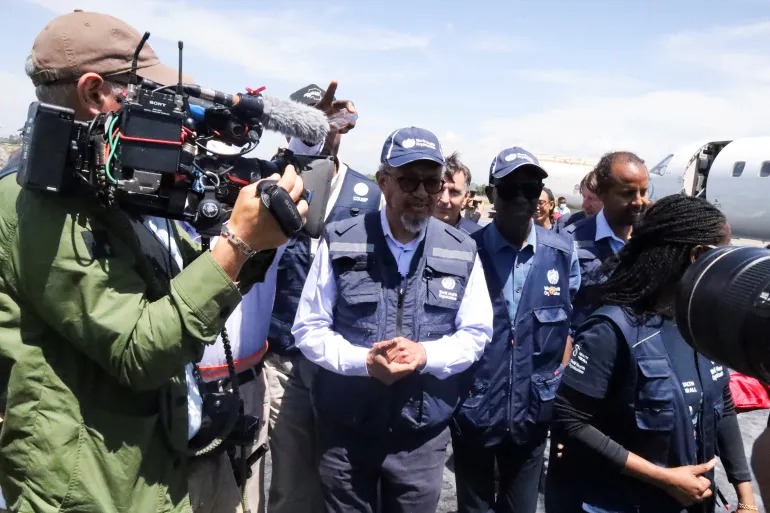
Dr Tedros visited Bunia, the capital of Ituri Province and the centre of the outbreak, on Saturday amid growing concerns over the rapid spread of the disease and mounting pressure on local health systems.
Speaking to reporters, the WHO Director-General emphasised the importance of community involvement in tackling the outbreak, noting that affected populations possess valuable insight into local challenges and potential solutions.

“The international community is involved under the leadership of the government of DRC, and at the same time, community ownership is important,” Tedros said, stressing the need for inclusive response strategies.
Congolese health authorities reported that confirmed Ebola cases rose to 225 on Friday, up sharply from 121 recorded just two days earlier. The outbreak is being driven by the Bundibugyo virus strain, a rare and highly severe form of Ebola for which there is currently no approved vaccine or treatment.
The WHO has classified the outbreak as a global health emergency, while medical humanitarian organisation Doctors Without Borders (MSF) described it as one of the fastest-spreading Ebola outbreaks recorded.
Authorities have also documented 1,028 suspected cases and more than 220 suspected deaths in DRC, with neighbouring Uganda confirming nine cases and one death following cross-border transmission.
Health officials say response efforts have expanded to include intensified testing, contact tracing, and surveillance, while international support continues to arrive. The European Union has delivered medical supplies to Ituri, and the United States has pledged additional funding for outbreak response.

However, conflict and insecurity in eastern DRC remain major obstacles. Health workers have reportedly faced attacks from armed groups, while resistance linked to burial practices and community distrust has complicated containment efforts.
Regional governments and international agencies continue to strengthen preparedness measures as concerns grow over further cross-border spread.