RismadarVoice Reporters, August 27, 2026
Rescue teams on Thursday intensified efforts to locate more than 1,300 people reported missing after flash floods and landslides along the Nepal-Tibet border killed at least 180 people.
The disaster struck on Wednesday morning, sending huge volumes of water, mud and debris through villages and towns along the Bhote Koshi and Trishuli rivers.
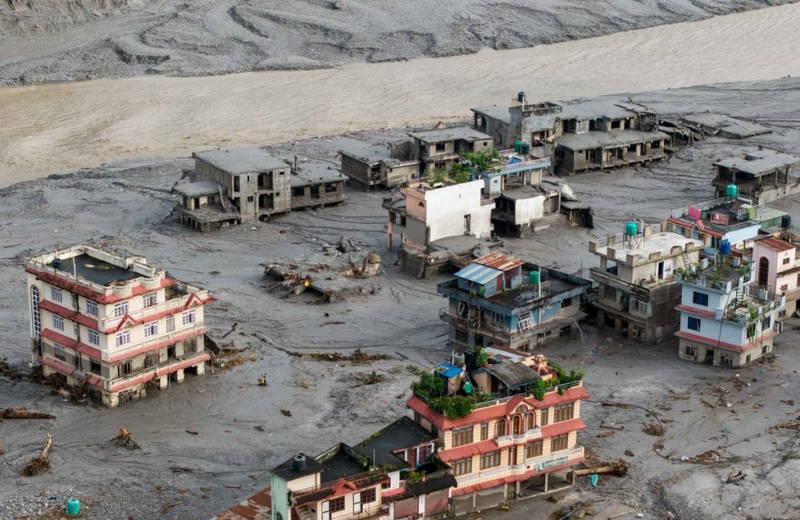
Homes were submerged while vehicles were swept away by the powerful floodwaters, which devastated communities on both sides of the border.

Nepali police said 177 bodies had been recovered, while 823 people, including 517 foreign tourists, remained out of contact.
In Tibet, Chinese state media reported that three people were killed in the mudslide disaster at Gyirong Port, while 558 people, including 260 foreigners, were reported missing.
Many of those missing are foreign tourists from countries including India, Australia, Britain, Malaysia, the Netherlands, Portugal, South Africa, South Korea and the United States, according to Nepal’s tourism board.
Among those searching for relatives was 52-year-old Chitra Bahadur Nepali, whose nephew, Yubraj Sewak, was travelling towards the badly affected Rasuwa district when contact was lost.
“My nephew was on his way to Rasuwa and was in contact with my sister until about 8:00 am yesterday,” Nepali said, adding that the family had not heard from him since the floods.
‘Like an inland tsunami’
Rescuers waded through thick mud and debris as they searched for survivors, with floodwaters burying the lower floors of several multi-storey buildings.

Nepal’s Prime Minister Balendra Shah travelled by road on Thursday to inspect some of the worst-hit areas after urging citizens to stand together in the aftermath of the disaster.
Environmental historian Ruth Gamble of Australia’s La Trobe University described the sudden rush of water and debris as “like an inland tsunami”, saying it travelled nearly 170 kilometres south into Nepal.
Rasuwa, in northern Nepal, was among the first areas affected. However, deaths were reported in seven Nepali districts as the floodwaters moved southwards towards Chitwan, near the Indian border.
The Dalai Lama, who is based in exile in India, expressed his condolences and said he would pray for those who lost their lives.
China also mobilised nearly 800 emergency personnel, sniffer dogs and speed boats to support rescue operations in Tibet, according to state news agency Xinhua.
The International Federation of Red Cross and Red Crescent Societies said it was sending emergency supplies, including blankets, first-aid kits, stretchers and body bags.

The United States Geological Survey said initial analysis indicated that the disaster was triggered by a glacial collapse that generated a massive debris flow, rather than an earthquake as initially reported.
The agency said the event was first recorded as a magnitude 4.4 earthquake, but further analysis of seismic recordings showed evidence of a glacial collapse and debris flow.
Scientists have warned that rising global temperatures are accelerating glacier melt, increasing the risk of glacial lake floods and other glacier-related disasters.
Authorities remained on alert for further flooding because large quantities of debris had accumulated upstream and could obstruct the river.
Qianggong Zhang, head of climate and environmental risks at the International Centre for Integrated Mountain Development in Kathmandu, warned that another flood could occur because of a blockage upstream on the Nepal-China border river.
A Nepali government technical report also warned that the possibility of additional water flow could not immediately be ruled out.

Chinese paramilitary officer Li Qipu said unstable water storage upstream and the narrow mountainous terrain were also complicating rescue operations.
Pilgrims among the missing
Hundreds of Hindu pilgrims were also reported missing after being caught in the disaster while returning from a pilgrimage to Mount Kailash in Tibet.
Indian spiritual leader Sadhguru said many of the pilgrims were at an immigration facility on the border when the floods struck.
“Literally, the entire group was there in the building,” he said in an emotional video message from Tibet, describing the incident as a “terrible and extraordinary event.”
Rescue operations were continuing on both sides of the border as authorities worked to locate missing people and evacuate survivors from affected areas.