


RismadarVoice Reporters
September 15, 2026
The Nigerian Air Force has taken delivery of five new helicopters as part of the Federal Government’s ongoing efforts to modernise the country’s airpower capabilities and strengthen military operations against terrorism, kidnapping and banditry.
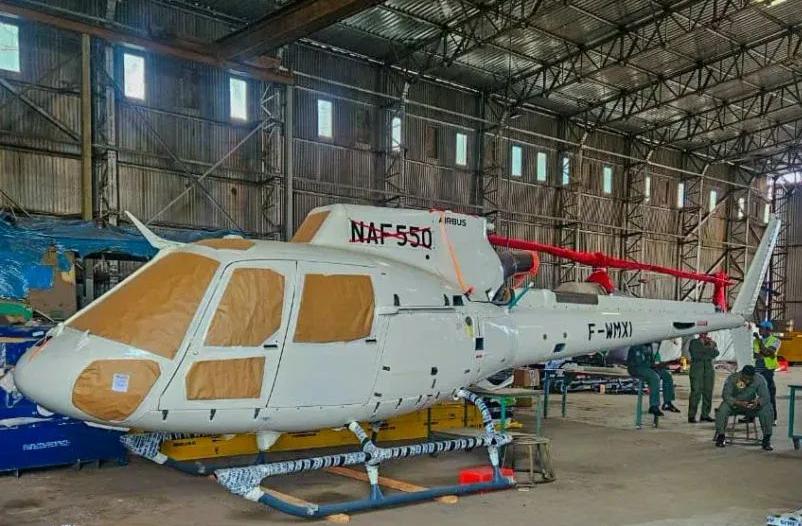
The newly delivered platforms comprise three AW-109 Trekker B helicopters manufactured by Leonardo Helicopters of Italy and two H-125 helicopters produced by Airbus Helicopters.
The development marks another phase in the Federal Government’s programme to expand and modernise the Nigerian Air Force’s rotary-wing fleet amid continuing security challenges across several parts of the country.

According to a statement issued on Tuesday by the NAF Director of Public Relations and Information, Air Commodore Ehinmen Ejodame, the three AW-109 Trekker B helicopters arrived in Lagos on September 15.
The three aircraft are part of 10 AW-109 helicopters recently acquired by the Federal Government. The NAF said the remaining seven are expected to be delivered before the end of 2026, while the two H-125 helicopters delivered earlier bring the total number of newly acquired platforms covered by the latest acquisition to five.
The Chief of the Air Staff, Air Marshal Sunday Aneke, described the delivery as a significant milestone in the Federal Government’s sustained investment in the modernisation and re-equipment of the Nigerian Air Force.
He said the additional helicopters would increase aircraft availability and give the service greater flexibility and responsiveness across multiple operational theatres.
Aneke said the new platforms would provide enhanced air support to ground forces engaged in ongoing security operations, particularly in areas affected by terrorism, kidnapping and banditry.
“The arrival of these five helicopters provides greater flexibility in the employment of airpower in support of ground troops in ongoing operations,” the Chief of the Air Staff said.
The AW-109 Trekker B helicopters are expected to strengthen the Air Force’s capabilities in intelligence, surveillance and reconnaissance, close air support, armed escort and combat search and rescue operations.

Their deployment is also expected to improve the ability of the military to conduct joint operations by providing faster aerial mobility and support to troops operating in difficult or remote terrain.
The H-125 helicopters, meanwhile, are designed to provide versatile light-helicopter support for a range of operational requirements.
The NAF said the platforms were undergoing post-delivery assembly and other technical procedures ahead of their formal induction and operational deployment.
The processes include technical checks, equipment integration and crew-readiness activities to ensure the aircraft meet operational and safety requirements before entering service.
Aneke said the Air Force would place emphasis on effective maintenance, logistics and operational management to ensure that the newly acquired aircraft remain available for missions.
“We will continue to prioritise effective employment, maintenance and logistics sustainment so that every aircraft delivered adds measurable value to ongoing operations and the protection of the lives and property of Nigerians,” he said.
The Chief of the Air Staff also expressed appreciation to President Bola Tinubu for what he described as sustained support for the modernisation and transformation of the Nigerian Air Force.

According to Aneke, the Federal Government’s investment in new platforms would progressively strengthen the service’s capacity to respond to Nigeria’s evolving security requirements.
“His commitment is enabling us to progressively build the capabilities required to meet our operational responsibilities and confront the nation’s evolving security challenges,” he said.
The latest acquisition comes as Nigeria continues to rely heavily on airpower in military operations against armed groups, terrorists, kidnappers and bandits across different theatres.
Rotary-wing aircraft are particularly important for troop transportation, medical evacuation, surveillance, logistics support and close coordination with ground forces, especially in areas where road access is limited or security conditions make conventional movement difficult.
The NAF said the increased helicopter capacity would consequently enhance the speed, reach and effectiveness of air support provided to troops conducting joint operations.

The service added that the aircraft would be maintained and deployed in a manner that maximises their contribution to ongoing operations and the protection of civilians and critical national assets.
The remaining seven AW-109 helicopters are expected to arrive before the end of the year, after which the NAF will proceed with the necessary induction and operationalisation processes for the platforms.