RismadarVoice Reporters, June 29, 2026
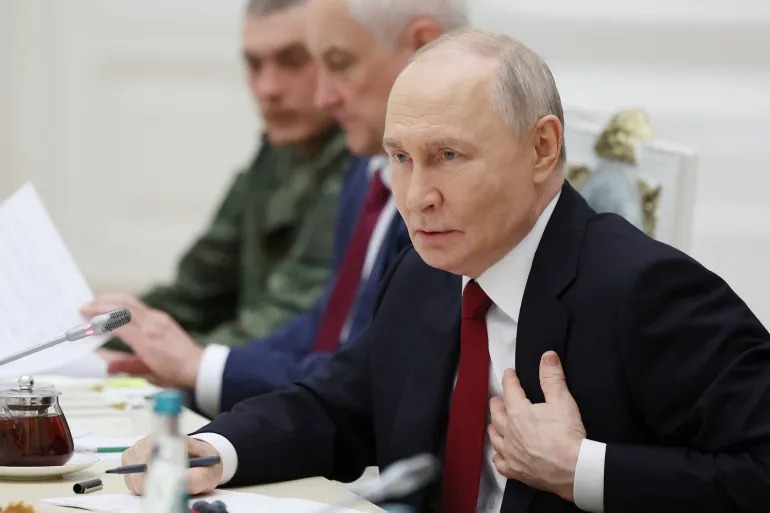
Russian President, Vladimir Putin has dismissed a reported Ukrainian proposal to halt long-range missile and drone attacks, signalling Moscow’s intention to continue its military campaign despite ongoing diplomatic efforts to end the more than four-year-old conflict.
Speaking in an interview with Russian state television on Sunday, Putin claimed that Kyiv had suggested a mutual suspension of long-range strikes as part of efforts to reduce hostilities. He argued, however, that the proposal stemmed from mounting pressure on Ukrainian forces along the front lines.
According to Putin, Russia’s deep-strike capabilities continue to inflict significant damage on military and strategic targets inside Ukraine, giving Moscow little incentive to accept restrictions.

“Our strikes deep inside Ukrainian territory are more powerful and more destructive,” he said, adding that Russia had no intention of adopting measures aimed at preserving what he described as the Kyiv government’s position.
Ukrainian authorities had not publicly responded to Putin’s remarks as of Sunday evening.
Putin’s comments came amid an escalation in Ukrainian drone operations targeting Russia’s energy sector.
Ukrainian President Volodymyr Zelenskyy announced that long-range drone attacks had struck oil refineries in Russia’s Sloviansk and Yaroslavl regions overnight, describing the operations as part of efforts to weaken Moscow’s ability to sustain its war effort.
Russian officials confirmed damage in several regions. Krasnodar Governor Veniamin Kondratyev reported a fire at an oil refinery in Slavyansk-na-Kubani and said one person was killed following the attacks.
Authorities in the Yaroslavl region also reported drone incursions, while officials in Belgorod and Kursk said dozens of Ukrainian drones had targeted border areas over 24 hours.

Despite the growing attacks, Putin insisted the strikes had not altered the battlefield situation and said Russia was increasing production of air defence systems to counter the threat.
Analysts say Russia’s refusal to accept restrictions on long-range strikes reflects its military advantage in that area.
Moscow possesses a larger arsenal of long-range missiles and strike capabilities, allowing it to maintain pressure on Ukrainian military infrastructure and logistics networks.
Putin also views Russia’s long-range strike capacity as an important deterrent, particularly as Ukraine expands its own ability to attack targets deep inside Russian territory using drones and Western-supplied weapons.
The Russian leader has repeatedly criticised Western support for Ukraine’s long-range operations, arguing that such assistance increases the risk of broader confrontation.
Russia has previously objected to Western approval for Ukraine to use long-range missiles against targets inside Russian territory.

In 2024, Putin warned that allowing Kyiv to strike Russia with Western-supplied weapons would amount to direct involvement by NATO countries in the conflict.
However, despite subsequent approval from the United States, Britain and France for such strikes, Russia has not formally declared a conflict with NATO.
The issue remains one of the most sensitive aspects of the war as both sides increasingly rely on long-range attacks to target military infrastructure, energy facilities and supply routes.
Diplomatic efforts to end the conflict have produced little progress despite repeated mediation attempts by the United States and European leaders.
Since returning to office in 2025, U.S. President Donald Trump has sought to broker a settlement between Moscow and Kyiv through separate engagements with both leaders.
Negotiations, however, remain stalled over fundamental disagreements, particularly Russia’s insistence on retaining occupied Ukrainian territories and Ukraine’s refusal to concede sovereignty over any part of its territory.
Putin recently indicated that Russia remains open to future discussions but insisted that any negotiations must be based on proposals outlined during earlier talks in Istanbul, including Moscow’s longstanding territorial demands.
While expressing readiness for further diplomatic engagement, the Russian president’s rejection of limits on long-range strikes underscores the significant obstacles still standing in the way of a negotiated settlement.