RismadarVoice Reporters
September 13, 2026
Chinese President Xi Jinping has called for deeper economic cooperation among the expanded BRICS grouping, proposing new initiatives on artificial intelligence, trade and investment as China seeks to strengthen the bloc’s role in advancing the interests of the Global South.
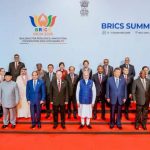
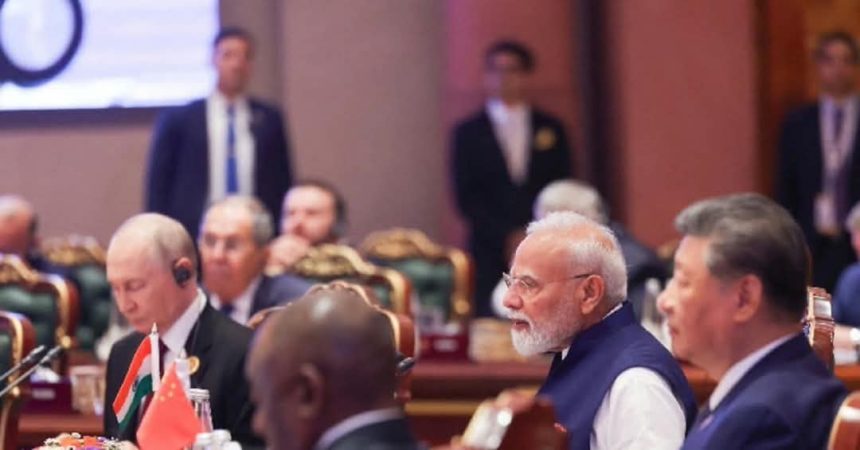
Speaking at the closing session of the BRICS summit in New Delhi on Sunday, Xi said the success of what China and Russia describe as “Greater BRICS” would depend on establishing a strong foundation for practical and sustained cooperation among its members and partner countries.
Xi urged the expanded grouping to strengthen cooperation, maintain stable industrial and supply chains and work towards creating a more integrated market among emerging economies.

As part of the proposals, China will take the lead in establishing a BRICS Artificial Intelligence Open Source Zone aimed at promoting cooperation on large language models, AI training and the development of an open AI ecosystem.
Xi also proposed a BRICS Special Economic Zone partnership and announced that China would host a BRICS Service Trade Forum next year as part of efforts to expand trade and investment links within the grouping.
The initiatives reflect Beijing’s push to transform BRICS from primarily a political and diplomatic platform into a more practical mechanism for economic cooperation among developing and emerging economies.
BRICS originally consisted of Brazil, Russia, India, China and South Africa but has expanded in recent years to include Iran, Indonesia, Egypt, Ethiopia and the United Arab Emirates.
The bloc also has 10 partner countries spanning Asia, Africa, Latin America and the Middle East, significantly expanding its geographical and economic reach across the Global South.

China and Russia have increasingly used the term “Greater BRICS” to describe the enlarged network.
Indian Prime Minister Narendra Modi, whose country holds the 2026 BRICS chairmanship, said solutions developed within the grouping should not remain confined to its members but should be adaptable to other developing countries.
Modi said BRICS should focus on producing practical solutions capable of addressing challenges across the wider Global South.
Russian President Vladimir Putin, meanwhile, described BRICS as an important force in efforts to build what he called a fairer and more multipolar global order.
Putin urged members to find ways to combine the competitive strengths of their respective economies, arguing that greater coordination could increase the bloc’s influence in global economic and political affairs.
The summit is taking place against the backdrop of renewed conflict in the Middle East, including escalating attacks involving the United States, Iran and Iran-backed Houthi forces, with Saudi Arabia also facing attacks.
Despite differences among members over regional security issues, BRICS leaders reached agreement on a joint declaration on Saturday that was backed by both Iran and the UAE.

The declaration expressed deep concern over escalating tensions in the Middle East and called for maximum restraint, marking an important diplomatic outcome for a grouping whose members have sometimes held sharply different positions on regional conflicts.
Iranian President Masoud Pezeshkian also held a meeting with Abu Dhabi Crown Prince Sheikh Khaled bin Mohamed bin Zayed Al Nahyan on the sidelines of the summit.
The meeting was significant because it represented the highest-level contact between officials from Iran and the UAE since the latest regional conflict began. The two sides discussed de-escalation, regional stability and efforts to promote peace and development.
The diplomatic engagement comes as India and China seek to use the expanded BRICS framework to give emerging economies a stronger collective voice in global affairs.
With its enlarged membership and network of partner countries, BRICS now represents a broad coalition of economies across several regions, allowing its leaders to push for greater influence in international economic governance, trade, technology and global institutions.

China’s latest proposals indicate that Beijing wants that influence to be backed by concrete economic mechanisms, particularly in strategic areas such as artificial intelligence, supply chains, services and investment.
The initiatives are expected to feature prominently when China assumes the BRICS chairmanship in 2027.