RismadarVoice Reporters, June 4, 2026
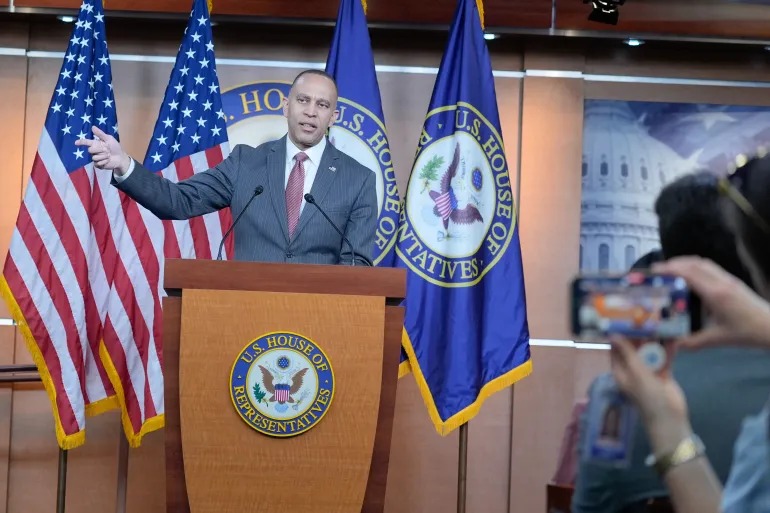
The United States House of Representatives has passed a Democratic-led resolution seeking to limit President Donald Trump’s authority over military action involving Iran, marking a rare bipartisan split with Republican leadership and underscoring growing tensions over war powers in Congress.
The measure, which passed on Wednesday by a 215–208 vote, calls for an end to U.S. military involvement in hostilities with Iran unless Congress formally authorises the use of force or declares war.
Although largely symbolic, the resolution represents a political setback for the Trump administration and reflects mounting debate over executive war powers. It does not compel an immediate withdrawal of forces but expresses congressional opposition to continued military engagement without legislative approval.

Four Republicans Brian Fitzpatrick of Pennsylvania, Thomas Massie of Kentucky, Tom Barrett of Michigan, and Warren Davidson of Ohio joined Democrats in supporting the measure.
Republican leaders strongly opposed the resolution, arguing it could undermine ongoing diplomatic efforts with Iran. House Speaker Mike Johnson and other senior Republicans warned that restricting presidential authority at this stage could weaken U.S. negotiating leverage in sensitive nuclear talks.
Foreign Affairs Committee Chair Brian Mast was among the most vocal critics, dismissing the vote as politically motivated.
He argued that lawmakers were not unified on a clear alternative strategy and accused Democrats of pursuing symbolism over substance, saying the move would “weaken the president’s hand” during negotiations.
The Iran resolution was one of two major foreign policy-related votes in the House on Wednesday. Lawmakers also advanced a separate procedural motion that could pave the way for additional U.S. aid to Ukraine.
That motion, which passed 218–204, allows legislation supporting Ukraine to move forward after a discharge petition secured a majority of House members’ signatures, effectively bypassing Republican leadership.
The petition was led by Representative Gregory Meeks of New York, the top Democrat on the House Foreign Affairs Committee, who also sponsored the Iran war powers resolution.

While the House vote signals growing unease among some lawmakers over presidential war powers, the resolution’s impact remains limited unless it gains traction in the Senate and survives a likely presidential veto.
A separate Senate version of a war powers measure has already advanced through earlier procedural stages but has yet to face a final vote.
Despite its uncertain legislative future, the House vote highlights continuing divisions in Congress over U.S. military engagement abroad and the balance of authority between the legislative and executive branches.