RismadarVoice Reporters
September 25, 2026
President Bola Tinubu has told world leaders that military victories alone cannot deliver lasting peace, calling for diplomacy, reconciliation and inclusive political processes to address conflicts and their underlying causes.
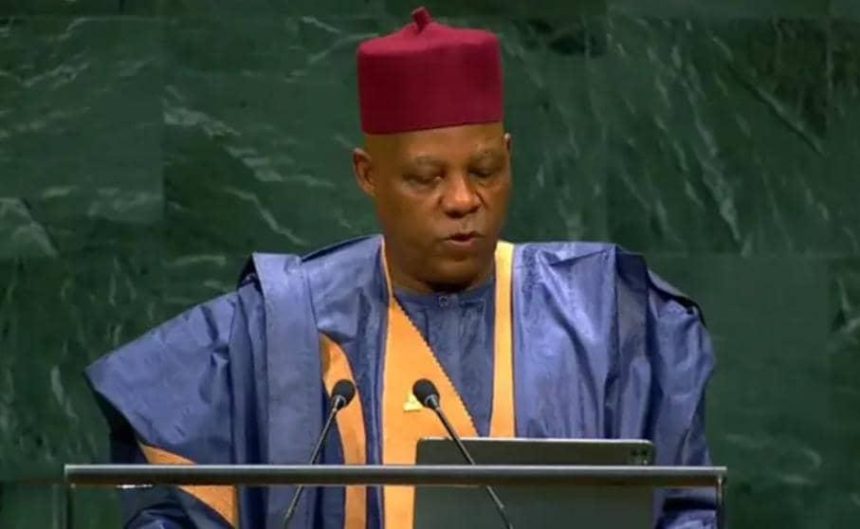
Tinubu’s national statement was delivered on his behalf by Vice President Kashim Shettima at the General Debate of the 81st United Nations General Assembly in New York on Thursday.
“We place our faith in diplomacy because military victories alone cannot secure lasting peace,” Tinubu said, adding that dialogue and reconciliation must give people a stake in ending violence and sustaining peace agreements.
He urged the United Nations to strengthen peacekeeping while devoting greater attention and resources to peacebuilding, mediation, institution-building and sustainable development.
Drawing on Nigeria’s experience confronting Boko Haram, ISWAP and other armed groups, Tinubu said security gains needed to be supported by education, economic opportunities, accountable governance and protection of communities’ rights and dignity.
He argued that development could not flourish amid persistent violence, while injustice and exclusion could continue to fuel insecurity.

Tinubu consequently called for stronger international cooperation against terrorism, organised crime, cyberattacks and illicit finance, including greater intelligence sharing, stronger institutions and efforts to disrupt the financing of violence.
Turning to ongoing conflicts, the President called for urgent diplomacy in Sudan and other war-affected countries, urging parties to protect civilians, facilitate humanitarian assistance and respect international humanitarian and human rights law.
He also warned against propaganda that obscures responsibility for violence, saying international institutions must preserve their commitment to truth and accountability.
Beyond security, Tinubu renewed Nigeria’s demand for reform of the United Nations Security Council, arguing that its structure no longer adequately reflects contemporary global realities.
Nigeria called for at least two permanent seats for Africa, with the full rights of permanent membership, including veto powers for as long as the veto remains, as well as five non-permanent seats.
On the global economy, Tinubu called for reform of the international financial architecture, wider access to concessional financing and debt sustainability arrangements that take developing countries’ needs into account.
He also reaffirmed Nigeria’s commitment to the Paris Agreement and its target of achieving net-zero emissions by 2060, while arguing that developing countries must be allowed to industrialise, reduce poverty and expand energy access as they pursue lower-carbon development.
Tinubu further highlighted the potential of artificial intelligence, urging international cooperation to ensure emerging technologies contribute to healthcare, agriculture, governance and economic productivity rather than deepen global divisions.
On Africa’s economic prospects, the President described the African Continental Free Trade Area as a major opportunity to expand intra-African trade, industrialisation and regional value chains.

He said Africa must increasingly move beyond exporting raw materials towards manufacturing, value addition, technological innovation and knowledge-driven growth.
Tinubu concluded by calling for a more representative and effective United Nations, pledging Nigeria’s continued support for cooperation, dialogue and international partnerships.
“A reformed, inclusive and effective United Nations is indispensable to the peaceful, just and sustainable world that future generations deserve,” he said.