RismadarVoice Reporters
May 12, 2026
President Bola Ahmed Tinubu has called for a comprehensive reform of the global financial architecture to better support Africa’s economic growth and industrial development.
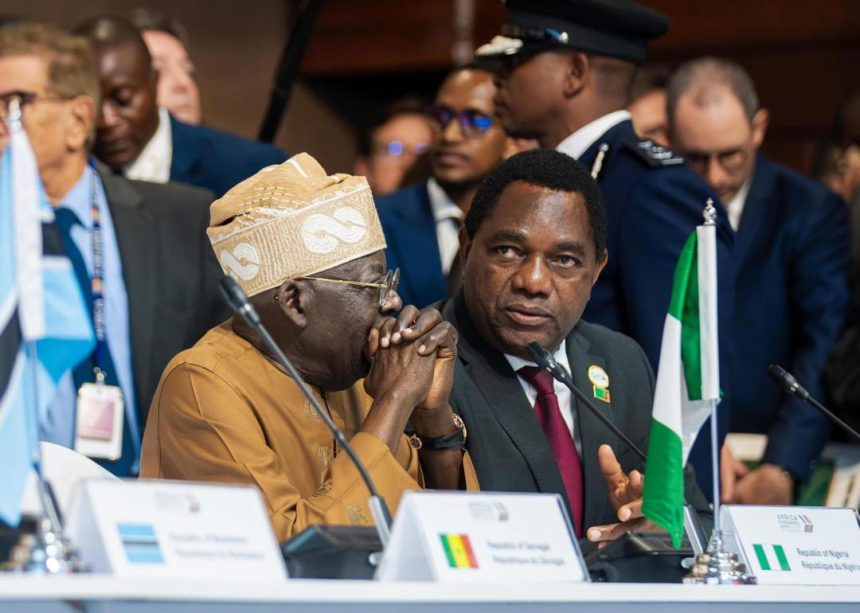
Tinubu made the call on Tuesday while leading Nigeria’s delegation to the Africa Forward Summit held at the Kenyatta Convention Centre in Nairobi, Kenya.
The summit, co-hosted by French President Emmanuel Macron and Kenyan President William Ruto, brought together leaders and top officials from over 30 African countries, alongside representatives of international organisations including the United Nations and the African Union Commission.

In his address, Tinubu stressed the need for fairer global financial and trade systems, arguing that existing structures continue to limit Africa’s industrial growth and access to affordable capital.
He noted that despite decades of independence, Africa’s share of global manufacturing value added remains below 2 per cent, a situation he attributed to structural constraints in the international financial system.
“The international system must reform or risk irrelevance,” the President said, adding that Africa remains disadvantaged by high borrowing costs, capital flight, and restrictive financial conditions.
Tinubu stated that Nigeria had undertaken major economic reforms, including the removal of fuel subsidies, exchange rate unification, and banking sector recapitalisation valued at over $3.4 billion.
According to him, these reforms have strengthened Nigeria’s fiscal position, improved investor confidence, and helped reduce the country’s debt-to-GDP ratio, projected at 32.3 per cent in 2026, while external reserves stand at $45.5 billion.
However, he warned that Nigeria would still spend about $11.6 billion on debt servicing in 2026, describing it as a major constraint on national development.
“Every dollar that leaves our treasury to service debt is a dollar that did not go into industry, infrastructure, or job creation,” he said.
The President argued that Africa’s industrial development was being hindered by what he described as an unequal financial system that makes borrowing significantly more expensive for African economies compared to developed nations.

He called for a system that supports African industrialisation, including the processing of raw materials, local manufacturing, and the expansion of value chains under the African Continental Free Trade Area (AfCFTA).
Tinubu also emphasised the importance of the blue economy, announcing Nigeria’s readiness to share its maritime security infrastructure under the Deep Blue Project with willing Gulf of Guinea states to strengthen regional cooperation.
On migration, the President urged development partners to invest more in job creation, climate adaptation, and skills development in Africa to address the root causes of irregular migration.
He also called for stronger global cooperation on migration governance, saying existing frameworks such as the Global Compact for Migration remain underfunded and non-binding.