RismadarVoice Reporters
October 17, 2026
Hundreds of thousands of demonstrators took to the streets across France on Saturday to protest rising living costs, deteriorating public services and growing uncertainty over the country’s economic future, with clashes between protesters and security forces reported in several major cities.
According to figures attributed to French authorities, approximately 550,000 people participated in demonstrations nationwide, including an estimated 110,000 in Paris.
The protests brought together students, teachers, healthcare workers, trade union members, parents and supporters of the Yellow Vests movement, reflecting widespread frustration over wages, public spending, education and the cost of essential goods and services.
Although much of the nationwide mobilisation was reported to be peaceful, disturbances broke out in Paris, Marseille and other cities, prompting police interventions, the use of tear gas and hundreds of arrests.
The demonstrations represent a continuation of a protest movement that reportedly began in mid-September before expanding into a broader campaign demanding economic and social reforms.
POLICE FIRE TEAR GAS AS TENSIONS ESCALATE IN PARIS
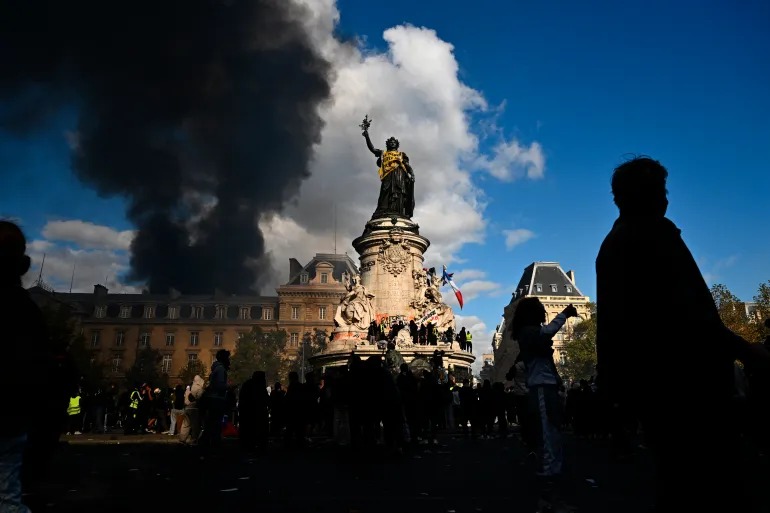
In the French capital, large crowds assembled at Place de la République before proceeding through the city to express their dissatisfaction with government policies.
Tensions escalated when some demonstrators reportedly confronted riot police, prompting officers to deploy tear gas.
Fireworks were allegedly thrown towards security personnel, while a vehicle and a newspaper stand were reportedly set ablaze during the disturbances.

Despite the confrontation, most protesters continued their march towards northwestern Paris.
The heavy security presence reflected concerns about possible violence as thousands of demonstrators gathered in the capital.
Students, workers and families participated in the march, carrying demands for improved living conditions, better-funded public institutions and stronger government responses to economic pressures.
STUDENTS DEMAND BETTER EDUCATION AND PUBLIC SERVICES
Students were among the groups at the forefront of the demonstrations, with many expressing frustration over conditions in public schools.
The protest movement reportedly began at a secondary school in Créteil, a suburb of Paris, in mid-September.
Initial grievances included overcrowded classrooms, shortages of teaching staff, inadequate facilities and inequalities within the education system.
The demonstrations subsequently spread beyond educational institutions as other professional and social groups joined the campaign.
One high school student, who requested anonymity, said participants wanted the government to listen to their concerns.
“We are here because we want to take back our rights,” the student said.
The demonstrations highlighted growing concerns among young people about educational opportunities, employment prospects and their economic future.
WORKERS AND TRADE UNIONS DEMAND HIGHER WAGES
France’s General Confederation of Labour (CGT), one of the country’s major trade union organisations, supported the demonstrations.
The union called for higher wages and pensions, measures to reduce living costs and stronger protection for essential public services.
Workers participating in the protests expressed concern about household purchasing power and the pressure of rising prices.
Healthcare professionals, teachers, firefighters and other public-sector workers were also reported among the demonstrators.
Their participation broadened the movement beyond its initial education-related demands.
The protests increasingly reflected dissatisfaction with the government’s ability to balance fiscal pressures with the needs of households and public institutions.
YELLOW VESTS SUPPORTERS JOIN NATIONWIDE MOBILISATION
Supporters of the Yellow Vests movement also joined the demonstrations.
The movement emerged in 2018 amid opposition to fuel taxes before developing into a wider campaign against economic inequality and government policies.

Its participation in the latest protests illustrated the persistence of economic grievances that have shaped French political debate for several years.
The demonstrations also attracted civil society organisations and human rights advocates concerned about social inequality and the country’s direction.
Jean Pierre, identified as a member of the French Human Rights League, said the protests reflected overlapping concerns about living standards, uncertainty over the future and international tensions.
Amelie, a mother of three who attended the Paris demonstration with her teenage daughter, said she wanted to contribute to efforts aimed at securing a better future for younger generations.
VIOLENCE REPORTED IN MARSEILLE, LYON AND OTHER CITIES
Outside Paris, disturbances were reported in several major cities.
In Marseille, demonstrators reportedly forced their way into the town hall, while some shops were looted.
In Lyon, reports indicated that a tourism office was set on fire.
Clashes and other violent incidents were also reported in Rennes, Toulouse and Angers.
French authorities accused groups of hooded individuals of attacking security personnel, attempting to loot businesses and setting fire to street furniture.
Public institutions and media organisations were also reportedly targeted during some confrontations.
The incidents occurred alongside largely peaceful demonstrations involving people demanding changes to economic and social policies.
FRENCH AUTHORITIES REPORT AT LEAST 400 ARRESTS
France’s Interior Ministry said at least 400 people had been arrested in connection with disturbances during the nationwide protests.
The ministry attributed several violent incidents to groups it described as belonging to the “ultra-left”.
Authorities accused those involved of attempting to disrupt demonstrations through vandalism, attacks on public property and confrontations with police.
However, the allegations concerning the identities and affiliations of those responsible for individual incidents have not been independently established in this report.
The arrests highlighted the security challenges facing authorities as demonstrations continued across the country.
FRANCE’S ECONOMIC CHALLENGES FUEL PUBLIC ANGER
The protests come amid concerns about France’s public finances, government borrowing costs and the sustainability of public spending.
France has faced pressure to address its debt burden while maintaining public services and responding to demands for economic relief.
Rising borrowing costs have increased scrutiny of the government’s fiscal policies.
The competing demands have created a difficult political environment, with protesters calling for improved public services and stronger household support while authorities face pressure to control expenditure.
Bruno Cautres, a researcher at the Paris-based Centre for Political Research, described the demonstrations as the culmination of several protest movements driven by concerns about taxation, public debt and government responsiveness.
He said many citizens were questioning the country’s direction and the measures authorities intended to adopt to address its financial challenges.
MACRON CALLS FOR CALM, RESPECT FOR PEOPLE AND PROPERTY
President Emmanuel Macron appealed for calm ahead of Saturday’s demonstrations, acknowledging the right of citizens to protest while stressing the importance of respecting people and property.
Speaking in Brussels on Friday, Macron said demonstrations should remain within the bounds of the law.
“There is a constitutional right to protest and to express oneself. But this right comes with the need to respect,” he said.
The President’s remarks came amid concerns about the possibility of further disturbances.
The government faces the challenge of protecting the right to peaceful assembly while responding to violence and maintaining public order.
PROTESTS ADD PRESSURE AHEAD OF 2027 ELECTIONS
The nationwide demonstrations come during the final months of Macron’s presidency, with France preparing for its next presidential election in 2027.
The election is expected to take place against a backdrop of economic uncertainty, political divisions and growing public debate over the country’s future.
The far-right National Rally remains a significant force in French politics, while other parties are seeking to respond to dissatisfaction with the current political establishment.
The protests have added to pressure on the government to address concerns over public services, wages and household living standards.
GOVERNMENT FACES GROWING DEMANDS FOR ECONOMIC REFORMS
The scale of Saturday’s mobilisation reflects the range of concerns expressed by students, workers, families and civil society organisations.
While the reported violence attracted significant attention, the central demands of many participants focused on economic security, public service provision and opportunities for younger generations.
The French government now faces the difficult task of responding to these demands while managing public debt and maintaining confidence in the country’s finances.
As demonstrations continue, the authorities’ response to the protesters’ grievances, alongside the investigation of violent incidents, is likely to shape the next phase of the movement.
The reported turnout of more than half a million people underscores the depth of public frustration, although the final scale of participation and the circumstances surrounding individual clashes remain subject to confirmation.