RismadarVoice Reporters, August 28, 2026
Singapore’s plans to clear parts of two forested areas for public housing have sparked an unusually strong public response, with residents and environmental groups calling for greater protection of wildlife habitats and more transparency in land-use decisions.
The Housing and Development Board announced plans last month to clear about 15 hectares of the 23-hectare Maju Forest in the Sunset Way area for housing. The government also plans to develop at least 10 hectares of Gillman Forest, about 6km away.
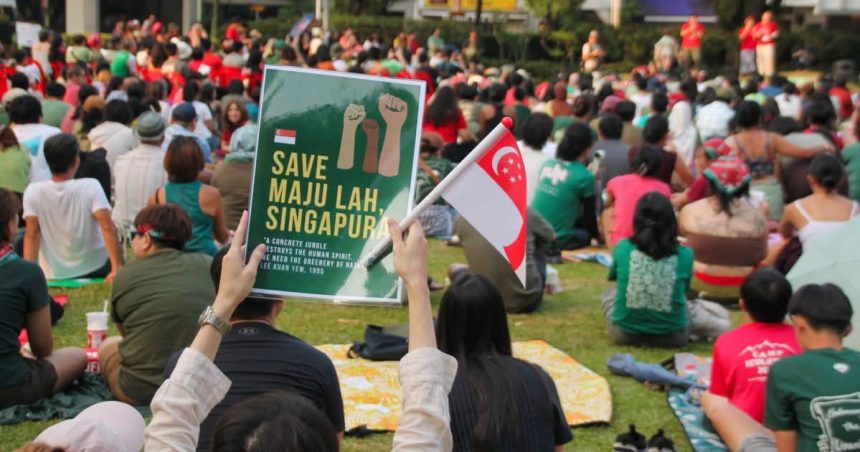
The proposals have prompted petitions, community meetings and public demonstrations in a country where major planning decisions are generally made through a centralised process and rarely generate sustained public protests.

More than 60,000 people have signed petitions calling for the projects to be cancelled or revised, while more than 2,000 people attended a rally at Speakers’ Corner in Hong Lim Park on August 16.
Residents and conservation groups say the forests provide habitats for several species, including the critically endangered straw-headed bulbul and Sunda pangolin.
Official environmental impact assessments found that Gillman Forest supports 178 animal species, while Maju Forest supports 113 species.
The straw-headed bulbul, whose global population is estimated at between 600 and 1,700 birds, is among the species found in the affected areas. Conservationists also say Maju Forest provides habitat for other wildlife, including long-tailed macaques and monitor lizards.
Housing Needs Versus Conservation:
The government has defended the development plans on the grounds of Singapore’s limited land availability and continuing demand for public housing.
Minister of State for National Development Alvin Tan said public housing launches were being oversubscribed by more than four times and argued that Singapore had fewer land-use options than larger countries.

Singapore’s population reached a record 6.11 million last year, driven in part by an increase in foreign workers. The country also has a public housing system with a home ownership rate of about 90 per cent.
Environmental campaigners, however, argue that housing development and nature conservation should not necessarily be treated as competing objectives.
The controversy has renewed discussion about how Singapore balances urban development with environmental protection, particularly as the city-state continues to promote its identity as a “City in Nature”.
Singapore has also pledged, alongside more than 130 other countries, to work towards halting deforestation by 2030 under the Glasgow Leaders’ Declaration on Forests and Land Use.
Government Offers Concessions:
The government has indicated that it will retain more green space than initially proposed.
Before the August 16 rally, Tan announced that authorities would preserve more of the forests than originally planned. The initial proposals called for retaining 40 per cent of the Gillman Barracks forest and 35 per cent of Maju Forest.
Tan said increasing the amount of preserved forest would mean fewer homes could ultimately be built on the sites.
The announcement has not ended opposition to the developments, with campaigners continuing to call for greater protection of the forests and their ecosystems.

The debate has also prompted wider public discussion about Singapore’s approach to urban planning and the extent to which residents should have a role in decisions affecting their communities.
The controversy comes after previous public opposition to development plans for Dover Forest resulted in the government retaining a substantial portion of the area as a nature park.
For residents living near Maju and Gillman forests, the current dispute has become a broader debate over what Singapore’s continued development should look like and how environmental considerations should be incorporated into future housing and infrastructure projects.