

RismadarVoice Reporters, May 31, 2026
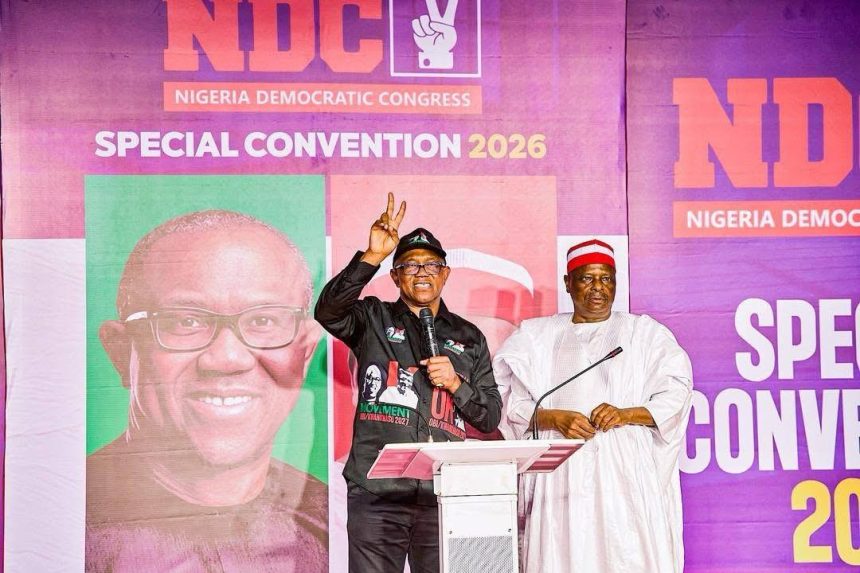
The presidential candidate of the Nigerian Democratic Coalition (NDC), Mr Peter Obi, has formally accepted the party’s nomination for the 2027 presidential election, pledging sweeping reforms in security, healthcare, education, agriculture, energy, and governance.
Speaking after he emerged as the party’s standard-bearer at a ceremony in Abuja on Saturday, Obi declared that “a New Nigeria is Possible,” describing the election as a defining moment for the country’s future rather than an individual political ambition.

The former Anambra State governor said Nigeria was facing growing insecurity, economic hardship, unemployment, food shortages, and declining public confidence in governance, but expressed confidence that the country could overcome its challenges through responsible leadership and national unity.
Obi called for greater national cohesion, urging Nigerians to rise above ethnic, religious, and regional divisions.
“Nigeria cannot move forward while divided by ethnic, religious, regional or narrow political interests. We may speak different languages and practise different faiths, but we share one destiny under one flag,” he said.
On security, Obi pledged to adopt an intelligence-driven and technology-enabled approach to tackling terrorism, banditry, kidnapping, and other forms of violent crime. He promised to strengthen security institutions, improve operational coordination, support security personnel, and address underlying causes of insecurity such as poverty, unemployment, and marginalisation.
Citing global terrorism rankings, Obi expressed concern over Nigeria’s worsening security situation and said restoring safety across the country would be a priority of his administration.
The NDC candidate also outlined ambitious healthcare targets, promising to increase health insurance coverage from about 10 per cent to over 20 per cent within four years. He further pledged to raise healthcare spending to at least 10 per cent of Gross Domestic Product and improve access to primary healthcare services nationwide.
According to him, every one of Nigeria’s 8,809 political wards would have a functional primary healthcare centre under his administration, while at least half of the country’s estimated 30,000 primary healthcare facilities would be fully operational by the end of his first term.
In the education sector, Obi promised increased investment in schools, teachers, technology, and vocational training, arguing that human capital development remains the foundation for national growth and prosperity.
Addressing food insecurity, the former governor described Nigeria’s hunger crisis as unacceptable despite the country’s vast agricultural potential. He pledged major investments in agriculture aimed at transforming Nigeria from a consumption-based economy into a production-driven one.
Obi noted that over 35 million Nigerians were projected to face acute hunger this year and argued that increased agricultural production would be key to reducing poverty and improving food security.
In the power sector, he promised to increase electricity generation and distribution by at least 10,000 megawatts over four years, describing the current supply of about 4,000 megawatts for a population exceeding 200 million as inadequate for economic development.

He also vowed to tackle unemployment and underemployment by supporting micro, small, and medium enterprises through tax incentives, affordable financing, and targeted investments in agriculture, manufacturing, entertainment, sports, and logistics.
On governance, Obi promised to reduce the cost of government, fight corruption through transparency and accountability, uphold the rule of law, and strengthen democratic institutions.
He pledged respect for opposition parties and promised that his administration would promote inclusive governance and electoral fairness.
Obi thanked the leadership of the NDC, including party officials and supporters, for entrusting him with the presidential ticket and called on Nigerians to join what he described as a collective effort to rebuild the country.
“Today is not about Peter Obi. It is about the future of Nigeria and the hope of millions of Nigerians who still believe that our country can work,” he said.