RismadarVoice Reporters
June 9, 2026
The Independent National Electoral Commission (INEC) has explained its decision to appeal two recent Federal High Court judgments challenging aspects of its Timetable and Schedule of Activities for the 2027 General Election, warning that conflicting legal interpretations could create uncertainty in the electoral process.
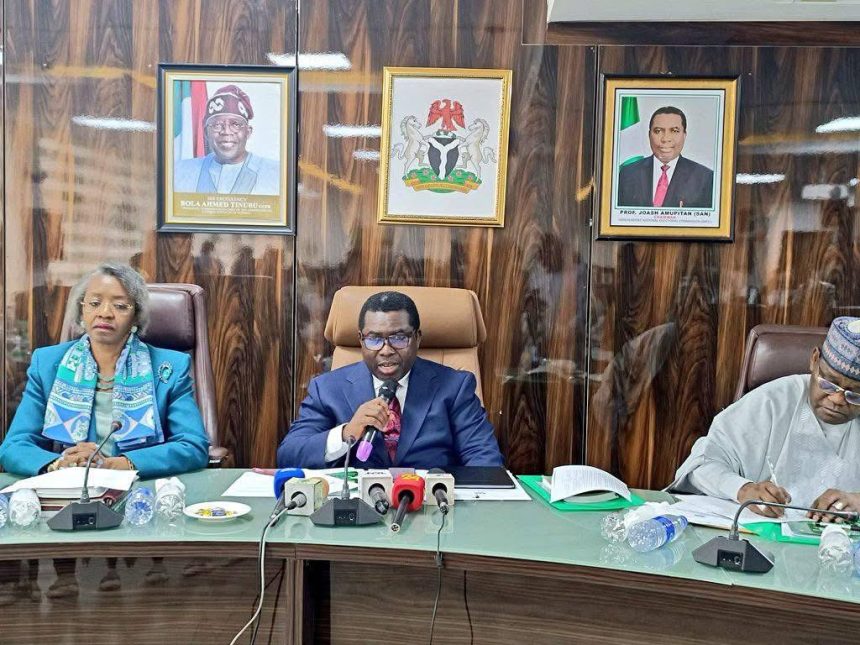
The INEC Chairman, Prof. Joash Amupitan, SAN, explained on Tuesday, June 9, 2026, during the Second Quarterly Consultative Meeting with leaders of political parties held at the Commission’s headquarters in Abuja.
He said the appeals became necessary to obtain authoritative interpretations from the appellate courts on the extent of INEC’s constitutional and statutory powers in designing and coordinating electoral timelines.

According to him, the absence of harmonised and enforceable timelines would undermine the Commission’s ability to properly plan and execute critical electoral activities.
Prof. Amupitan referenced Suit No. FHC/ABJ/CS/517/2026 (Youth Party v. INEC), in which the court questioned certain aspects of the Commission’s timetable, and Suit No. FHC/ABJ/CS/720/2026 (SDP v. INEC), which upheld INEC’s authority to issue an electoral timetable but nullified some provisions relating to candidate nomination and substitution timelines.
He stressed that electoral activities are interconnected operational processes that require coordination, noting that several key activities prescribed in the electoral calendar do not have explicit statutory timelines but remain essential to credible elections.
These, he said, include verification of party membership registers, monitoring of party primaries, pre-upload of primary results, printing of ballot materials, BVAS configuration, and statutory compliance processes under Section 42 of the Electoral Act 2026.
“The Commission considers it imperative that all electoral activities be harmonised within a coherent and workable framework that promotes certainty, transparency, administrative efficiency and equal treatment of all political parties,” he said.
Despite the legal disputes, the INEC Chairman reaffirmed the Commission’s commitment to conducting the 2027 General Election in line with the Constitution and the Electoral Act.
He also provided updates on upcoming elections, announcing that preparations for the Ekiti State governorship election scheduled for June 20, 2026, were on track, with 1,059,360 registered voters expected to participate.
He added that bye-elections would also be conducted the same day in six constituencies across Enugu, Nasarawa, Rivers, Ondo, Kano, and Kebbi States, with uniform operational and security standards.
Prof. Amupitan further disclosed that the Osun State governorship election is scheduled for August 15, 2026, urging political parties to comply strictly with electoral guidelines and timelines.
On candidate nomination for the 2027 elections, he announced that access codes for the Candidate Nomination Portal would be issued on June 26, 2026, warning that the portal would close automatically at the end of the stipulated period without extension.
He urged political parties to intensify voter education and mobilisation for the Continuous Voter Registration exercise and encouraged eligible Nigerians to register, transfer, or correct their voter details.
The INEC Chairman also expressed concern over ongoing internal disputes within some political parties, describing them as distractions that could affect electoral preparedness.

In his remarks, the National Chairman of the Inter-Party Advisory Council (IPAC), Dr Yusuf Mamman Dantalle, supported INEC’s decision to appeal the judgments, saying conflicting court rulings had created uncertainty for political parties and stakeholders.
However, he called for broader reforms of the Electoral Act 2026, particularly Section 84(2), which he said had placed unnecessary constraints on party primaries by limiting nomination options to consensus or direct primaries.
He also raised concerns about political tensions and violence in some states, urging parties to embrace peaceful, issue-based campaigns as the country moves toward the 2027 general elections.