RismadarVoice Reporters
September 4, 2026
The United States and Iran are offering conflicting accounts of the level of shipping activity through the strategic Strait of Hormuz, with Washington claiming that dozens of vessels carrying millions of barrels of oil are crossing the waterway daily.
US President Donald Trump has said the United States is helping about 30 ships transit the strait each night and has described the waterway as being under US control.
However, data from several maritime tracking companies indicates that significantly fewer vessels are currently crossing the strait.

The Strait of Hormuz is a crucial global energy route, with about one-fifth of the world’s oil and gas supplies normally passing through it. Traffic has dropped sharply since the US-Israel war with Iran began six months ago.
US officials say commercial traffic through the strait has increased considerably in recent weeks.
Two US officials told CNN that about 40 commercial vessels carrying approximately 18 million barrels of oil crossed the waterway under US military escort on Tuesday.
Trump also said the US Navy was assisting around 30 ships to pass through the strait each night, later declaring that the waterway was under American control.
US Treasury Secretary Scott Bessent said at least 10 million barrels of oil were moving through Hormuz daily, with the figure reaching between 15 million and 17 million barrels on Monday.
The claims followed an announcement by US Central Command commander Brad Cooper that American forces had cleared the transit lanes of sea mines.
Before the conflict, an estimated 100 vessels carrying roughly 20 million barrels of oil passed through the strait each day.

Independent maritime tracking data presents a substantially different picture.
According to marine analytics company Kpler, only six vessels crossed the strait on Wednesday, 11 on Tuesday and five on Monday. Its 10-day average was about 13 vessels per day.
Lloyd’s List Intelligence recorded a similar trend, reporting an average of about 12 daily transits between August 26 and September 1.
The company, however, warned that its figures could be incomplete because some vessels have switched off their tracking systems, making them difficult to identify immediately.
Between August 17 and 23, Lloyd’s List Intelligence recorded about 14 non-Iranian-linked vessels crossing the strait each day.
The Joint Maritime Information Centre also said commercial traffic remained “far below baseline”, despite a modest increase from recent lows.
It rated the risk level in the Strait of Hormuz as severe, citing continued concerns about drifting or uncharted mines.
Maritime analysts say differences in how vessels are counted could explain part of the discrepancy between the US figures and commercial shipping data.
Bridget Diakun, maritime intelligence and research director at Lloyd’s List Intelligence, said it was difficult to determine the exact reason for the gap without knowing how the US military compiles its figures.

She suggested that the US may be counting smaller vessels and ships that do not carry commercial cargo, while commercial tracking companies generally apply stricter criteria.
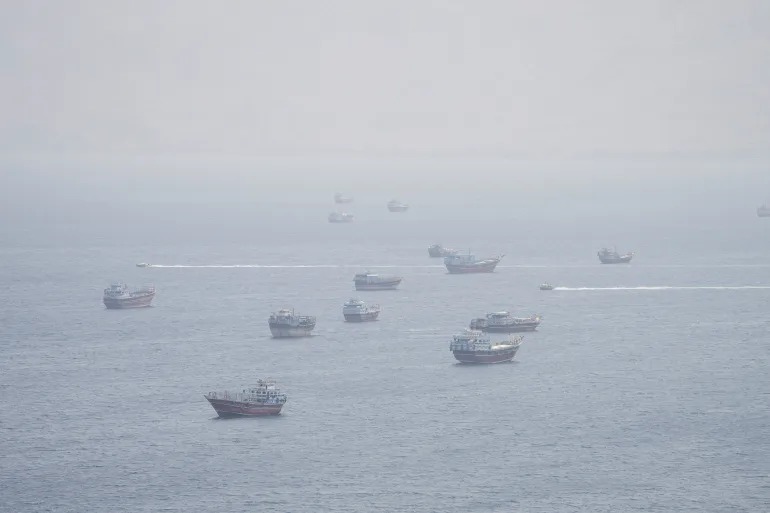
Eirik Hooper, a senior associate covering ports and terminals at maritime consultancy Drewry, said US operational figures could include naval support vessels, tugs, offshore support vessels, coastal craft and traditional dhows operating alongside protected convoys.
He added that the US military has access to satellite imagery, aircraft-based surveillance and other intelligence systems, as well as convoy information that may allow it to identify vessels not immediately visible through standard Automatic Identification System tracking.
A growing number of vessels have also been classified as “dark” or unidentified because they have switched off their tracking transponders.
Analysts say this can cause initial shipping data to underestimate the number of vessels crossing the waterway, with some movements only confirmed and added later.
Iran has acknowledged that some vessels have managed to cross the Strait of Hormuz but insists that its forces remain in control of the waterway.

Iranian Parliament Speaker Mohammad Bagher Ghalibaf said some ships had managed to pass through the strait but maintained that Iran would not allow the waterway to be fully reopened.
He accused the United States of giving ships assurances that they could safely use a southern route and warned that vessels attempting to do so could be targeted.
Iran’s Islamic Revolutionary Guard Corps later claimed that two oil tankers had struck mines while using what it described as an unauthorised route through the strait.
Saudi Arabia has also accused Iran of attacking one of its oil tankers, an incident that reportedly killed two Filipino sailors.