RismadarVoice Reporters
October 11, 2026
Military tensions have intensified around the Strait of Hormuz and the Gulf of Oman, with reports of attacks on commercial vessels, naval operations and fresh security warnings as diplomatic efforts to end the conflict involving Iran, the United States and Israel remain stalled.
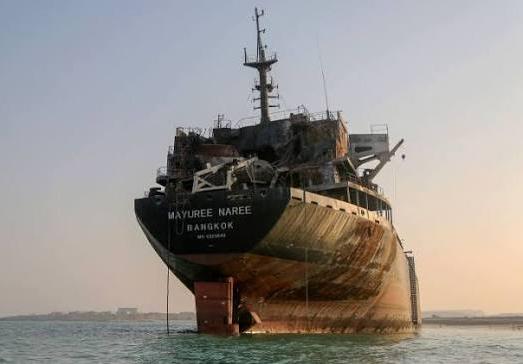
Iran’s Islamic Revolutionary Guard Corps (IRGC) Navy said an unidentified crude oil supertanker struck a naval mine and caught fire while passing through the strategic waterway.
According to the IRGC, the vessel was travelling through an unauthorised route with its navigation equipment switched off. The force warned that ships disregarding its maritime security instructions could face similar incidents.

The claim could not be independently verified, and the identity of the tanker was not immediately established.
The Strait of Hormuz remains one of the world’s most important energy corridors, normally carrying approximately one-fifth of global oil consumption and significant volumes of liquefied natural gas.
On Sunday, senior Iranian military official Habibollah Sayyari said the country’s armed forces remained prepared to respond to further attacks.
Sayyari maintained that Iranian forces had previously targeted vessels belonging to opposing forces and would respond again if Iran came under attack.
His remarks followed maritime security alerts concerning several incidents around the Strait of Hormuz and the Gulf of Oman.
The United Kingdom Maritime Trade Operations (UKMTO) reported that vessels near Ras al-Khaimah in the United Arab Emirates had received radio instructions to leave their anchorages.
The maritime security organisation also reported that an unidentified projectile struck a tanker departing the Strait of Hormuz. Details of the vessel’s condition and the circumstances of the incident were not immediately established.
Separately, UAE authorities reported rescuing 22 crew members following a fire aboard a tanker near the country’s coast. The cause of that incident had not been confirmed.
Meanwhile, the United States Central Command (CENTCOM) said American forces had disabled a Panama-flagged cargo vessel in the Gulf of Oman after it allegedly attempted to breach Washington’s naval blockade of Iranian ports.

The US military released footage of the operation and said the strike targeted the vessel’s propulsion system.
CENTCOM also reported that its blockade operations had forced numerous commercial vessels to turn back and disrupted Iranian maritime exports. Those operational claims have not been independently verified.
The latest incidents follow reports of increased attacks on commercial shipping across the region, including waters beyond the immediate Strait of Hormuz.
Shipping disruptions have also affected energy transportation.
According to figures attributed to commodities analytics firm Kpler, average crude oil movements through the strait fell to approximately 8.5 million barrels per day during the week ending October 7, around 40 per cent below normal levels.
The reported decline highlights the potential consequences of prolonged maritime insecurity for international energy markets and countries dependent on shipments through the waterway.
DIPLOMATIC TALKS REMAIN DEADLOCKED
Efforts to negotiate an end to the conflict have continued through intermediaries, but disagreements over maritime restrictions, security arrangements and Iran’s nuclear programme remain unresolved.
Tehran has called for the restoration of an earlier memorandum of understanding reached in June and renewed support for arrangements with Oman governing coordinated vessel movements through the strait.
The United States has continued to press Iran for restrictions on its uranium enrichment activities.
US Vice President JD Vance recently indicated that a substantial reduction in Iran’s enrichment capacity would be necessary for a negotiated settlement.
Iranian authorities, however, have maintained that the country will not completely abandon domestic uranium enrichment.
Iran’s nuclear chief, Mohammad Eslami, defended the country’s nuclear programme, saying it serves domestic purposes, including electricity generation.
Eslami also criticised the International Atomic Energy Agency over its response to threats against Iranian nuclear facilities.
Similarly, Behrouz Kamalvandi, spokesman for Iran’s Atomic Energy Organisation, said Tehran would continue pursuing its national interests through diplomatic channels while retaining other options.
The opposing positions underline the difficulties confronting mediators seeking an agreement that addresses both nuclear restrictions and wider regional security concerns.
With commercial shipping facing continued threats and neither side announcing a diplomatic breakthrough, uncertainty persists over the restoration of normal maritime operations through the Strait of Hormuz.
The duration of the disruption will depend largely on developments in the conflict, the effectiveness of maritime security arrangements and whether negotiations produce an agreement acceptable to the parties involved.