RismadarVoice Reporters, August 10, 2026
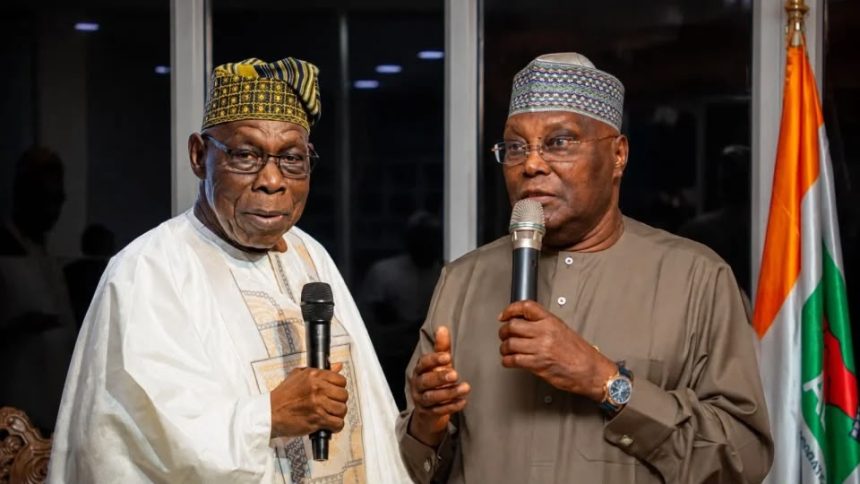
Former Vice President Atiku Abubakar has accused former President Olusegun Obasanjo of waging a prolonged campaign of falsehoods and political manipulation against him, arguing that the former president’s latest allegations are inconsistent with accounts from people who witnessed events during their time in office.
Atiku made his position known through his Media Adviser, Paul Ibe, in response to a recent claim by Obasanjo that the former vice president had worked with the late Speaker of the House of Representatives, Ghali Na’Abba, to orchestrate his removal from office during their administration between 1999 and 2007.
Obasanjo reportedly made the allegation on July 23, bringing back one of the long-running disputes that have characterised his relationship with Atiku.

In a statement issued in Abuja on Sunday, Ibe accused Obasanjo of repeatedly reviving allegations against Atiku, particularly as the political contest draws closer.
He described the latest claim as unfair because it involved Na’Abba, who died in 2023 and could no longer respond to the allegation.
“This time, he chose to make a man who passed away nearly three years ago the subject of his baseless allegation,” Ibe said.
The Atiku camp also relied on the account of Abubakar Bwari, a former member of the House of Representatives who served as Chief Whip during the period under review.
According to Bwari, Na’Abba did not plot to remove Obasanjo from office. He said, instead, that Atiku had engaged members of the National Assembly as an intermediary on behalf of the former president.
Ibe also disputed claims surrounding the events leading to Obasanjo’s re-election in 2003.
He referred to comments by former Abia State governor, Orji Uzor Kalu, who was among the PDP governors at the time. Kalu reportedly said Atiku appealed to the governors to support Obasanjo’s bid for a second term.
According to the account cited by Ibe, Atiku personally appealed to about 17 PDP governors, telling them he did not want to betray Obasanjo, who had entrusted him with the vice-presidential position.
Ibe argued that Kalu’s version of events conflicted with claims that Obasanjo had been compelled to seek Atiku’s support by kneeling before him.
The statement further cited Kalu as saying that Atiku had been in a position to emerge as president but chose not to undermine Obasanjo.
Kalu was quoted as saying that arrangements had been made that could have paved the way for Atiku to emerge as the presidential candidate. Still, the former vice president rejected the idea because he believed Obasanjo had trusted him and therefore did not want to betray him.

The statement also revisited the controversial investigation into the Petroleum Technology Development Fund, which became a major source of tension between the two leaders before the 2007 presidential election.
Obasanjo had directed the Senate to investigate alleged financial irregularities involving the PTDF. Atiku denied any wrongdoing and offered himself for investigation, maintaining that the money under scrutiny was held in fixed deposit accounts.
Atiku subsequently alleged that the investigation was politically motivated and connected to his opposition to Obasanjo’s attempt to secure a third term in office.
Ibe also referred to accounts contained in the autobiography of the late Awujale of Ijebuland, Oba Sikiru Adetona, titled Awujale, in an attempt to challenge aspects of the narrative surrounding the PTDF investigation.
According to the statement, Oba Adetona documented the treatment of businessman and Globacom chairman, Mike Adenuga, by officials of the Economic and Financial Crimes Commission during the same period.
The monarch reportedly wrote that EFCC officials visited Adenuga’s Lagos residence on July 9, 2006, broke through the gate and detained him before he was later released following questioning.
The account, as cited by Ibe, suggested that the EFCC investigation was ostensibly linked to funds belonging to the PTDF, although Oba Adetona believed there were other issues behind the action.
Ibe alleged that the investigation was intended, among other things, to establish a connection between Adenuga and Atiku over the disputed PTDF funds.
He also rejected claims that Adenuga financed Globacom’s operating licence with PTDF money, arguing that the businessman secured funding for the transaction from BNP Paribas Bank.
The statement further referred to Oba Adetona’s account of Adenuga’s relationship with Obasanjo after the businessman’s detention and his subsequent departure from Nigeria.
According to the account, Obasanjo later encountered Adenuga at a social gathering and subsequently invited him to Ota, where he allegedly sought the businessman’s assistance in constructing an administrative building at Bells University, established by the former president.
Adenuga reportedly agreed to undertake the project, which was subsequently handled by Cachez Turnkey Projects Ltd.
Ibe said Adenuga eventually left Nigeria amid what he described as persistent harassment by the EFCC but returned after Obasanjo completed his tenure as president.
He added that Oba Adetona’s account indicated that work on the Bells University project slowed during Adenuga’s absence and that the university later contacted him about resuming the construction.
According to Ibe, the account raised questions about the apparent difference between the former president’s public posture towards Adenuga and his alleged private dealings with the businessman.
The latest dispute is another chapter in the long-standing political disagreement between Obasanjo and Atiku.
The two politicians were allies before the 1999 presidential election, when Obasanjo emerged as the presidential candidate of the Peoples Democratic Party and selected Atiku as his running mate.
They secured a second term in 2003, but their relationship subsequently deteriorated amid disagreements over political succession, corruption allegations and Obasanjo’s controversial effort to extend his tenure beyond two terms.
Atiku eventually left the PDP and contested the 2007 presidential election under the platform of the Action Congress after his political relationship with Obasanjo collapsed.
He has remained a prominent figure in Nigeria’s opposition politics and is the presidential candidate of the African Democratic Congress for the 2027 election.
Ibe maintained that Obasanjo’s latest allegation should be considered against the backdrop of the political rivalry that has persisted between the two men for more than two decades.
He accused the former president of repeatedly seeking to undermine Atiku’s reputation, insisting that the latest allegation would not stand up to scrutiny.
Obasanjo had not publicly responded to the claims contained in Atiku’s statement as of the time of filing this report.
Kehinde Akinyemi, a Special Assistant to the former president on Media, was contacted for a response but declined to comment.