RismadarVoice Reporters, August 9, 2026
Iran has introduced fresh conditions for reopening the strategically important Strait of Hormuz, demanding major concessions from the United States as tensions over the waterway continue to threaten regional stability and global energy supplies.
The development came as the United Arab Emirates reported that one of its vessels had been targeted by an Iranian missile while transiting the strait.
In Yemen, the military stepped up attacks against Iran-backed Houthi rebels, while Turkey moved closer to adopting legislation aimed at supporting a new peace process with Kurdish insurgents.

The developments point to a wider escalation across several Middle Eastern fronts, with the Strait of Hormuz remaining a major flashpoint between Iran and the United States.
Iran sets fresh conditions:
Iran’s Supreme National Security Council said the Strait of Hormuz would not be reopened until Washington changed its approach towards Tehran.
Among the conditions issued by the Iranian body are a guarantee that the United States will not threaten Iran again, an end to military action against Iran and its regional allies, and the lifting of the naval blockade on Iranian ports.
Tehran also demanded the withdrawal of American forces from the region and compensation for damage caused during the conflict. It further called for the lifting of sanctions imposed on Iran and the unconditional release of Iranian assets frozen abroad.
The demands could complicate ongoing negotiations between the two countries over the management and reopening of the waterway.
There was no immediate public response from Washington to the latest Iranian conditions.
The United States has maintained that an acceptable arrangement on navigation through the Strait of Hormuz must be reached before the blockade is lifted.
The latest position comes as the deadline for negotiations on a final agreement approaches. Under an interim understanding reached in June, issues including sanctions, compensation and frozen Iranian assets were expected to be addressed as part of a broader settlement.
Iran and Oman discuss navigation:
Iranian Foreign Minister Abbas Araghchi said Tehran was close to reaching a separate understanding with Oman on navigation through the strait.
He said discussions had focused particularly on establishing a transit route for vessels using the waterway.
Araghchi, however, indicated that agreement on navigation alone would not automatically lead to the reopening of the strait, as other conditions remained unresolved.
Oman, which has played a mediating role in discussions between the parties, said negotiations were continuing in a positive and constructive atmosphere.
The Gulf state also condemned attacks on commercial vessels operating in the waterway.
The Strait of Hormuz is a critical international energy route through which large volumes of crude oil and natural gas pass. Any prolonged disruption to shipping through the strait could have significant implications for global energy markets.
UAE reports missile attack on vessel:
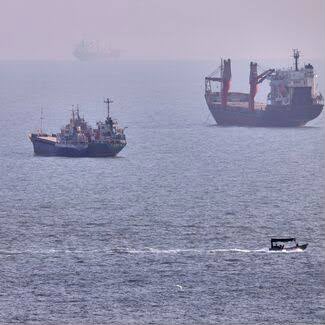
The diplomatic tensions were accompanied by a fresh security incident after the UAE said a vessel belonging to Abu Dhabi’s state-owned oil and gas company, ADNOC, was attacked while sailing through the Strait of Hormuz.
The Emirati Foreign Ministry said Iran launched a missile at the vessel as part of attacks on commercial shipping.
ADNOC said there were no casualties in the incident, which occurred early Saturday. The company did not disclose the precise location of the attack or whether the vessel sustained damage.

The company said more than a dozen of its vessels had been targeted by missiles and drones while transiting the strait since the conflict between Iran, the United States and Israel began in February.
ADNOC said one crew member had been killed and 20 others wounded in the attacks recorded during that period.
Separately, the United Kingdom Maritime Trade Operations centre reported that a vessel east of Khasab, Oman, had been struck by a projectile. The impact caused a fire, which was later extinguished, while the vessel and its crew were reported to be safe.
It was not immediately established whether the incident reported by the UK maritime authorities was the same attack reported by the UAE.
Yemen conflict shows signs of renewed escalation:
In Yemen, the country’s military said it had launched attacks against positions and military capabilities belonging to the Iran-backed Houthi rebels.
The military said the operation was carried out across several front lines in response to recent Houthi attacks in central and eastern Yemen.
A military spokesperson, Col. Majed al-Nazili, said the strikes were directed at Houthi sites and capabilities but did not provide detailed information about the targets or casualties.
The renewed fighting has raised concerns that Yemen’s long-running civil war could intensify after the relative calm that followed a 2022 truce.
The Houthis control significant territory in Yemen and are backed by Iran, while the internationally recognised Yemeni government is supported by a Saudi-led coalition.
Turkey advances Kurdish peace initiative:
Meanwhile, Turkey’s parliament took a step towards legislation designed to support a new peace initiative involving Kurdish militants.
A parliamentary committee approved the draft law on Saturday, paving the way for consideration by the full parliament in the coming week.
The proposed legislation outlines procedures for the disarmament and rehabilitation of members of the Kurdistan Workers’ Party, or PKK.
The development follows the group’s declaration last year that it would disarm and dissolve as part of an initiative aimed at ending its decades-long conflict with the Turkish state.
The proposed measures would take effect after Turkey’s National Security Council confirms that the organisation has dissolved and surrendered its weapons.
The conflict between Turkey and the PKK began in the 1980s and has resulted in tens of thousands of deaths.
Turkey, the United States and other Western countries classify the PKK as a terrorist organisation.
What the developments mean:
The latest developments show the interconnected nature of security tensions across the Middle East.
Iran’s conditions for reopening the Strait of Hormuz could complicate negotiations with Washington, while the reported attack on an Emirati vessel adds another layer of risk to commercial shipping in a waterway vital to the global economy.
At the same time, renewed fighting in Yemen could further destabilise the region, while Turkey’s efforts to advance a Kurdish peace process represent a separate attempt to resolve one of the Middle East’s longest-running conflicts.
For now, the Strait of Hormuz remains the most immediate concern because of its importance to international energy supplies. Continued attacks or restrictions on shipping could have consequences well beyond the countries directly involved in the conflict.