RismadarVoice Reporters
September 28, 2026
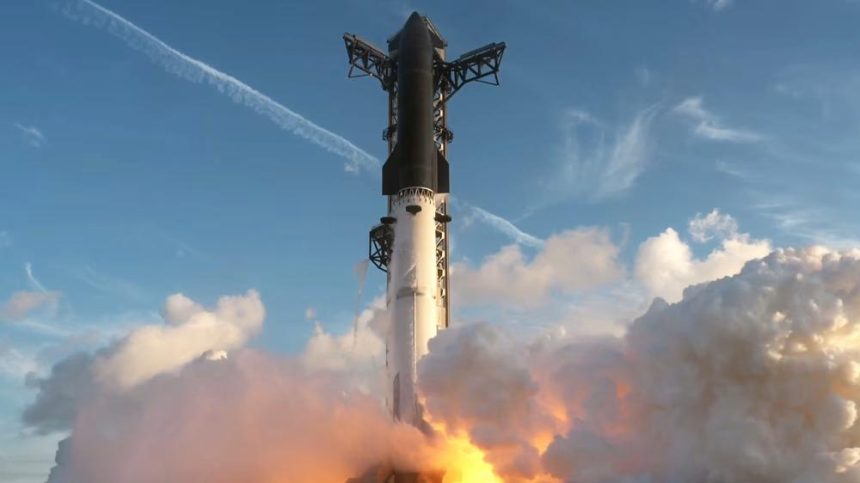
SpaceX has successfully launched its giant Starship spacecraft into orbit for the first time, marking a major milestone in the development of the company’s fully reusable launch system.
The spacecraft lifted off on Monday from SpaceX’s Starbase facility in southern Texas and successfully reached orbit despite an engine shutting down earlier than planned during the flight.
Mission controllers continued with the mission after determining that the affected engine was no longer required for the remaining stages of the planned journey.

“Starship is orbital,” mission control announced following confirmation that the spacecraft had reached orbit.
The achievement represents an important step in SpaceX’s long-running programme to develop Starship for satellite deployment and future human missions to the Moon and Mars.
The 407-foot launch vehicle carried 26 of SpaceX’s latest Starlink satellites, which were scheduled to be deployed individually after Starship reached orbit.
The satellites are intended to join the company’s existing Starlink constellation, which provides satellite-based internet services in different parts of the world.
Monday’s launch was Starship’s 14th full-scale flight from Texas since testing of the integrated launch system began.
Previous Starship test flights had followed suborbital trajectories or travelled only partway around Earth, with some missions ending prematurely during the experimental programme.
For the latest mission, SpaceX planned for Starship to complete six orbits of Earth at an altitude of approximately 170 miles during a flight expected to last nearly 10 hours.
The spacecraft was then expected to re-enter Earth’s atmosphere and splash down in the Pacific Ocean near Chile.
Unlike some previous tests involving attempts to recover the Super Heavy booster at the launch site, the first-stage booster for Monday’s mission was scheduled to descend into the Gulf of Mexico shortly after liftoff.
Starship has been designed as a fully reusable transportation system comprising the Super Heavy booster and the upper-stage Starship spacecraft.
SpaceX ultimately intends to recover and rapidly reuse both stages, an approach the company says could substantially reduce the cost of carrying people and cargo into space.

Engineers have been developing a recovery system involving large mechanical arms at the launch tower capable of catching returning vehicles.
The company has also continued modifying Starship’s thermal protection system using information gathered from previous test flights.
Beyond SpaceX’s commercial ambitions, Starship is a central part of NASA’s plans to return astronauts to the lunar surface under the Artemis programme.
NASA selected a modified version of Starship to serve as a human landing system for future Artemis missions, making progress in the spacecraft’s development important to the agency’s broader lunar exploration programme.
SpaceX founder Elon Musk has also identified Mars settlement as a long-term objective for Starship.
For now, the programme remains focused on expanding the spacecraft’s capabilities, demonstrating reusability, deploying satellites and developing the technologies required for future lunar and deep-space missions.