RismadarVoice Reporters
September 6, 2026
Hundreds of people remain unaccounted for after a massive landslide and flooding destroyed the Gyirong Port, a major border crossing between China and Nepal.
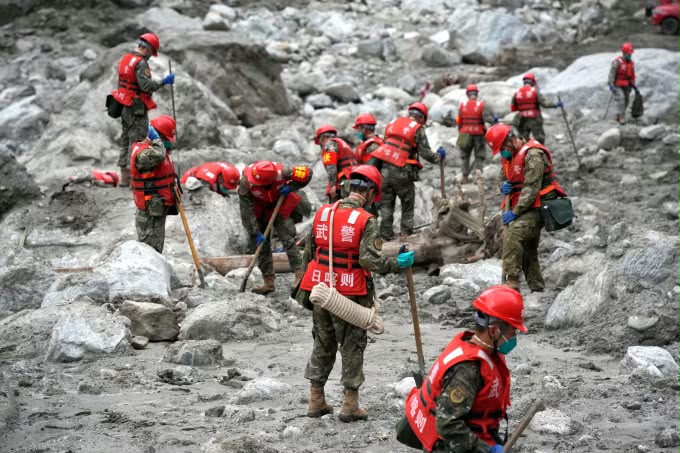
A CNN team that visited the disaster zone on Sunday observed that the once-busy trading and tourism hub had been almost completely wiped out, leaving behind rocks, mud, gravel and debris as rescue workers continued searching for victims.
The border post, located in China’s Xizang Autonomous Region, was engulfed by a huge surge of water on August 26 after a landslide triggered severe flooding that also devastated parts of neighbouring Nepal.
Surveillance footage showed people running for safety as floodwaters swept through the border facility.

Gyirong Port previously served as an important route for tourists, traders and other travellers between China and Nepal, with hundreds of people passing through the crossing each day.
However, the disaster destroyed the main five-storey border facility, along with nearby businesses, a supermarket, travel agencies and a bridge linking the two countries.
Chinese authorities said 31 people had been confirmed dead while 531 remained missing on the Chinese side of the border as of the latest update.
More than 250 foreigners were reportedly among those missing, according to local authorities in Tibet.
No survivor has so far been found at the port, which has become a major focus for families seeking information about relatives who may have been at the crossing when the floods struck.
Authorities have not publicly released a list of people who were at the port at the time of the disaster or those believed to be missing, raising concerns among some families about the pace and transparency of information coming from the affected area.
Beijing has defended its handling of the disaster, saying information has been released in a timely and transparent manner.

The Chinese Ministry of Foreign Affairs and the State Council Information Office organised a visit to the restricted disaster area for about a dozen international journalists, including CNN, as part of efforts to showcase ongoing rescue operations.
The scale of the destruction has made rescue operations extremely difficult, particularly because of the remote and mountainous location of the border crossing.
A CNN team travelled for about eight hours from Lhasa, the regional capital, to Dingri on Saturday, passing through areas with elevations reaching about 13,000 feet.
The journey from Dingri, which has the nearest airport, to Gyirong Port took another six hours.
The narrow road leading to the port runs through mountainous terrain and features numerous sharp bends. Authorities said the route was cleared only on Wednesday, seven days after the disaster, allowing thousands of rescue personnel and heavy equipment to reach the affected area.
Before the road was reopened, smaller rescue teams reportedly had to reach the area on foot, by boat or by air.
Search operations have also been repeatedly hampered by the threat of further landslides, heavy rainfall and the possible failure of temporary barrier lakes created when mud and debris blocked parts of a nearby river.
Authorities have additionally warned of possible further collapses around a glacier on Nepal’s Langtang Lirung mountain, where a section reportedly broke away and contributed to the August 26 landslide and flooding.

The disaster has raised concerns about the need for stronger monitoring and early-warning mechanisms in the mountainous region shared by China and Nepal.
Experts and authorities may increasingly focus on cross-border data sharing and coordinated warning systems as both countries confront a growing risk of extreme natural disasters.
For now, however, rescue teams remain focused on searching the devastated border area, while families of those still missing continue to await information about the fate of their loved ones.