By RismadarVoice Reporters
January 5, 2026
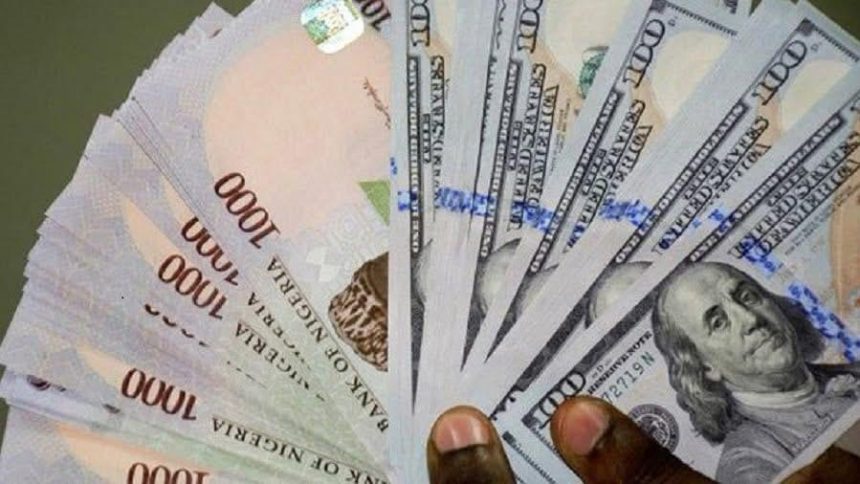
The Naira began the first trading day of the New Year on a firmer note, appreciating to N1,430.84 per dollar at the official window, supported by gains from relative stability recorded in 2025, according to data from the Central Bank of Nigeria (CBN).
In the preceding week, the currency had traded around the N1,440/$ level at the official Nigerian Foreign Exchange Market (NFEM), with stability underpinned by improved foreign exchange supply, sustained CBN interventions, and a stronger external reserve position acting as a buffer.
Over the week, the naira strengthened by N12.53 per dollar, representing an 86 basis-point week-on-week gain.
Trading ranged between N1,427.00/$ and N1,445.68/$, with appreciation recorded in three of the four trading sessions.
Analysts note that the exchange rate has remained broadly stable compared with the sharp volatility experienced in the previous year. According to Meristem Securities, while the average exchange rate in 2025 stood at N1,519.63/$, slightly weaker than N1,486.03/$ in 2024, volatility declined sharply to 0.53 per cent from 4.58 per cent, reflecting improved FX liquidity and stronger external buffers.
At the official market, the naira last traded below N1,430/$ on 31 October 2025, when it closed at N1,421.73/$.
Market stability has been largely attributed to CBN-led reforms, including the rollout of the Electronic Foreign Exchange Matching System in December 2024 and the implementation of the FX Code, which enhanced transparency, pricing efficiency, and curtailed speculative activities.
Nigeria’s external reserves rose significantly in 2025, increasing by 10.60 per cent year-to-date to $45.21 billion, from $40.9 billion at the end of 2024.
Although reserve accumulation was initially constrained by foreign debt servicing and FX market interventions in the first half of the year, it rebounded in the second half, supported by higher trade receipts, stronger capital importation, and proceeds from Eurobond issuances.
Looking ahead, analysts at Meristem project that the naira will trade within a band of N1,350.00/$ to N1,528.57/$ in 2026, citing sustained foreign inflows and a resilient external reserve position.
“The official exchange rate is expected to remain broadly stable in 2026, supported by sustained foreign inflows and a resilient external reserve position,” Meristem said.
“Planned foreign currency–denominated issuances by the Federal Government, as outlined in the MTEF, are expected to provide an additional boost to external reserves.”
The firm added that while oil receipts may remain relatively soft, gas and non-oil exports, alongside robust foreign portfolio investment (FPI) inflows, should support FX liquidity. A potentially dovish stance in advanced economies could further drive capital inflows into emerging markets such as Nigeria.
Meristem also expects the parallel market to remain relatively stable, reflecting the impact of FX reforms and enhanced oversight following the issuance of new Bureau de Change licences.
Similarly, Coronation Research projected that the naira would trade within a range of N1,400–N1,500/$ in 2026, supported by higher oil production, reduced reliance on refined fuel imports, and improved FX to attract foreign investment and consolidate stability in the foreign exchange market.