RismadarVoice Reporters
October 22, 2026
At least 16 people have been killed, and 32 others injured after a powerful magnitude-7.0 earthquake struck China’s Tibet region on Thursday, triggering emergency rescue operations and causing widespread damage to residential buildings.
Chinese state news agency Xinhua reported that the earthquake occurred at approximately 10:33 p.m. local time in Baqen County, within Nagqu City in the northern part of the Tibet Autonomous Region.
According to local emergency management authorities, 11 of the injured victims sustained serious injuries, while 21 others suffered minor injuries.
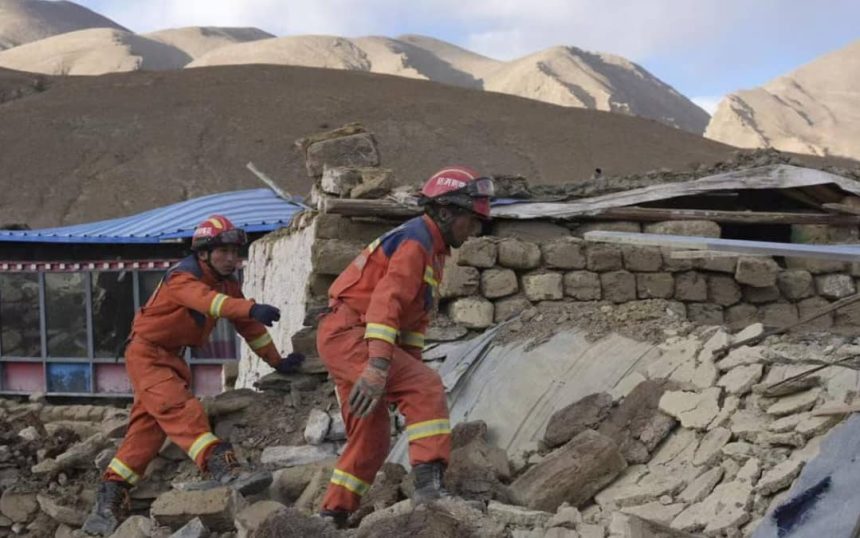
Officials also confirmed that at least 339 residential buildings collapsed following the tremor, leaving affected communities facing urgent shelter and humanitarian needs.
The United States Geological Survey located the earthquake’s epicentre approximately 190 kilometres east-northeast of Nagqu and about 390 kilometres northeast of Lhasa, Tibet’s regional capital.
Chinese seismic authorities initially reported that the earthquake occurred at a depth of 10 kilometres, making it a relatively shallow event capable of producing intense ground shaking near the epicentre.
Following the disaster, authorities activated a Level-II earthquake emergency response and deployed rescue personnel to affected communities.

Emergency workers began searching damaged buildings, assessing casualties and providing assistance to residents displaced by the disaster.
Local reports indicated that several houses near the epicentre sustained structural damage, while residents in surrounding communities rushed outdoors as the ground shook.
Videos circulated by Chinese state media showed frightened residents leaving their homes and seeking temporary shelter in open spaces and parked vehicles.
The earthquake also disrupted electricity and telecommunications services in some affected locations, complicating initial assessments and emergency coordination.
The tremor was followed by additional seismic activity, raising concerns among residents about further damage to already weakened structures.

Tibet lies within a highly active earthquake zone influenced by the collision of the Indian and Eurasian tectonic plates, which continues to generate significant seismic activity across the Himalayan region.
The latest earthquake is among the strongest recorded in China in recent years and highlights the vulnerability of remote mountainous communities to major natural disasters.
Authorities are continuing search-and-rescue operations and damage assessments, while the casualty figures could change as emergency teams reach more affected settlements.