RismadarVoice Reporters
September 20, 2026
Survivors of devastating floods and mudslides in Nepal are returning to communities where homes, businesses and entire neighbourhoods have been buried or swept away, as authorities continue searching for thousands of people reported missing.
At least 1,386 people have been confirmed dead on the Nepalese side of the disaster, while authorities say about 5,130 others remain missing.
The floods, which struck last month, were triggered by a glacial collapse in mountainous territory along the Nepal-China border, sending large quantities of water, mud and debris through settlements along the Trishuli River.
Search operations are continuing, although authorities have reported no survivors found in recent days.
Thousands of residents have been displaced, with temporary shelters established for families unable to return to their communities.
Betrawati, a riverside settlement in Nuwakot district, was among the communities severely affected.

Anusa Thapa Magar, 23, returned from her job in the Maldives after learning about the disaster, hoping to find her grandmother alive.
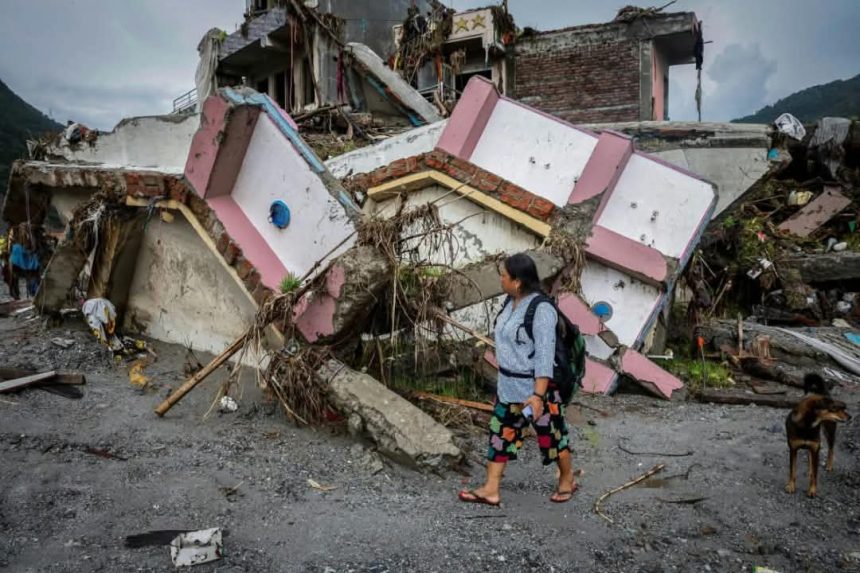
Instead, she returned to discover that the family’s two-storey home and much of the surrounding community had disappeared beneath hardened mud and debris.
“If my house is buried underneath, that means my Aama is still here underneath too, right?” she said while standing near the location where the family home once stood.
Her grandmother, who had difficulty walking, remains missing.
Other survivors described fleeing after receiving warnings that floodwaters were approaching.
Garment business owner Kalpana Thapa Magar, 43, said she received a telephone call from a friend upstream warning her to run.
“Run! Run!” she recalled being told.
“I just ran. When I looked back, everything was gone, even the people who had been running behind me,” she said.
Downstream in Devighat, residents have continued searching damaged properties for belongings, while others say the scale of destruction has left them uncertain whether rebuilding in their former communities will be possible.
For some survivors, the disaster has revived memories of Nepal’s devastating 2015 earthquake, which killed nearly 9,000 people.
Teacher Sita Thapa Magar, 45, said the difference this time was that some families had lost not only their houses but also the land on which they once lived.
“This time, we have lost everything,” she said. “Our houses, our land, our future.”
Another survivor, 61-year-old Shanti Dangol, returned to the location where she once operated a three-storey lodge serving pilgrims and trekkers.
She described Betrawati as a community that had experienced growing prosperity in recent years, with residents investing in larger homes, rental accommodation and their children’s education.
“Economically, people here had started doing well,” she said. “Now, nothing remains.”
SURVIVORS FACE UNCERTAIN FUTURE
Across the affected districts, the emergency has moved beyond the immediate destruction to a growing humanitarian challenge involving shelter, food, healthcare and the restoration of livelihoods.
Families who once depended on small businesses, farming, tourism and daily labour are confronting an uncertain future after losing homes, land and sources of income. For those whose relatives remain missing, the struggle to rebuild is unfolding alongside continued uncertainty over the fate of loved ones.

Temporary shelters are providing immediate refuge for some displaced residents, but the scale of the destruction means recovery is likely to extend far beyond emergency relief.
Rebuilding will require not only houses and public infrastructure, but also support for families whose economic foundations have been swept away and communities where residents say the land itself has been transformed.
For survivors in Betrawati, Devighat and other devastated settlements, the humanitarian challenge is therefore not simply returning home. For many, there may be no home to return to.
As search operations continue, thousands of families are left confronting the same difficult questions: where they will live, how they will rebuild their livelihoods, and whether communities that existed along the Trishuli River before the floods can ever be restored.