


RismadarVoice Reporters
September 18, 2026
Russia has sharply increased the use of repurposed training missiles in attacks on Ukraine, allowing Moscow to expand its aerial campaign while conserving stocks of its more advanced ballistic weapons, according to Ukrainian military and prosecutorial data.
The missiles, known as RM48Us, were originally designed as targets for air-defence training but have increasingly been adapted for offensive operations.
Ukrainian data showed RM48Us accounted for more than half of 228 ballistic and hypersonic missiles recorded in July and the first eight days of August.

The increased deployment comes as Ukraine faces pressure on its air-defence capabilities, particularly supplies of Patriot interceptors used against ballistic missile threats.
Russia’s Defence Ministry has not publicly provided details about its use of RM48Us in Ukraine. Moscow maintains that its attacks are directed at military and related infrastructure and denies deliberately targeting civilians.

TRAINING MISSILES TAKE BIGGER ROLE
RM48Us are launched from Russia’s S-400 air-defence systems and travel on a ballistic trajectory at high speed, according to Ukrainian authorities.
However, Ukrainian investigators say they are less accurate than Russia’s Iskander short-range ballistic missiles.
Official Ukrainian figures recorded 158 ballistic and hypersonic strikes in July, including 87 involving RM48Us.
Another 70 ballistic and hypersonic strikes were recorded during the first eight days of August, with 36 involving the repurposed missiles.

As RM48U use increased in July, the number of Iskanders fired reportedly fell to 38 from more than 100 the previous month.
Sidharth Kaushal, a senior research fellow at the Royal United Services Institute, said the strategy could allow Russia to preserve more capable weapons, including Iskanders, KN-23s and Zircons, for future operations.
It could also force Ukraine to expend scarce air-defence interceptors against a larger number of incoming threats.

UKRAINE LINKS MISSILES TO DEADLY STRIKES
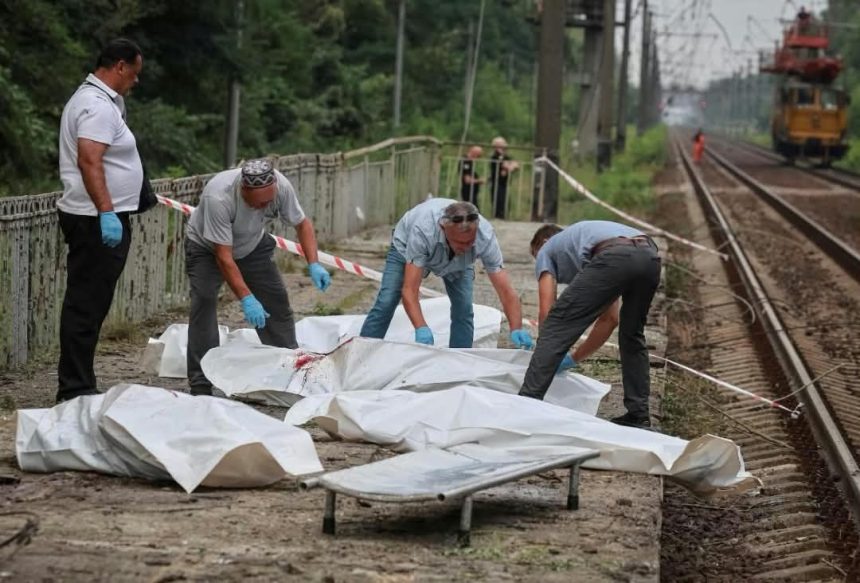
Ukrainian investigators have linked RM48Us to several recent attacks, including an August 5 strike near a railway station in the Brovary district outside Kyiv where eight people were reported killed.
Investigators said forensic examination of the site indicated an RM48U was involved. The findings have not been independently confirmed.
Russia said its operation in the area targeted a logistics facility allegedly used to store drone components.
Ukrainian military experts estimate that RM48Us can deviate from their intended targets by about 300 metres on average, making them less precise than weapons designed specifically for conventional strikes.
The United Nations recorded at least 437 civilian deaths in Ukraine in July, its highest monthly figure since the early stages of Russia’s full-scale invasion in 2022, with missile and drone attacks identified as a major factor.

RUSSIA BUILDS STOCKS AS UKRAINE SEEKS PATRIOTS
The Institute for the Study of War estimated last month that Russia had about 400 RM48Us and 100 Iskander missiles available.
Ukraine’s military intelligence also says Russia intends to increase RM48U production to about 480 missiles this year, compared with 200 in 2025.
Kaushal estimates Russia is capable of producing about 750 Iskander missiles annually, although manufacturing constraints mean Moscow has an incentive to conserve them.
Ukraine, meanwhile, has continued pressing the United States and other allies for additional Patriot systems and interceptors.
Demand for the weapons has increased internationally, complicating efforts to replenish Ukrainian stocks.

The United States says it is balancing its own strategic requirements and those of allies while expanding weapons production and examining possible future defence-industrial cooperation with Ukraine.
The growing use of RM48Us highlights a shift in Russia’s air campaign towards combining larger numbers of lower-value missiles with its more sophisticated weapons, as both sides increasingly rely on long-range strikes alongside fighting on the ground.