


RismadarVoice Reporters
September 15, 2026
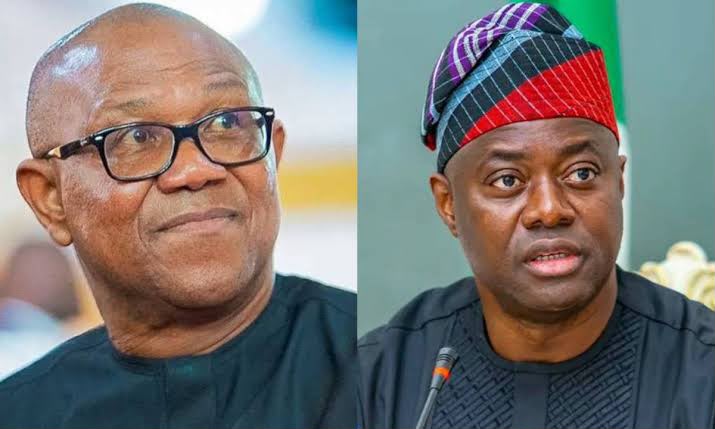
The emerging political rapprochement between National Democratic Congress presidential candidate Peter Obi and Oyo State Governor Seyi Makinde has renewed speculation over the possibility of a broad opposition coalition ahead of Nigeria’s 2027 presidential election.
The two politicians, who pursued different political paths during the 2023 election, have recently appeared together at a series of engagements, including a private meeting in Ibadan and the inauguration of Makinde’s Allied People’s Movement presidential campaign office in Abuja.
Makinde is seeking the presidency in 2027 on the APM platform, while Obi remains a major opposition figure with a substantial political following.

Obi’s decision to attend the inauguration of Makinde’s campaign office has attracted particular attention because presidential aspirants traditionally campaign against one another during election periods rather than participate in events associated with a potential rival.
The development has also coincided with renewed activities by the G-100, a group of opposition stakeholders advocating the creation of a united political front ahead of the 2027 election.
Sources close to the two political camps reportedly said their discussions have centred on national interest, governance and the political calculations surrounding the next presidential election.
Although neither politician has publicly confirmed a formal alliance, their recent interactions have raised questions about whether the consultations could eventually develop into a wider opposition arrangement.
FROM 2023 RIVALS TO POSSIBLE PARTNERS
The political histories of Obi and Makinde provide an important context to their current engagement.
During the 2023 election, Makinde, then a prominent member of the Peoples Democratic Party, was one of the G-5 governors who opposed the party’s presidential candidate, Atiku Abubakar.

The disagreement within the PDP contributed to divisions within the opposition party ahead of the election.
Obi, meanwhile, contested the presidential election on the Labour Party platform and emerged as a major third-force candidate, drawing significant support, particularly among younger Nigerians and voters seeking an alternative to the APC and PDP.
Their political trajectories consequently remained largely separate.
The approach of the 2027 election, however, appears to have altered some of those calculations, with opposition figures increasingly exploring possible areas of cooperation in an effort to avoid another fragmented contest.
Makinde has increasingly positioned himself as an independent political voice while criticising some policies of the Federal Government and advocating greater cooperation among opposition forces.
His departure from the PDP amid the party’s internal crisis and his decision to pursue his presidential ambition on the APM platform have further complicated the political realignment.

Obi, for his part, remains central to discussions about the opposition’s prospects, largely because of the support base associated with the Obidient movement.
The emerging question is whether an understanding between Obi and Makinde could become part of a much broader arrangement involving elements of the PDP, Labour Party, New Nigeria Peoples Party, African Democratic Congress and other opposition groups.
Both men have reportedly played down suggestions that their meetings amount to a formal alliance, describing their interactions as consultations among political actors concerned about the country’s future.
Whether those consultations will produce a coordinated political structure remains uncertain.
INCUMBENCY ADVANTAGE
Any opposition coalition seeking to challenge President Bola Tinubu and the All Progressives Congress would have to overcome the considerable advantage associated with incumbency.
The APC controls the Federal Government and maintains extensive political and grassroots structures across the country.
The Tinubu administration is also expected to campaign on its Renewed Hope Agenda, highlighting economic reforms and infrastructure projects as evidence of progress.

Foreign exchange reforms, student loan initiatives, infrastructure development, the CrediCorp programme and the Compressed Natural Gas initiative are among the policies likely to feature prominently in the ruling party’s campaign.
The Federal Government is expected to argue that its reforms are designed to stabilise the economy and create the conditions for long-term growth, while improvements in inflation, exchange-rate stability and infrastructure delivery could become important campaign messages.
The opposition, however, is likely to focus on the immediate impact of the reforms on households, particularly the cost of food, transportation, electricity and other essential goods and services.
LESSONS FROM 2015
Another major consideration for opposition strategists is Nigeria’s political history.
Former President Goodluck Jonathan remains the only sitting Nigerian president to have lost a re-election bid. His defeat in 2015 followed the emergence of a broad opposition alliance that brought several political forces together under the APC.

The 2015 experience is therefore likely to remain a reference point for opposition politicians attempting to build a coalition ahead of 2027.
The challenge, however, is determining whether the political circumstances that enabled the 2015 alliance can be replicated.
The APC currently controls a significant number of states and has an extensive grassroots network. The ruling party could also benefit from support or cooperation from governors outside its structure.
Among the governors mentioned in the emerging political calculations are Anambra State Governor Chukwuma Soludo of the All Progressives Grand Alliance, Abia State Governor Alex Otti of the Labour Party and Osun State Governor Ademola Adeleke of the Accord Party.
While governors alone cannot determine the outcome of a presidential election, their political influence, party structures and grassroots networks can play a significant role in mobilisation.

THE ANTI-APC VOTE
Opposition strategists are expected to place considerable emphasis on the argument that the anti-APC vote was divided among several presidential candidates in 2023.
The proposed calculation is that bringing together the support bases associated with Atiku, Obi, Kwankwaso, Makinde and other opposition figures could create a stronger electoral challenge to Tinubu.
But translating those separate political constituencies into a single electoral bloc would present significant difficulties.
The major opposition figures have their own political ambitions, support bases and organisational structures. Convincing them to surrender or modify individual ambitions in favour of a consensus candidate could prove difficult.
A viable coalition would have to resolve at least four major issues: competing ambitions, zoning, organisational structure and trust.

ZONING AND PRESIDENTIAL AMBITIONS
The question of zoning is expected to be particularly sensitive.
Political interests in both the North and South have different expectations regarding where the presidency should be located in 2027.
Some Southern interests argue that the region should retain the presidency after the current administration, while Northern political interests may contend that the region should begin positioning itself for the presidency, particularly ahead of 2031.
A coalition that fails to address these competing expectations could face resistance before the election campaign gains momentum.
The choice of presidential and vice-presidential candidates would therefore require extensive negotiations involving regional, religious, political and demographic considerations.
A possible one-term arrangement could also become part of the negotiations, although such an arrangement could generate concerns among political actors seeking longer-term opportunities.
TRUST AND GRASSROOTS STRUCTURE
Beyond zoning and individual ambition, trust among the various opposition camps could ultimately determine whether a coalition succeeds.
The PDP and Labour Party were major competitors during the 2023 election, while other opposition groups also pursued separate political strategies.
Bringing their structures together at the state, local government and ward levels would require extensive negotiations.
A coalition announced at the national level would have limited electoral value if its component parties could not cooperate effectively at the grassroots.
This makes the emerging relationship between Obi and Makinde potentially significant.
If the two politicians can agree on a workable framework and attract other governors, political leaders and influential opposition figures, their cooperation could become the nucleus of a broader alliance.
If they fail to translate their engagement into a practical political structure, however, their recent public appearances may remain largely symbolic.
COST OF LIVING, SECURITY MAY SHAPE 2027
Beyond political alliances, issues affecting ordinary Nigerians are expected to have a significant influence on the 2027 election.
The cost of living is likely to remain one of the central issues.
If food, transportation, electricity and other essential costs remain high as the election approaches, opposition parties could make economic hardship a major campaign theme.
Security is another potentially decisive issue.
Any deterioration in the security situation, particularly in the North and Middle Belt, could become a major point of attack against the Federal Government.
The APC, in response, would be expected to emphasise its security measures, economic policies and infrastructure investments while arguing that reforms require time to deliver their full benefits.
COALITION TALKS REMAIN OPEN
For an opposition alliance to mount a credible national challenge, political unity would have to extend beyond presidential-level consultationnnnns.
A consensus candidate would need to emerge early enough to give the coalition sufficient time to build a nationwide campaign organisation.
The alliance would also need a clear structure for coordinating state-level campaigns, sharing responsibilities, mobilising voters and managing competing interests among participating parties.
The backing of a substantial number of governors and influential political leaders could further strengthen such an arrangement.
Without these elements, the opposition risks repeating the fragmentation that characterised the 2023 contest, potentially allowing the APC to retain its advantage.
The Obi-Makinde rapprochement should therefore not yet be interpreted as a fully established opposition coalition.
Rather, it could signal a growing recognition among opposition leaders that political fragmentation may weaken their prospects of defeating an incumbent administration.
Whether the current consultations eventually produce a formidable alliance will depend largely on the willingness of the major actors to compromise on individual ambitions and agree on a common political strategy.
For now, the political landscape remains fluid. The meetings and public appearances involving Obi and Makinde have added a new dimension to opposition calculations, but the extent to which that relationship can develop into a broader national coalition will become clearer as the 2027 election approaches.