RismadarVoice Reporters
September 14, 2026
Russia and Ukraine are rapidly expanding the use of artificial intelligence on the battlefield, with both sides developing increasingly autonomous systems capable of identifying and attacking targets with limited human intervention.
The growing role of AI in the conflict has raised fresh concerns about the future of warfare, particularly over whether machines could eventually make life-and-death decisions without direct human control.
The risks were highlighted in July when 18-year-old Ukrainian student Tetiana Bubynets was killed in Zaporizhzhia after a Russian drone struck a gas station.
Bubynets collapsed following the explosion and was taken to hospital, where she was pronounced dead alongside two other civilians.

According to an analysis by The New York Times, the strike was the first documented case of Russia deploying a fully autonomous attack drone using artificial intelligence.
Ukrainian officials examining the wreckage reportedly discovered that the drone contained a commercially available Nvidia-powered computer capable of helping it identify and engage a pre-programmed target.
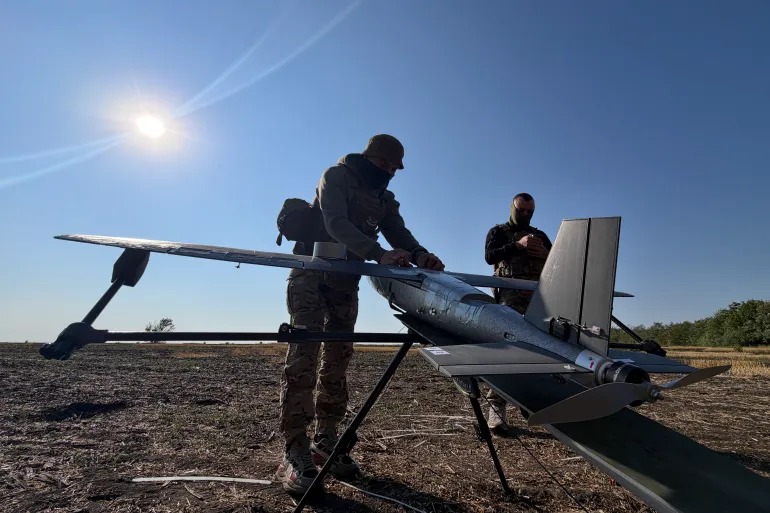
The development illustrates how AI-enabled drones are becoming part of a much broader military transformation involving battlefield surveillance, targeting and weapons coordination.
Military analysts say the emerging technology is not simply about individual drones being equipped with artificial intelligence.
Instead, Russia and Ukraine are building integrated battlefield systems that can collect information from drones and other military equipment, process the data and rapidly transmit targeting information to weapons units.

Marina Miron, a defence studies researcher at King’s College London, described the emerging model as a reconnaissance-strike architecture.
Such systems can combine information from multiple sensors, map enemy positions and coordinate military responses, potentially reducing the time between detecting a target and attacking it from hours or minutes to significantly less.
Ukraine has been developing its DELTA battlefield management system, while Russia has deployed the Svod Tactical Situational Awareness Complex to some frontline units.
The systems are reportedly designed to provide commanders with possible courses of action while retaining a human role in the final decision.
However, experts warn that the extent of human control is difficult to independently verify.
Miron said the use of AI in high-pressure combat situations could also influence commanders to follow machine-generated recommendations, even when humans technically retain the authority to make the final decision.

Ukraine’s Ministry of Defence adviser on loitering munitions, Serhiy Beskrestnov, has predicted that future combat systems will eventually make navigation, target identification and attacks largely autonomous.
Drones with limited autonomous capabilities are already being used extensively, particularly during the final stage of long-range missions.
Heorhii Volkov, commander of Ukraine’s Yasni Ochi drone unit, said AI can take over when drones lose communication with their operators because of electronic warfare or limitations associated with long-distance flight.
In such situations, an onboard AI system can assume control, locate the intended target and complete the mission without a continuous connection to the human operator.
Yaroslav Azhnyuk, founder of Ukrainian technology firm The Fourth Law, said the competition between Moscow and Kyiv was no longer simply about producing an autonomous drone.
He said the bigger challenge was developing systems that were reliable, affordable and capable of being deployed on a massive scale.

According to Azhnyuk, electronic warfare, longer engagement distances and the rapidly growing number of drones are making conventional human-operated systems increasingly inadequate.
He predicted that autonomy could become a decisive factor on the battlefield within the next six to 12 months, arguing that the advantage would go to whichever side could successfully deploy reliable autonomous technology across hundreds of thousands of systems.
Despite the potential military advantages, experts have warned about the serious risks associated with delegating targeting decisions to algorithms.
Kateryna Bondar, a senior fellow at the Centre for Strategic and International Studies’ Wadhwani AI Centre, said AI systems do not understand the consequences of their actions but simply follow the rules and data with which they have been programmed.
Teaching an AI system to differentiate between military equipment can be relatively straightforward, she noted, but distinguishing between civilians and combatants is considerably more difficult.
The challenge is further complicated by the poor-quality cameras often used on inexpensive first-person-view drones, whose performance can deteriorate under difficult weather and atmospheric conditions.

Bondar warned that autonomous weapons could therefore make errors in distinguishing civilians from combatants, raising difficult questions about accountability.
As Russia and Ukraine continue to develop and deploy AI-powered weapons, the conflict is increasingly becoming a testing ground for autonomous warfare and intensifying debate over how much control humans should retain when machines are making decisions on the battlefield.