

RismadarVoice Reporters
September 13, 2026
Niger’s military government has reshuffled its top army command, appointing a new head of the armed forces weeks after a failed mutiny that exposed tensions within the country’s military establishment.
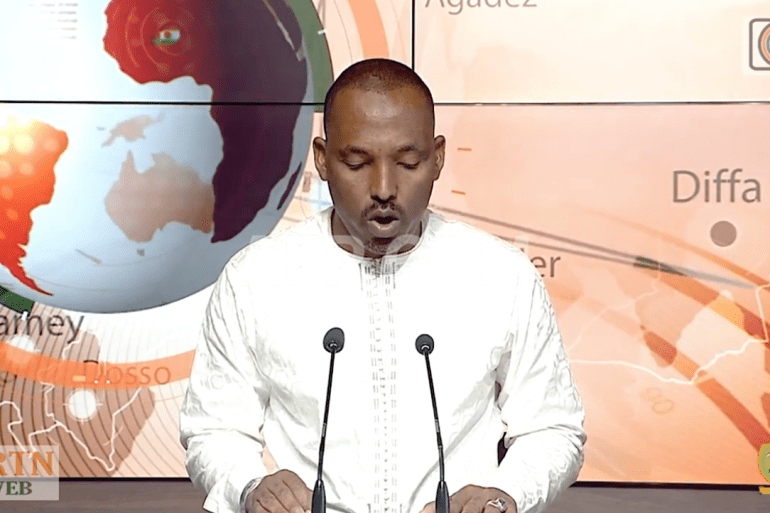
A decree read on Niger’s state television announced that General Mamane Sani Kiaou, who previously served as army chief of staff, had been appointed head of the armed forces, replacing General Moussa Salaou Barmou.
The decree did not provide a reason for Barmou’s removal, although the change comes less than three weeks after a serious military mutiny that involved fighting around strategic installations in the capital, Niamey.
General Abdourahmane Abou Zataka has been appointed to succeed Kiaou as army chief of staff.

Regional broadcaster RFI also reported that General Ismael K Sidi Omar had been named deputy chief of the general staff. Sidi Omar previously commanded Base 101, the airport military base that became one of the main centres of the mutiny, and was reported to have remained loyal to military leader General Abdourahamane Tchiani throughout the crisis.
The mutiny began on August 28 and lasted for almost 24 hours, with clashes reported around the presidential palace, Niamey’s international airport and a nearby military installation.
According to Niger’s Defence Ministry, mostly young soldiers took fellow servicemen hostage and opened fire at several sensitive military and government locations.
The military government subsequently received assistance from Russia’s Africa Corps, a state-backed force that has taken over many of the roles previously associated with the Wagner mercenary organisation in parts of Africa. The Russian force reportedly provided both ground and air support during the crisis.
Dozens of mutineers were reportedly killed or arrested, while three members of the presidential guard were also killed or detained. The Nigerien authorities have not released a comprehensive death toll or provided details of the charges facing the detained soldiers.
The attempted uprising represented a significant challenge to the military government, which has been in power since a coup in July 2023. General Tchiani and his fellow officers seized power from elected President Mohamed Bazoum, accusing his administration of failing to contain armed violence and insecurity.
Analysts and diplomats cited by international media said the mutiny appeared to have been driven partly by dissatisfaction among soldiers over deteriorating security conditions and worsening attacks by armed groups, as well as complaints about conditions within the military.
The government has sought to restore discipline and unity within the armed forces following the incident. Kiaou, the newly appointed military chief, had recently completed a tour of major military garrisons across the country, state media reported, as part of efforts to strengthen cohesion among troops.
Kiaou is regarded as an experienced field commander, having led military operations against armed groups in the western Tillabéri region and southeastern Diffa region. He also played a role in negotiations surrounding the withdrawal of French and United States troops from Niger following the 2023 coup.

The leadership changes come as Niger continues to face a deteriorating security situation despite its military government’s decision to abandon longstanding military partnerships with Western powers and deepen security ties with Russia.
Since taking power, the military government has severed military cooperation with France and the United States while strengthening relations with Moscow and relying increasingly on Russian-backed security support.
The authorities have also accused France of being involved in the August mutiny, but the French government has rejected the allegation, describing it as unfounded.
The latest reshuffle is therefore expected to be closely watched as the Tchiani administration attempts to consolidate control over the armed forces, address internal grievances and prevent another challenge to its authority.
The changes also underscore the continuing pressure on Niger’s military rulers as they confront armed groups in several parts of the country while seeking to maintain cohesion within a military that has governed the country since the 2023 coup.