RismadarVoice Reporters
September 7, 2026
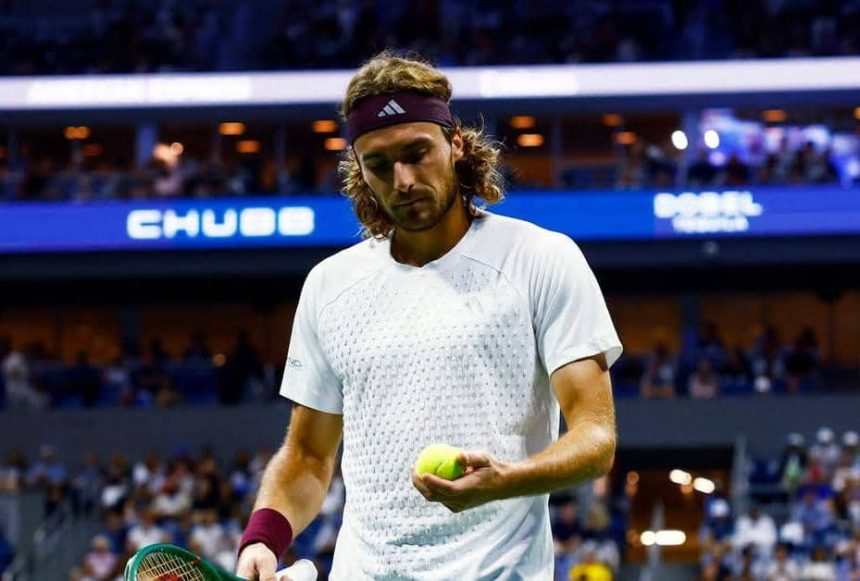
Greek tennis star Stefanos Tsitsipas has expressed disappointment over the decline of the one-handed backhand in modern tennis after the stroke disappeared from the men’s singles draw at the US Open for the first time in 149 years.
The development came after American player Ben Shelton defeated Tsitsipas in the fourth round of the tournament on Sunday, leaving no player using a one-handed backhand among the remaining men’s singles competitors.
The one-handed backhand, once considered one of tennis’ most elegant and technically demanding shots, has gradually declined as players have increasingly adopted the two-handed backhand, which is viewed as better suited to the speed and power of the modern game.

At least one player with a one-handed backhand had reached the men’s singles semi-finals at a Grand Slam tournament every year since Wimbledon in 1877, a run that ended at Flushing Meadows this year.
Several tennis legends, including Roger Federer, Stan Wawrinka, John McEnroe, Ivan Lendl, Pete Sampras, Stefan Edberg and Gustavo Kuerten, helped maintain the popularity of the shot over previous decades.
Shelton’s victory over Tsitsipas followed his earlier defeat of another one-handed backhand player, Canada’s Denis Shapovalov, in the third round of the tournament.
Speaking after his 6-2, 6-3, 6-4 defeat, Tsitsipas highlighted how dramatically the playing style has changed, noting that the one-handed backhand was once widely used but has now become rare among professional players.
“In the 1950s, I think 97% or 98% of players were playing one-handed backhands. It’s literally like 2% or 3% now,” Tsitsipas said.
He described the shot as a traditional and classic part of tennis, but acknowledged that the sport would continue despite its decline.
Tsitsipas also argued that the reduction of one-handed backhand players reflected a broader narrowing of playing styles in modern tennis.

He said the sport previously featured a wider variety of approaches, including serve-and-volley players, defensive specialists and counter-punchers, while today’s game has become more focused on a similar power-based style.
“The variation has narrowed to one particular style of game these days,” Tsitsipas said, adding that different playing techniques had previously made tennis more unpredictable and entertaining.
The US Open result marked a significant moment in tennis history, highlighting the continued evolution of the sport and the changing techniques used by the next generation of players.