RismadarVoice Reporters
September 13, 2026
The late King Oyo Nyimba Kabamba Iguru Rukidi IV of Uganda’s Tooro Kingdom was buried on Saturday amid an unresolved dispute over who should succeed the 34-year-old monarch, whose death has triggered an unusual challenge to the kingdom’s traditional succession process.
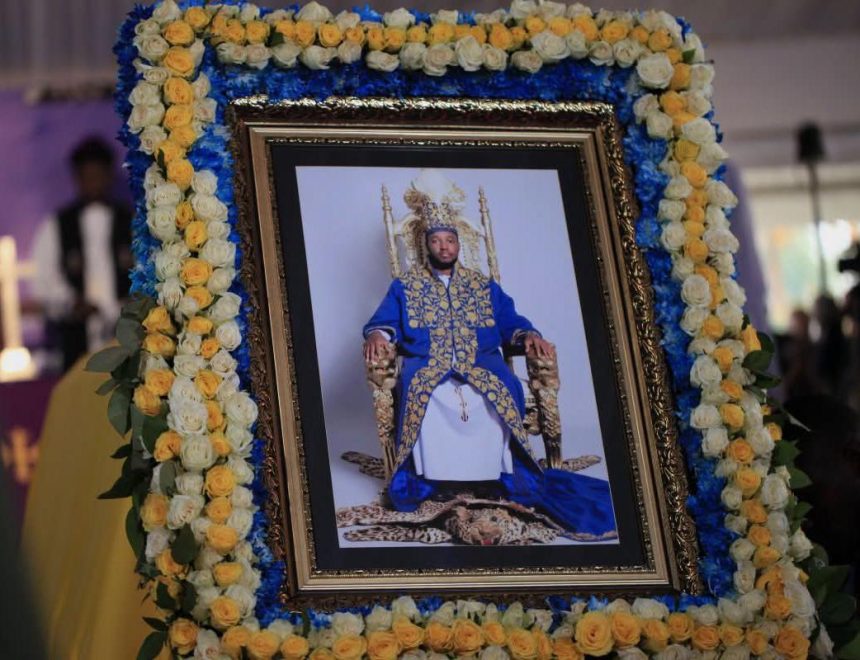
Oyo was laid to rest at the Karambi Royal Tombs in Fort Portal, western Uganda, after nine days of mourning following his death in the United States on August 27 while undergoing cancer treatment.
During the burial ceremony, Prince Edward Rukidi Kijanangoma, a 56-year-old news anchor and editor with Uganda Broadcasting Corporation, formally assumed the traditional leadership role after having been selected by members of the royal Babiito clan.
As part of the traditional handover ceremony, Kijanangoma cast nine coffee berries into Oyo’s grave, a ritual symbolising the transfer of royal authority.
However, the succession remains contested by members of Oyo’s immediate family, who maintain that the late king left behind a son who was named in his 2022 will as his heir.

DISPUTE OVER KING’S ALLEGED SON
Oyo never married and was not publicly known to have children during his lifetime.
Following his death, however, Tooro Kingdom Prime Minister Calvin Armstrong Rwomiire Akiiki announced that the king had left a son and said the child’s identity would be disclosed at an appropriate time.
The child has not publicly been identified.
Oyo’s mother, Queen Mother Best Kemigisa, and his sister, Princess Ruth Komuntale, have rejected the selection of Kijanangoma, arguing that the late king’s will identified a son as his legally recognised biological heir.
According to the family, the 2022 document named the child as Oyo’s lawful biological son and expressed his wish that the boy succeed him on the Tooro throne.
Babiito clan elders, however, have rejected the argument that the will automatically determines succession. They maintain that the alleged son was never formally introduced through the customary process required by the kingdom.
The elders subsequently backed Kijanangoma as successor.
Reverend Father Charles Oyo, a Babiito clan elder, said the will represented the late king’s wishes but did not by itself determine who should occupy the throne.
Princess Komuntale has accused the elders of attempting to take control of the succession process, while insisting that she would continue to defend what she believes was her brother’s wish.
The disagreement has divided members of the royal family and the wider kingdom, prompting the Ugandan government to participate in discussions aimed at resolving the dispute before the burial.

A KING WHO ASCENDED THE THRONE AT THREE
Oyo’s own rise to the throne was extraordinary. He became king in 1995 at the age of three following the death of his father, Patrick David Matthew Kaboyo Olimi III.
His accession made him widely recognised as the world’s youngest reigning monarch at the time.
Because of his age, Oyo was initially guided by regents and received much of his early education at home, with the royal palace serving as his classroom.
Those who knew him as a child described him as friendly and compassionate. Childhood friend and radio journalist Martin Odong recalled that Oyo would interrupt football games to check on injured players, regardless of which side they belonged to.
His passion for football continued into adulthood, when he supported local sporting competitions, including the Tooro Kingdom MTN Masaza Cup.
His death came as he was preparing to mark Empango, the anniversary of his coronation, with his people. He had reportedly hoped to return to Uganda for the celebration but died before he could do so.
At a requiem Mass at St John’s Cathedral in Fort Portal, Queen Mother Kemigisa described her son as a protective figure who had consistently stood by her.
Princess Komuntale similarly remembered him as a humorous and caring younger brother who remained close to her and their mother throughout his life.
CULTURAL INFLUENCE WITHOUT POLITICAL POWER
The succession dispute concerns a traditional institution that has no formal political authority under Uganda’s constitutional system.
Uganda abolished its traditional kingdoms in 1967 before restoring them in 1993 under President Yoweri Museveni.
Although traditional kings do not exercise governmental power, the kingdoms retain substantial cultural influence and continue to command loyalty among communities associated with them.

Oyo used his position to promote environmental conservation, health awareness and development projects.
In 2020, he climbed the Rwenzori Mountains to highlight the effects of climate change and the retreat of glaciers. He also supported a campaign to plant 10 million trees across Tooro over five years.
He participated in cancer-awareness activities and promoted healthy living, while also supporting plans for a paediatric hospital in Kyenjojo district.
Before his death, Oyo had reportedly allocated land and begun fundraising for the proposed hospital. Clan elders have since called for government support to complete the project and have also proposed a specialised cancer facility and an international stadium in his memory.
PRIVATE BATTLE WITH CANCER
Oyo’s illness was largely kept away from public attention at his request.
His sister said he began experiencing pain around his back and rib cage in 2025. The family initially believed the symptoms could be related to strenuous physical activity or ulcers.

He later travelled to Kenya, where he was diagnosed with angiosarcoma, an aggressive form of cancer. He subsequently received treatment in Germany before travelling to the United States, where he died on August 27 at the age of 34.
Komuntale said the family respected his wish to keep his illness private.
His death brought thousands of mourners to Fort Portal, where his coffin was taken through the city before the burial at the Karambi Royal Tombs.
While the funeral marked the end of the official mourning period, the question of who will ultimately be recognised as Oyo’s legitimate successor remains unresolved.
The competing claims between the royal family and the Babiito clan have left the Tooro Kingdom facing a rare succession dispute, with the alleged son’s identity, customary recognition and the legal and traditional weight of Oyo’s will likely to remain central to the debate over the future of the throne.