


RismadarVoice Reporters
June 8, 2026
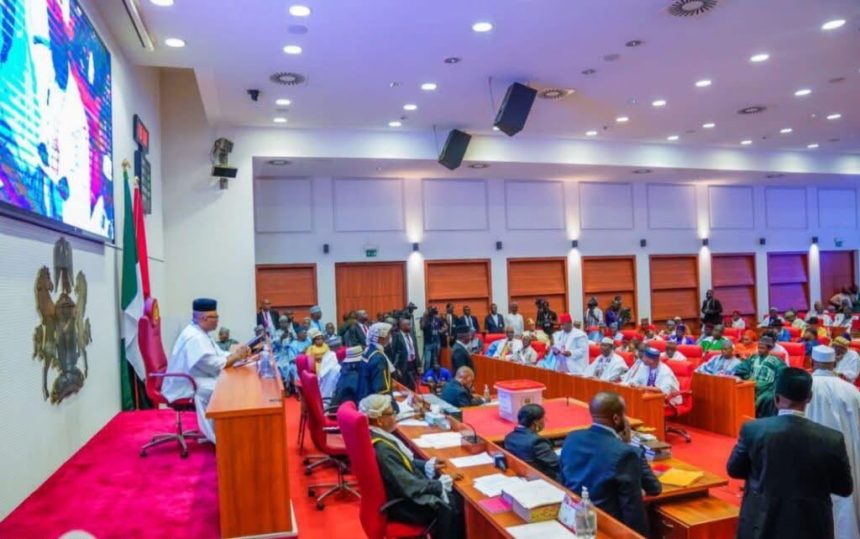
The Senate has scheduled deliberations on constitutional amendments to establish state police in Nigeria for this legislative week, with lawmakers indicating that the proposal will be transmitted to state Houses of Assembly for approval once passed.
Senate Leader, Senator Opeyemi Bamidele, disclosed this in a statement issued on Monday, noting that stakeholders across the federation now broadly support the creation of state-level policing structures.
According to him, the National Assembly has decided to separate the state police provision from other constitutional amendment proposals due to its urgency.

He said the leadership of the Senate and House of Representatives had concluded consultations with key stakeholders, including the Attorney-General of the Federation, the Presidency, security chiefs, and the Inspector-General of Police, ahead of the planned passage.
Bamidele expressed confidence that the bill would be passed within the week, adding that both President Bola Tinubu and state governors were supportive of the reform.
“Our position is very clear on state police… All strata of the federation have made it clear that there cannot be a better time to establish state police than now,” he said.
He explained that once approved by the National Assembly, the bill would be sent to the 36 State Houses of Assembly, where it must be ratified by at least two-thirds before it can be transmitted to the President for assent.
The proposed reform seeks to amend Section 214(1) of the 1999 Constitution, which currently establishes a single centralised police force and does not allow for state or local government policing structures.

Supporters of the bill argue that state police would improve response to security challenges such as banditry, kidnapping and insurgency by allowing locally grounded enforcement.
However, concerns persist over the risk of political abuse by state governments if adequate safeguards are not put in place.
The proposal remains one of the most consequential security-related constitutional reforms currently under consideration in Nigeria’s National Assembly.