By Micah Jonah, February 27, 2026
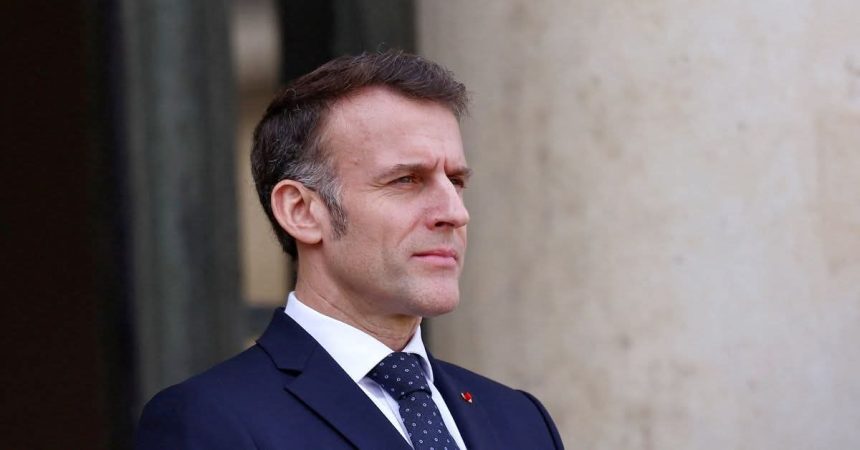
French President, Emmanuel Macron is set to update France’s nuclear doctrine on Monday as European allies question the reliability of the United States’ nuclear umbrella under President Donald Trump.
Macron will rule out any shared European control of France’s nuclear weapons but is expected to clarify what Paris can offer allies amid growing unease over Washington’s commitment to transatlantic security.
Although France and Britain are nuclear powers, most European countries depend largely on the United States for deterrence. Concerns have intensified following Trump’s rapprochement with Russia over the Ukraine war and his tougher stance toward traditional allies, including threats aimed at Greenland, an autonomous territory of NATO member Denmark.
Earlier this month in Munich, German Chancellor, Friedrich Merz confirmed that Berlin had opened discussions with France on the possibility of a European nuclear deterrent. Other European states, including Nordic countries traditionally aligned with Washington, have also shown cautious interest.
However, questions remain over France’s capacity to extend protection across the continent. European officials have privately raised concerns about cost-sharing, decision-making authority, and whether an expanded nuclear focus could divert resources from urgently needed conventional military capabilities.
France spends about 5.6 billion euros annually to maintain its arsenal of roughly 290 submarine- and air-launched nuclear weapons, making it the world’s fourth-largest nuclear power. As part of NATO’s nuclear sharing arrangement, the United States stations about 100 nuclear bombs across several European countries, including Germany, Belgium, Italy, the Netherlands and Turkey.
French officials insist Paris does not seek to replace the U.S. nuclear umbrella or compete with NATO. They emphasise that France’s doctrine is based on maintaining a minimal yet credible arsenal designed to inflict unacceptable damage on any aggressor.
A key element of France’s posture is “strategic ambiguity” over when nuclear weapons could be used and how French vital interests align with broader European defence. However, some eastern European diplomats say they want clearer assurances on the credibility of France’s deterrent.
Macron is expected to deliver the doctrine update at France’s nuclear submarine base in Brittany, marking his once-per-term presidential review of nuclear policy. Officials say the strategic environment has shifted significantly since his last address in 2020, pointing to Russia’s expanding arsenal and heightened nuclear rhetoric since its 2022 invasion of Ukraine.
Despite ongoing discussions, French authorities maintain that only the French president has the authority to order a nuclear strike a principle they say will remain unchanged.