RismadarVoice Reporters
October 21, 2026
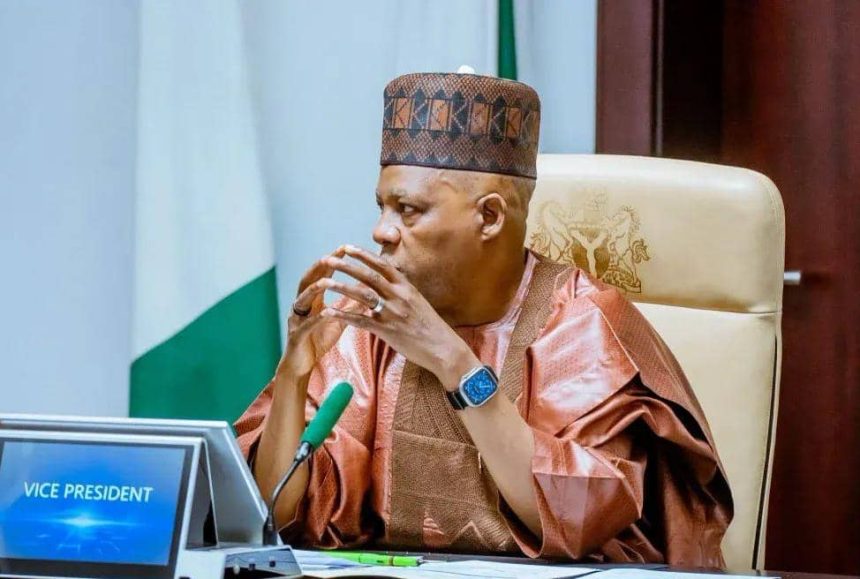
Vice President Kashim Shettima has urged state governments to take responsibility for addressing electricity supply challenges within their territories instead of depending entirely on the Federal Government for solutions.
Shettima made the call on Wednesday during the opening of the National Stakeholders’ Workshop on the Electricity Act 2023, held at the State House Banquet Hall, Presidential Villa, Abuja.
Represented by the Deputy Chief of Staff to the President, Senator Ibrahim Hassan Hadejia, the Vice President said the Electricity Act 2023 had created opportunities for states to establish and regulate their own electricity markets.
He stressed that Nigeria’s ambition to become a competitive industrial economy would remain difficult to achieve without reliable electricity for businesses, households and public institutions.
According to Shettima, state governments must take advantage of their constitutional and statutory powers to develop electricity solutions suited to their economic needs and available resources.
He noted that Nigeria’s diverse energy resources provided opportunities for decentralised electricity generation and investment.
The Vice President identified solar energy potential in Sokoto, Borno and Katsina, natural gas resources in Delta, Rivers and Bayelsa, and hydroelectric opportunities in Niger and Kebbi states.

He urged state authorities to transform these resources into viable investments capable of supporting agriculture, manufacturing, healthcare and education.
Shettima warned that the passage of legislation alone would not guarantee improved electricity supply, stressing the need for competent regulatory institutions and effective implementation.
He called on states yet to establish electricity regulatory commissions to commence the necessary legislative and administrative processes without delay.
The Vice President also proposed a National Electricity Reform Peer Review and Implementation Framework involving the Nigerian Electricity Regulatory Commission (NERC), the Federal Ministry of Power, the Nigeria Governors’ Forum and state electricity regulators.
Under the proposed arrangement, participating states would share experiences, assess their progress and identify challenges affecting electricity investment, consumer protection and market development.
Shettima further emphasised that government resources alone could not finance the country’s electricity infrastructure requirements.
He called for increased private-sector participation, transparent licensing procedures, predictable regulations and commercially sustainable electricity markets.
The Vice President also demanded stronger consumer protection against arbitrary billing, poor service delivery and unfair commercial practices by electricity operators.
Speaking at the event, the Permanent Secretary of the Federal Ministry of Power, Mahmuda Mamman, said the success of the reforms would depend on the ability of states to establish credible institutions and attract investment.
The Director-General of the Nigeria Governors’ Forum, Abdulateef Shittu, disclosed that efforts were underway to develop a standard tariff framework that would balance consumer protection with investment requirements.

Meanwhile, NERC’s representative, Hauwa Yakubu, revealed that the commission had issued regulatory transfer orders to 17 states, with Akwa Ibom being the latest.
President Bola Tinubu signed the Electricity Act into law in June 2023, creating a framework for states to regulate electricity generation, transmission and distribution within their jurisdictions.
However, the transition of regulatory authority does not automatically guarantee improved electricity supply, as states must still develop effective institutions, attract investment and expand infrastructure.
Shettima maintained that the ultimate measure of the reforms would be their ability to deliver reliable and affordable electricity to Nigerian households and businesses.