RismadarVoice Reporters
October 14, 2026
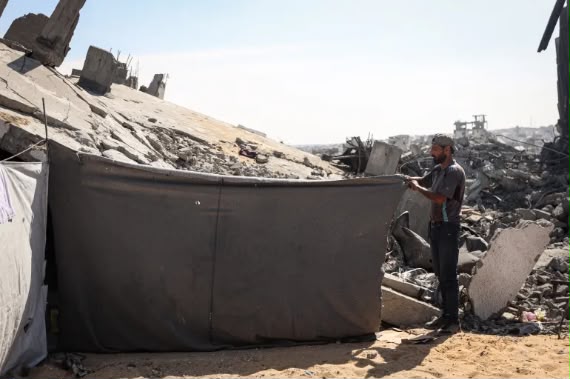
Displaced Palestinian families in Gaza’s Shujayea neighbourhood are facing renewed displacement as Israeli forces reportedly move the military boundary known as the Yellow Line farther into the territory, leaving residents struggling to find safe and affordable shelter.
Residents say the movement of concrete boundary markers, accompanied by shelling and gunfire, has forced families to abandon temporary accommodation and relocate repeatedly despite the ceasefire agreement reached in October 2025.
The Yellow Line was established under the ceasefire arrangement to separate areas under Israeli military control from other parts of Gaza.
However, residents report that the boundary has continued to shift westward, bringing additional areas of eastern Gaza City under Israeli control.
United Nations figures cited in reports indicate that Israeli forces now control approximately 65 per cent of Gaza, compared with about 53 per cent under the original ceasefire arrangement.
The reported expansion has raised concerns among displaced residents who say they can no longer determine which areas are safe for their families.

Mahmoud Harzeen, a 35-year-old father of 10, said he was preparing to relocate for the sixth time after Israeli forces reportedly moved boundary markers farther into Shujayea on October 11.
Harzeen said his family had moved between several locations, including Zeitoun, Sahat al-Shawa and al-Muntazah, as the military boundary advanced.
According to him, one of the family’s temporary shelters lasted only a night before renewed military activity forced them to leave.
He described repeated displacement as exhausting, particularly for children who have already endured prolonged insecurity and the loss of stable accommodation.
Harzeen said residents continued to hear military aircraft, artillery and gunfire around areas where displaced families were sheltering.
He expressed concern that further movement of the boundary could force his family to relocate again.
Another resident, Asma Ali, a 32-year-old mother of three, said her family had been displaced approximately seven or eight times since the ceasefire began.
Ali explained that her family initially sought refuge in central Gaza City before returning to Shujayea in the hope of rebuilding a more stable life.
However, renewed shelling and fears of further military advances forced them to leave their accommodation again.
The family subsequently moved between a school, a residential building and relatives’ accommodation as security conditions deteriorated.
Ali said the repeated movements had resulted in the loss of household possessions, clothing and other essential belongings.
Among the items destroyed was a medical brace used by one of her children, who has a disability.
She said the equipment had been obtained shortly before it was lost during another displacement.
Beyond the immediate security concerns, families face growing difficulties securing alternative accommodation.
Extensive destruction of residential buildings has reduced available housing, while rising rental costs have placed additional pressure on households already struggling to meet basic needs.
Residents say relocating to southern Gaza is also difficult because of transport challenges, limited resources and uncertainty over the availability of suitable shelter.

The situation has left many families moving between temporary locations without assurance that they will be able to remain there.
The reported changes to the Yellow Line have also raised questions about the implementation of the ceasefire and the extent of Israeli military control within Gaza.
The residents’ accounts of the latest boundary movements and accompanying military activity have not been independently verified.
For displaced families in Shujayea, however, the immediate concern remains the search for somewhere they can live without the constant threat of another evacuation.
Ali said her greatest wish was to find a secure home where her children could rest without fearing that they would have to flee again during the night.