RismadarVoice Reporters
September 27, 2026
A powerful nor’easter battered the northeastern United States on Sunday, flooding coastal communities and leaving more than 130,000 homes and businesses without electricity as authorities warned of further flooding during approaching high tides.
The slow-moving storm continued to bring heavy rainfall, strong winds and dangerous surf across areas stretching from New Jersey to New England.
At least one death has been linked to the severe weather after a New York City Housing Authority worker was killed on Saturday when a tree fell.
The storm was positioned south of Long Island and east of northern New Jersey on Sunday morning and was expected to remain in the region for about another 24 hours.
Bob Oravec, a lead forecaster with the National Weather Service in College Park, Maryland, said the heaviest remaining rainfall was expected across northern New Jersey, New York City, Long Island and southern New England.

Although the storm was gradually weakening, the risk of coastal flooding was expected to persist through Sunday’s high-tide cycles.
“The most impactful parts of the storm are likely going to be the high winds and the tidal flooding,” Oravec said.
More than 130,000 electricity customers across the Northeast and mid-Atlantic were without power on Sunday morning.
Some of the most significant outages were reported along the New Jersey shore, Long Island and coastal Connecticut.
Strong winds brought down trees and utility lines across Long Island, damaging homes and vehicles and blocking roads in some communities.
Emergency authorities increased their preparedness across affected areas, with response teams placed on standby in parts of New England amid concerns over further power outages.
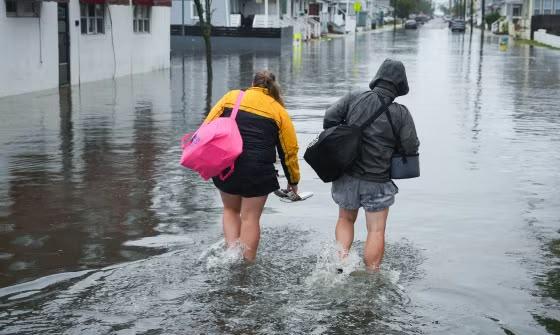
Coastal flooding was also reported in communities across New Jersey and New York, with water covering streets and affecting homes, businesses and other infrastructure.
In Sea Bright, New Jersey, emergency personnel rescued a woman and her dog after their vehicle became trapped in floodwaters.
Flooding also affected a marina in Surf City, New Jersey, where equipment was moved to higher ground as rising water threatened boats and other property.

Marina owner Kenny Formica said customers reported boats and Jet Skis being swept away or blown from their lifts.
Farther south, floodwaters covered sections of roads in Norfolk, Virginia, disrupting movement through affected areas.
The severe weather also caused significant transportation disruption.
Hundreds of flights were cancelled at Boston Logan International Airport, while flooding cut highway access to North Carolina’s Hatteras Island.
The closure left some visitors unable to reach the island and disrupted local events, including a wedding for which most guests were reportedly unable to arrive.
The storm has drawn comparisons with Superstorm Sandy, which devastated parts of the eastern United States in 2012, although the scale of the current damage remains substantially lower.
Forecasters continued to urge residents in vulnerable coastal areas to monitor weather warnings, particularly around high tides, as strong winds, dangerous surf and flooding remained possible while the storm gradually weakened.