RismadarVoice Reporters
September 10, 2026
The Federal Government of Nigeria has announced major reforms to Nigeria’s tertiary institution accreditation system, warning institutions against presenting borrowed staff, equipment and facilities during regulatory assessments.
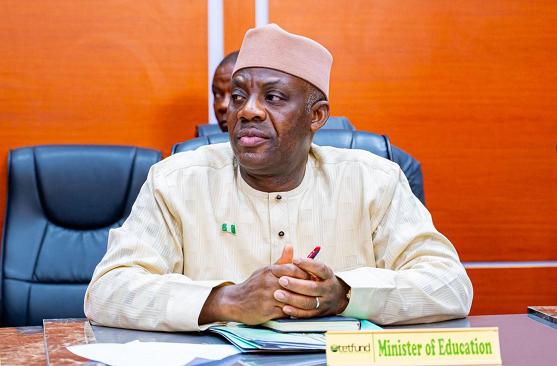
The Minister of Education, Dr Tunji Alausa, said officials of institutions that violate admission and accreditation requirements could lose their positions. In contrast, private institutions that fail to meet regulatory standards risk losing their operating licences.
Alausa disclosed this on Wednesday during the inauguration of the Ministerial Committee on Strengthening Accreditation and Quality Assurance Systems for Tertiary Institutions in Nigeria.

He said the government was moving to transform accreditation from a periodic exercise into a continuous, digital and evidence-based quality assurance process capable of verifying the actual capacity of universities, polytechnics and colleges of education.
The minister criticised institutions for temporarily moving academic staff, laboratory equipment, library materials, and other facilities to create a false impression during accreditation exercises.
He said accreditation teams must only verify resources that represent the “actual and sustainable capacity” of an institution.
According to him, the government plans to deploy technologies such as geospatial mapping, geotagging and digital identification systems to track infrastructure, equipment and personnel presented by institutions.
Alausa added that critical equipment used during accreditation would be digitally linked to specific institutions and locations to prevent manipulation.
He also proposed a staff verification framework that would use national identity infrastructure, including the National Identification Number and other secure technologies, to establish the identity and institutional affiliation of academic personnel.
The minister said the system would help detect cases where individuals are falsely presented as full-time staff members in multiple institutions.
He explained that the current accreditation model, which is conducted every three to five years, would be replaced with a continuous monitoring system where institutions maintain required standards throughout the year.
Alausa said the proposed digital platform would serve as a reliable database for regulators, including the National Universities Commission, National Board for Technical Education and National Commission for Colleges of Education.
On illegal admissions, the minister said the Federal Government would intensify measures to stop institutions from admitting students beyond approved carrying capacities.
He said hundreds of thousands of students may have gained admission through unapproved channels, creating pressure on lecturers, facilities and other academic resources.
Alausa warned that institutions approving excessive admissions would face consequences, noting that admitting far above approved capacity affects the quality of graduates produced.

He said the government would hold responsible officials accountable for breaches, adding that private institutions found violating standards could have their licences withdrawn.
Meanwhile, the Federal Government announced the release of the Consolidated Academic Tools Allowance (CATA) for academic staff in federal universities, polytechnics and colleges of education from January to August 2026.
Alausa said the payment was in line with the 2025 Federal Government–Academic Staff Union of Universities agreement and was intended to support teaching, research and academic activities.
He added that payment processes for non-academic staff were also ongoing.
The minister said the reforms and welfare initiatives were part of efforts by the administration to strengthen Nigeria’s tertiary education system through improved standards, accountability and investment.