RismadarVoice Reporters, June 13, 2026
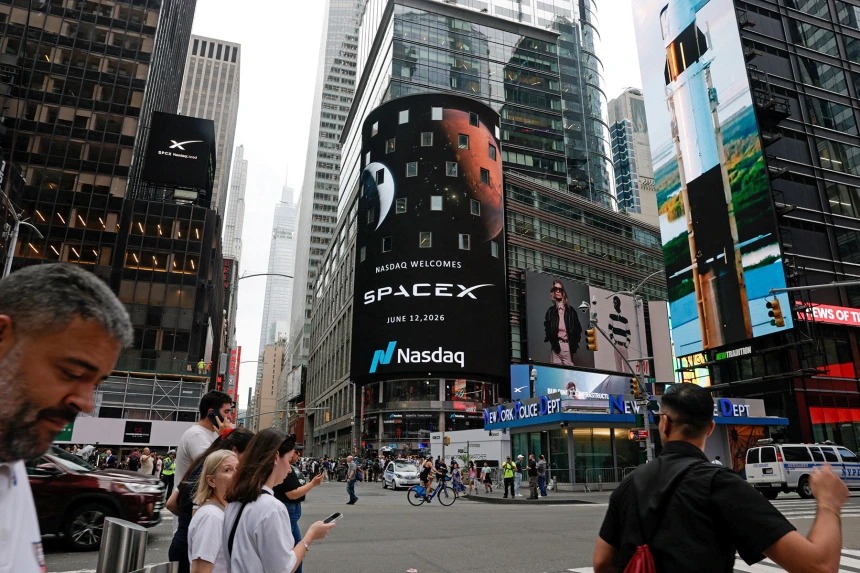
Elon Musk’s SpaceX made a powerful entrance on the Nasdaq stock exchange, with shares jumping 19% on its first day of public trading, marking one of the most closely watched stock market debuts in recent years.
The stock closed at $160.95 after opening at $150 and briefly climbing more than 30% during intraday trading, pushing the company’s valuation above $2.25 trillion at its peak. The blockbuster listing raised about $75 billion, making it the largest initial public offering in history.
The debut also made headlines for Musk personally, with reports noting that the surge in SpaceX’s valuation contributed to his position as the world’s first trillionaire.

The IPO signals what analysts say could be the beginning of a new wave of large-scale public offerings tied to artificial intelligence and advanced technology industries. Companies such as Anthropic and OpenAI are reportedly preparing similar market entries, reflecting growing investor enthusiasm for AI-driven businesses.
Musk, who serves as SpaceX chairman and CEO, marked the milestone alongside employees at the company’s Starbase facility in Texas, while executives and investors celebrated simultaneously at the Nasdaq headquarters in New York.
Speaking ahead of the listing, Musk reflected on the company’s early uncertainty, noting that SpaceX was once widely considered unlikely to succeed before becoming a central player in global space operations.
Founded in 2002, SpaceX has grown into a dominant force in aerospace, working closely with NASA, the U.S. military, and commercial partners. In recent years, its Starlink satellite internet service has expanded its business beyond rocket launches into global connectivity services.

The company is also positioning itself for long-term ambitions in space exploration, including missions to the Moon and Mars, while exploring artificial intelligence-related ventures through its xAI division.
Despite the strong debut, questions remain about valuation and profitability. SpaceX reported approximately $19 billion in revenue last year but has yet to turn a profit. Some analysts have cautioned that its market valuation may be significantly higher than its financial fundamentals justify.
Supporters, however, argue that the company’s long-term vision and technological leadership justify investor confidence. SpaceX executives have emphasised that the company is focused on future growth rather than short-term earnings performance.
Chief Operating Officer Gwynne Shotwell defended the company’s outlook, pointing to its track record of innovation and operational success in highly complex aerospace projects.
The IPO, underwritten by major Wall Street banks including Goldman Sachs, Morgan Stanley, JPMorgan Chase, Bank of America, and Citigroup, also includes provisions allowing retail investors to participate through select brokerage platforms.