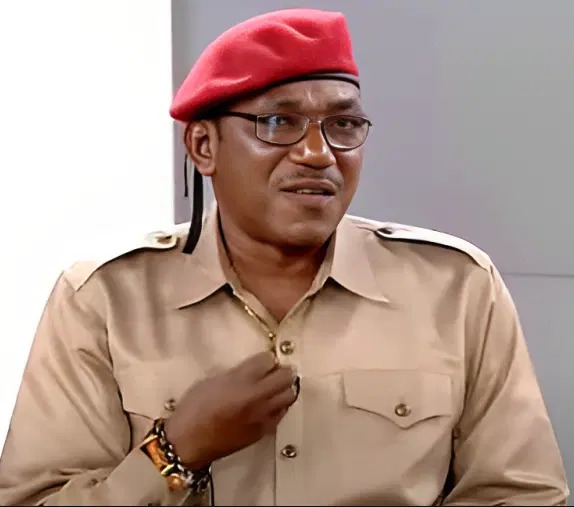
RismadarVoice Reporters, June 6, 2026
Former Minister of Youth and Sports Development, Solomon Dalung, has accused the Federal Government of lacking the political commitment needed to effectively confront terrorism and insecurity across the country.
Dalung, who served under former President Muhammadu Buhari, argued that the administration of President Bola Tinubu appeared more focused on political calculations ahead of the 2027 general elections than on addressing the growing security challenges facing Nigerians.
Speaking on The Morning Show on Arise Television on Friday, the former minister delivered a scathing assessment of the government’s performance on security, economic management and governance over the past three years.
According to him, the persistence of terrorist attacks, kidnappings and violent crimes reflects a failure of political leadership rather than a lack of resources.

“The government appears unwilling to take the decisive steps required to end insecurity,” Dalung said.
He argued that while security agencies have demonstrated the capacity to track and arrest critics of government policies, the same level of effectiveness has not been applied to tracking and dismantling terrorist networks operating across the country.
Dalung also criticised recent calls by government officials for Nigerians to unite against terrorism, describing such appeals as evidence that authorities are struggling to find lasting solutions to the security crisis.
According to him, the country’s security architecture suffers from poor coordination among agencies responsible for intelligence gathering and law enforcement.
He alleged that security institutions often operate independently rather than collaboratively, resulting in ineffective responses to security threats.
“The intelligence community, the military and other security agencies should be working from a common strategy. Instead, there appears to be a lack of synergy in confronting the challenge,” he said.
The former minister further warned that terrorist groups have established self-sustaining operations in parts of the country, creating what he described as a parallel economy beyond government control.
Dalung also questioned the effectiveness of foreign support in Nigeria’s counter-terrorism efforts, particularly assistance reportedly provided by the United States.
He said Nigerians have yet to see tangible results from such partnerships despite repeated assurances that international allies are supporting security operations.

“If foreign partners are assisting Nigeria, citizens should be able to see the impact in terms of improved security and reduced terrorist activities,” he stated.
He urged authorities to move beyond public assurances and develop strategies that empower communities to play a more active role in securing their environments.
Turning to politics, Dalung expressed concern over what he described as increasing regionalisation of the country’s political landscape ahead of the 2027 elections.
According to him, the emergence of presidential hopefuls from different geopolitical zones could create a complex and highly competitive electoral environment.
He predicted that the North-Central region may once again play a crucial role in determining the outcome of the next presidential election.
Dalung also criticised the administration’s economic reforms, arguing that ordinary Nigerians have yet to experience meaningful benefits despite repeated government assurances.
“Many citizens continue to struggle with rising living costs and economic hardship. The promised gains of the reforms have not translated into improved living conditions for most Nigerians,” he said.
However, political analyst Obafemi George offered a contrasting perspective, arguing that the Tinubu administration deserves recognition for implementing difficult reforms aimed at placing the country on a sustainable development path.
George cited Nigeria’s recent sovereign credit rating improvement by Standard & Poor’s as evidence that economic stability is gradually improving.
He also linked the recent rise in insecurity across parts of West Africa to broader regional developments, including the withdrawal of French military forces from the Sahel, which he said created opportunities for terrorist groups to expand their activities.
According to him, the current administration inherited significant challenges and has recorded measurable progress in addressing them.
“This government is confronting security challenges that have evolved beyond what previous administrations faced, yet there have been notable operational successes,” George said.
He pointed to recent rescue operations and military interventions as indicators of ongoing efforts to tackle insecurity.
Defending the pace of reforms, George argued that meaningful national transformation cannot be achieved within a few years.
Drawing comparisons with countries such as China, Rwanda and the United Arab Emirates, he noted that economic development and institutional reforms often take decades to produce visible results.
“No country has transformed from poverty to prosperity within 36 months,” he said.
“Major economies invested consistently in infrastructure, economic reforms and institution-building over many years before achieving lasting growth.”
George maintained that President Tinubu’s policies are laying the groundwork for future economic stability, even if the immediate effects are difficult for many citizens.
He also defended the removal of fuel subsidy, describing it as a difficult but necessary decision that previous administrations had postponed.
According to him, the current hardships being experienced by Nigerians are partly the result of reforms that should have been implemented years ago.
“The sacrifices being made today are intended to prevent even greater economic challenges in the future,” he said.
The contrasting views expressed by Dalung and George reflect the broader national debate over the Tinubu administration’s performance as it approaches the midpoint of its tenure.
While critics argue that insecurity and economic hardship remain major concerns requiring urgent intervention, supporters maintain that the government is implementing long-term reforms whose benefits will become more evident in the years ahead.
As discussions over governance, security and economic recovery continue, public expectations remain focused on tangible improvements in the lives of ordinary Nigerians.