By Micah Jonah, February 19, 2026
The United States has renewed threats of possible military action against Iran following a second round of nuclear talks, as Tehran and Moscow announced joint naval exercises in the Sea of Oman amid rising regional tensions.
The White House warned that Iran must reach an agreement with President Donald Trump or risk facing military strikes. White House Press Secretary, Karoline Leavitt told reporters that while indirect talks in Geneva made some progress, significant differences remain between both sides.
“Iran would be very wise to make a deal,” she said, adding that the two sides are “still very apart on some issues.”
President Trump also escalated his rhetoric on social media, warning that failure to reach a deal could prompt decisive military action. The US has already deployed two aircraft carriers and thousands of troops to the Gulf region in what analysts describe as a show of force.
The renewed threats come after a second round of indirect talks between Washington and Tehran held in Geneva, Switzerland, following earlier discussions in Oman on February 6. Iran’s Foreign Minister, Abbas Araghchi said both sides agreed on certain “guiding principles” towards a potential deal. However, US Vice President, JD Vance maintained that Tehran had not accepted all of Washington’s red lines.
Washington is demanding that Iran halt uranium enrichment on its soil and is seeking to expand negotiations to include Iran’s missile programme. Tehran, however, insists its nuclear activities are for peaceful purposes and has rejected calls for zero enrichment while ruling out negotiations over its missile capabilities.
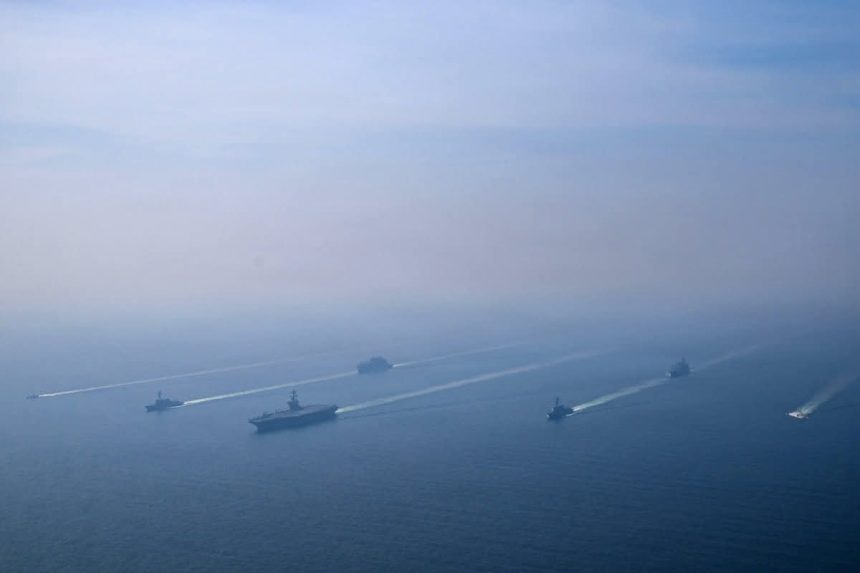
Even as diplomacy continues, the US military buildup in the region has intensified. The aircraft carrier USS Abraham Lincoln is currently positioned in the Arabian Sea, while a second carrier group is expected to be fully operational in the region by mid-March, according to US officials.
In response, Iran has staged military drills through its Islamic Revolutionary Guard Corps in the Strait of Hormuz, a strategic oil transit route, describing the exercises as preparation against potential security threats.
On Wednesday, Iran also announced joint naval drills with Russia in the Sea of Oman. Rear Admiral Hassan Maqsoudlou said the exercises were aimed at strengthening maritime security and deterring “any unilateral action” in the region.
Russia’s Foreign Minister, Sergey Lavrov cautioned against further US strikes on Iran, warning that such action could trigger serious consequences and risk broader instability. He stressed the need for restraint and diplomatic engagement.
Meanwhile, US Secretary of State, Marco Rubio is scheduled to visit Israel later this month for talks with Prime Minister Benjamin Netanyahu, where Iran is expected to top the agenda.
Security experts say the combination of stalled diplomacy, military deployments and joint Iran-Russia exercises has heightened fears of a potential regional conflict. Observers note that Gulf states including Oman, Qatar and Saudi Arabia are continuing quiet diplomatic efforts to prevent escalation.
As tensions mount, the coming weeks are expected to be critical in determining whether negotiations will yield a breakthrough or push the region closer to confrontation.