RismadarVoice Reporters
February 17, 2026
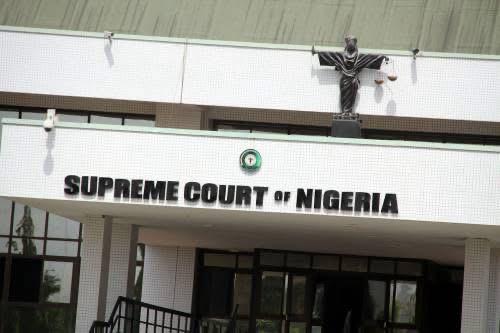
The Supreme Court of Nigeria has upheld the dissenting judgment of Justice Okon Abang, declaring Joshua Ishaku as the valid candidate of the All Progressives Congress (APC) for the 2026 Bwari Area Council chairmanship election.
In a split 4–1 decision delivered on Monday, Justice Jamilu Yammama Tukur, who read the lead judgment, set aside the majority decision of the Court of Appeal, Abuja Division, which had earlier affirmed Haruna Audi as the party’s candidate.
Resolving all issues in favour of Ishaku, the apex court held that the appellate court erred in concluding that the appellant’s suit was statute-barred.
The Supreme Court ruled that the “inevitable conclusion is that the appellant was denied the opportunity to be heard” and was therefore denied fair hearing.
On the question of whether Ishaku’s suit was premature for failing to exhaust internal party remedies, the court held that “the internal affairs principle is not absolute.”
It added that “where issues transcend domestic party affairs, the court can intervene,” particularly where a political party violates its own guidelines.
The court further reasoned that “where a party violates its guidelines, the shield of internal affairs falls away.”
Agreeing that Ishaku emerged as the winner of the APC primary, the apex court held that it was the aggrieved party, not the declared winner, that ought to have exhausted internal dispute resolution mechanisms.
“It is contradictory to insist that the appellant ought to have exhausted the party’s internal mechanisms,” the court held.
The Supreme Court also agreed with Justice Abang that the dispute went beyond internal party matters, as it involved alleged violations of constitutional rights, Section 84(14) of the Electoral Act, and the party’s guidelines.
It emphasized that only a loser in an election is expected to exhaust domestic remedies before approaching the court, not the declared winner.
The court further noted that each case must be determined on its peculiar facts and faulted the lower court for failing to properly evaluate the material evidence before it.
The dispute arose from the June 25, 2025 APC primary election in Bwari Area Council.
The majority judgment of the Court of Appeal had upheld the earlier decision of the Federal High Court, which dismissed Ishaku’s suit on the ground that it was statute-barred.
However, in his dissenting opinion at the appellate court, Justice Abang disagreed with both the trial court and the majority.
He described the respondents’ position on when the cause of action accrued as an “imaginary position” unsupported by law or evidence.
Justice Abang held that the proper test in determining whether a suit is statute-barred is to ascertain when the cause of action actually arose.
In the instant case, he ruled that the cause of action could only have arisen when the name of the second respondent was forwarded to the Independent National Electoral Commission (INEC).
He reasoned that time cannot begin to run against a litigant based on a concealed or undisclosed act.
According to him, the argument that the cause of action arose at the point of the panel’s alleged decision was a legal fiction deliberately constructed to render the suit statute-barred and prevent it from being heard on its merits.
Justice Abang also faulted the trial court for failing to properly evaluate Exhibit J and Exhibit INEC 4, which he described as crucial to the just determination of the case.
Consequently, the Supreme Court allowed the appeal, set aside the majority judgment of the Court of Appeal, and affirmed Justice Abang’s dissenting judgment.
The apex court ordered the relevant authorities to publish Joshua Ishaku’s name as the APC candidate for the forthcoming Bwari Area Council election.
The ruling now brings a definitive end to the legal battle over the APC candidacy for the council poll.