By RismadarVoice Media
December 25, 2025
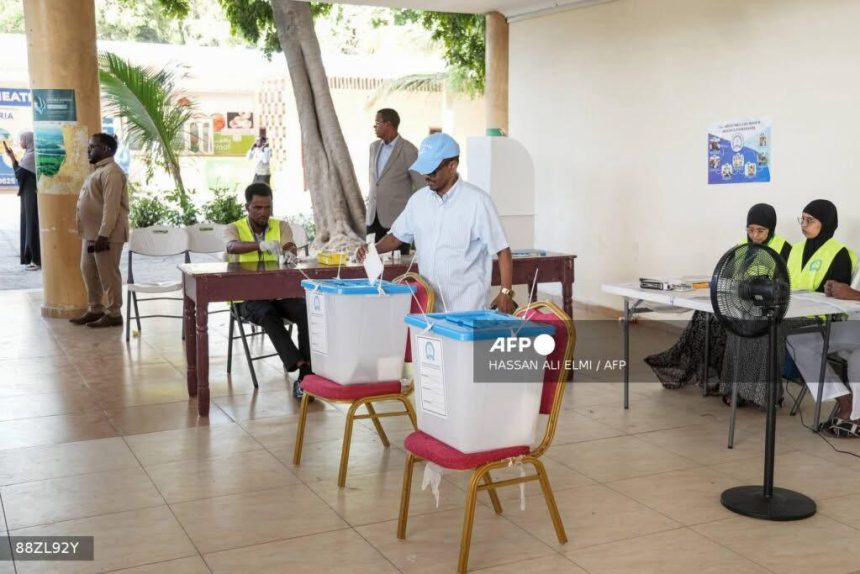
Somali authorities on Thursday imposed tight security as voters in the Mogadishu region participated in the first direct local elections in nearly 60 years, a vote boycotted by major opposition figures.
Around 10,000 security personnel were deployed across the capital, while Mogadishu’s international airport was temporarily closed for the exercise, which is seen as a key test ahead of presidential elections scheduled for next year.
Long queues were observed outside some polling stations early in the day, although turnout appeared to decline, significantly by the afternoon, according to an AFP correspondent.
The chairman of the election commission, Abdikarin Ahmed Hassan, said all polling stations closed without incident at 1500 GMT.
“All polling stations have closed peacefully,” Hassan said in a statement, adding that vote counting would begin “soon,” without specifying when results would be announced.
Some voters described the election as historic.“This is a great day,” said Guhad Ali, 37, displaying the ink on his finger to show he had voted.
Another resident, Ali Salad, 51, said he waited in line for hours to cast his ballot.
Somalia last held direct elections in 1969, before military ruler – Siad Barre abolished universal suffrage after taking power that year.
Since the collapse of his regime in 1991, the country has relied on a clan-based political system.
The vote took place against a backdrop of long-running insecurity. Since 2006, the Somali government has been fighting the Islamist group Al-Shabaab, which is linked to Al-Qaeda.
While security has improved in Mogadishu, violence persists in nearby areas.
In the past year, incidents have included an attempted ambush on the President’s convoy, missile fire near the airport, an attack on a detention facility.
According to the electoral commission, more than 1,600 candidates contested 390 local council seats in Banadir region, which includes Mogadishu.
President Hassan Sheikh Mohamud, a strong advocate of direct elections, described the vote as “the future of the Somali people.”
However, the opposition Somali Future coalition boycotted the polls, with several federal states also rejecting the process, arguing it was an attempt by the central government to consolidate power in Mogadishu.
Former prime minister Hassan Ali Kheire, a leading figure in the coalition, accused the government of using the elections to extend the president’s mandate.
“This is not going to be accepted,” Kheire warned.
Although direct elections were abolished nationwide nearly six decades ago, they have since been reintroduced in Somaliland, the self-declared independent northern region that is not internationally recognized.
The semi-autonomous state of Puntland also held direct local elections in 2023, but abandoned the system for local and regional polls in January 2025.
Thursday’s vote had been postponed three times earlier this year.
The political disagreement has heightened tensions ahead of national elections scheduled for 2026.
Parliament’s mandate expires in April next year, while President Mohamud’s term ends in May.
In September, the International Crisis Group warned that the government’s push to replace the clan-based indirect voting system with direct elections could destabilize the country if political leaders fail to reach a compromise.
Without what it called an “inclusive electoral roadmap,” the group cautioned that Mogadishu could witness a repeat of the deadly clashes seen in 2021, when delayed elections triggered political violence after then-president Mohamed Abdullahi Mohamed attempted to extend his term.
Opposition groups have threatened to organize a rival presidential election in 2026 if the federal government insists on proceeding with direct elections.