By Micah Jonah
February 16, 2026
Muslims across the world are awaiting the sighting of the crescent moon to determine the commencement of Ramadan 2026, the ninth month of the Islamic lunar calendar.
In Saudi Arabia, the first day of fasting in Mecca is expected to fall either on Wednesday, February 18, or Thursday, February 19, depending on the outcome of the official moon sighting.
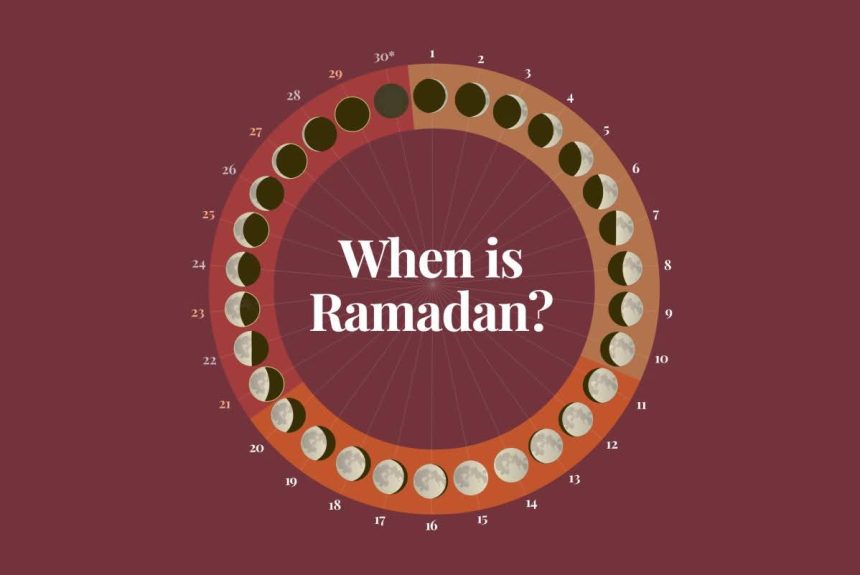
Ramadan is determined by the Islamic Hijri calendar, which is based on the lunar cycle. The beginning of the holy month is confirmed with the sighting of the new crescent moon after sunset on the 29th day of Sha’ban.
How the moon is sighted:
For the crescent to be visible, it must set after the sun, allowing the sky to darken sufficiently for observers to spot the thin sliver of the new moon.
On the evening of February 17, moon sighters in Saudi Arabia and other Muslim-majority countries will look towards the western horizon shortly after sunset. If the crescent is sighted, Ramadan will begin the following day. If not, the month of Sha’ban will complete 30 days, and fasting will commence on February 19.
In Saudi Arabia, testimonies from accredited moon sighters are submitted to the Supreme Court, which then announces the official start date.
Astronomers consider three key factors when determining visibility:
Elongation – The angular distance between the moon and the sun. For naked-eye visibility, the moon typically needs to be at least 10 degrees away from the sun.
Altitude – The height of the moon above the horizon at sunset. A higher altitude improves the chances of visibility.
Lag time – The time between sunset and moonset. A minimum of about 45 minutes is generally required for reliable naked-eye sighting.
Global expectations:
Astronomical data indicates that the new moon will be born on February 17 at approximately 3:01pm Mecca time. However, visibility that evening is considered highly unlikely in most parts of the world because the moon will be too young and set shortly after sunset.
As a result, many countries are projecting Thursday, February 19, as the first day of Ramadan.
In North America, both the Fiqh Council of North America and the Islamic Society of North America, which rely on astronomical calculations, have announced February 18 as the likely start date.
In Europe, the European Council for Fatwa and Research has declared February 19 as the first day of fasting, citing the difficulty of sighting the moon on February 17. Turkiye has also announced the same date.
Across the Middle East, official confirmation will depend on local moon sightings, although expectations point strongly towards February 19.
Countries in South Asia, including India and Pakistan, as well as Singapore and Australia, have indicated that fasting will most likely begin on February 19. Several African nations are also expected to follow the same date.
Significance of Ramadan:
Ramadan is regarded by Muslims as the month during which the first verses of the Quran were revealed to Prophet Muhammad over 1,400 years ago.
During the month, Muslims fast daily from dawn, marked by the Fajr prayer, until sunset, marked by the Maghrib prayer. Fasting involves abstaining from food, drink, smoking and marital relations during daylight hours as an act of worship and spiritual reflection.
Fasting in Ramadan is one of the five pillars of Islam, alongside the declaration of faith, daily prayers, charity and the Hajj pilgrimage to Mecca for those who are able.
In many Muslim-majority countries, working hours are reduced during the holy month, and restaurants remain closed during fasting hours.
As Muslims worldwide prepare for the sacred month, greetings such as “Ramadan Mubarak” and “Ramadan Kareem” are already being exchanged in anticipation of a spiritually uplifting period.