Micah Jonah
February 16, 2026
European leaders have signalled a major shift in security strategy, declaring plans to rely less on the United States for defence following renewed tensions triggered by President Donald Trump’s push to annex Greenland.
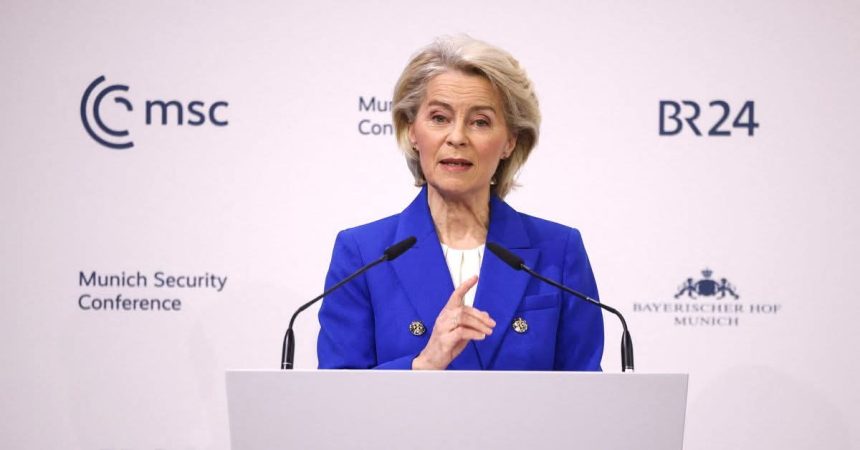
At the Munich Security Conference, President of the European Commission, Ursula von der Leyen, captured the mood among European leaders, saying, “Some lines have been crossed that cannot be uncrossed anymore.”
Transatlantic relations have faced fresh strain since Trump returned to the White House. However, his stance on Greenland, an autonomous territory of Denmark, has deepened European doubts about Washington’s long term commitment to defend the continent under the NATO alliance.
Although US Secretary of State, Marco Rubio attempted to reassure European allies during his speech, he stopped short of directly addressing NATO or Russia’s war in Ukraine, issues that remain central to Europe’s security concerns.
With the war in Ukraine approaching its fifth year and Moscow increasingly viewed as a threat by its neighbours, European leaders said they would accelerate efforts to strengthen their own military capabilities.
German Chancellor, Friedrich Merz, French President, Emmanuel Macron and British Prime Minister, Keir Starmer all pledged commitment towards building a stronger “European pillar” within NATO.
Merz revealed he had begun discussions with Macron on the possibility of a European nuclear deterrent, a move seen as a hedge against any future US decision to scale back its defence commitments.
France currently holds the only fully independent nuclear deterrent in Europe, while Britain’s Trident system depends significantly on US support.
European countries have significantly increased defence spending in recent years. NATO members agreed to raise core defence spending to 3.5 percent of GDP, with an additional 1.5 percent allocated to broader security investments. Von der Leyen disclosed that European defence spending has risen by nearly 80 percent since before the war in Ukraine began.
Several joint defence initiatives are also underway. France, Germany, Italy, Poland and Sweden signed a letter of intent to advance the European Long-range Strike Approach project aimed at developing deep strike missile systems.
However, internal disagreements continue to slow progress on some major projects, including the Future Combat Air System fighter jet programme involving France, Germany and Spain. Disputes over work share and whether defence contracts should be restricted to EU companies have created friction among member states.
Amid the high level discussions in Munich, Ukrainian President, Volodymyr Zelenskiy reminded delegates of the brutal realities of war, revealing that Ukraine was attacked by more than 6,000 drones and 150 missiles in January alone.
“During this war, weapons evolve faster than political decisions meant to stop them,” Zelenskiy said.
As Europe reassesses its strategic posture, leaders face the challenge of translating bold declarations into concrete military capability, funding and unified action in an increasingly uncertain global security environment