By RismadarVoice Media
December 14, 2025
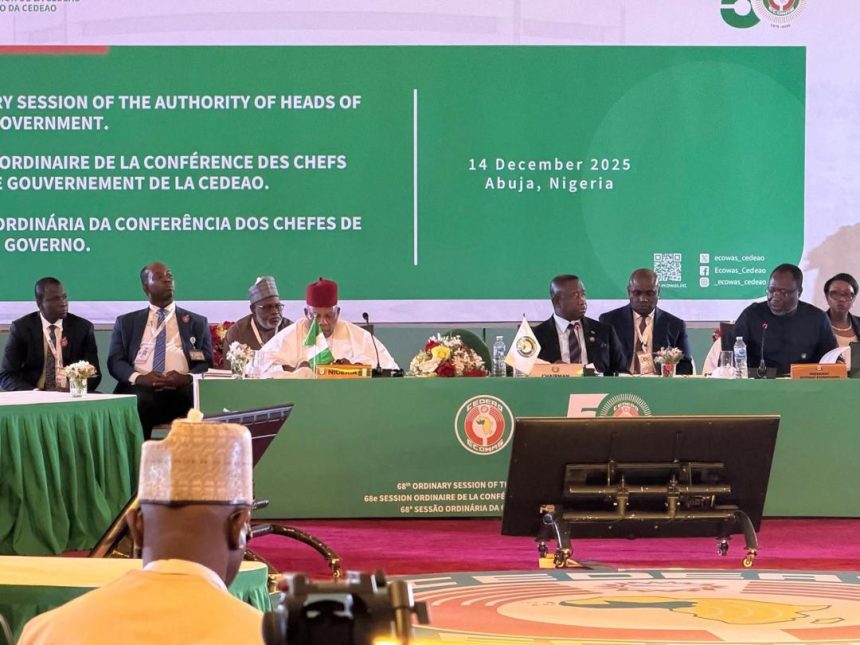
West African leaders have resolved to adopt a stronger, coordinated approach to end the wave of military coups, terrorism and rising insecurity across the sub-region, as the 68th Ordinary Session of the Economic Community of West African States (ECOWAS) concluded in Abuja on December 14
At the high-level meeting, Presidents and Heads of Government agreed to move from largely reactive measures to more proactive military, diplomatic, political interventions to safeguard constitutional order, regional stability. The decision comes amid recent coups, attempted takeovers in parts of the Sahel and coastal West Africa.
A key highlight of the summit was the collective endorsement of swift action taken to halt the attempted coup in the Republic of Benin on December 7, 2025.
ECOWAS leaders cited the rapid response, led by Nigeria’s President, Bola Ahmed Tinubu, which included the deployment of Nigerian fighter jets and ground troops in support of loyalist forces, as evidence of renewed regional resolve.
Speaking at the session, President Tinubu, represented by Vice President Kashim Shettima, warned that the region faces interconnected threats which transcend national borders, including terrorism, violent extremism, transnational organized crime, arms proliferation, cyber insecurity, climate shocks, food insecurity, irregular migration.
“No single member state, regardless of size or strength, can achieve enduring stability in isolation”, Tinubu said, stressing that West Africa’s security and prosperity are indivisible. He reaffirmed Nigeria’s long-standing commitment to ECOWAS, describing regional unity as “foundational, not transactional”, urged member states to guard against internal divisions that could weaken the bloc.

Chairman of the ECOWAS Authority of Heads of State and Government, President of Sierra Leone, Julius Maada Bio, described the summit as a defining moment for the Community.
He commended Nigeria for what he termed its leadership role in defending constitutional governance, particularly in Benin Republic.
President Bio also announced that ECOWAS will, from January 2026, begin implementing measures to significantly reduce the cost of air travel within the region.
According to him, the reforms will include the abolition of certain air transport taxes by member states, a move aimed at boosting regional integration, trade and tourism.
President of the ECOWAS Commission, Dr. Omar Alieu Touray, said recent developments in West Africa have demonstrated the effectiveness of regional solidarity.
He noted that instability in Guinea-Bissau, the attempted coup in Benin were addressed through swift, coordinated action by the bloc.
Touray also announced the appointment of Africa’s leading industrialist, Aliko Dangote, as Chairman of the ECOWAS Business Council, a platform expected to deepen engagements between governments and the private sector.
The African Union (AU) also lent its voice to the resolutions.
AU Commission Chairperson, Mahmoud Ali Youssouf, represented by the Commissioner for Political Affairs, Peace and Security, Ambassador Bankole Adeoye, described the attempted coup in Benin, instability in Guinea-Bissau as unacceptable, reaffirming the AU’s support for ECOWAS efforts to defend democracy and regional stability.

The Abuja summit ended with renewed commitments by leaders to strengthen collective security mechanisms, promote economic integration and preserve democratic governance across West Africa.