Micah Jonah
March 16, 2026
Asian financial markets opened the week cautiously on Monday as ongoing tensions in the Gulf kept oil prices elevated, raising concerns about inflation and economic growth across major economies.
Oil markets remained volatile amid uncertainty over shipping through the Strait of Hormuz, a key global energy route. Brent crude rose 0.8 per cent to about $104 per barrel, while U.S. crude slipped slightly to around $98.48.
Reports suggest the U.S. administration may soon announce a coalition of countries to escort commercial ships through the strategic waterway, where hostilities have disrupted tanker traffic.
President Donald Trump has warned that it would be damaging for the future of NATO if allied countries fail to help secure the route.
European Union foreign ministers are also expected to discuss strengthening a small naval mission in the Middle East, though analysts say any operation in the Strait of Hormuz could be risky.
Meanwhile, several major central banks, including those in the United States, United Kingdom, Europe, Japan, Australia, Canada and Switzerland, are holding policy meetings this week as they assess the economic impact of rising energy prices.
Economists say higher oil prices could push inflation upward while slowing economic growth.
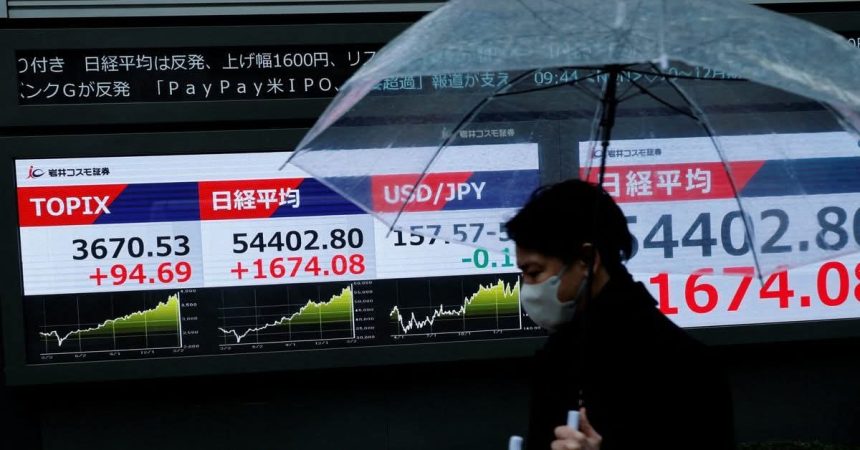
Japan’s Nikkei index fell 0.8 per cent, while South Korean stocks gained 0.2 per cent. A broader Asia-Pacific stock index outside Japan edged down slightly.
In China, blue-chip shares declined after data showed stronger-than-expected retail sales and industrial output for the first two months of the year, even as housing prices continued to fall.
Financial markets are also watching upcoming talks between U.S. and Chinese officials in Paris on trade issues including agriculture, critical minerals and other economic cooperation ahead of a possible visit by President Trump to Beijing.
Currency markets saw the U.S. dollar remain strong, benefiting from global uncertainty and America’s position as a net energy exporter.
Analysts say markets are likely to remain volatile as investors monitor developments in the Middle East conflict and signals from central banks on interest rates and inflation.